6
always revert to the values in the temporary register as you exit from Pass Through.
With the rarest of exceptions this is a very safe transition, very infrequently will the
normal chosen level be higher than 0 dB.
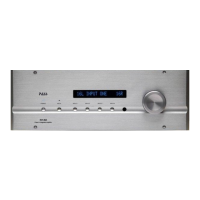
The electronic volume control allows greater than 70 dB range and is driven by a
micro-controller that reads the optical encoder serving as a front panel volume
control. In this manner tracking of the volume of the two balanced channels is
possible with accuracy unavailable on any ordinary volume control, assuring precise
level steps and high common mode rejection in balanced circuits.
Note: The way the volume control is designed, you may need to be at step 40 or 50
before you can hear anything.
Don’t be afraid to turn the volume up to 60, 70, 80 etc. The volume control is an
attenuator so the higher up you use it the more of the original signal is used.
Wayne Colburn’s exceptional volume control in conjunction with the fl uorescent
display gives the user ability to replicate volume levels with absolute accuracy in steps
of roughly 1 dB.
We recommend the use of the balanced output mode where possible. Balanced
input to power-amplifi ers will typically retain the character of the input mode,
but offers less distortion, less noise, more gain, and more voltage swing, without
compromising the sound.
With balanced operation, the common mode rejection of the preamp refl ects
the intrinsic common mode rejection of the topology, the matching of the gain
devices, and the matching of the attenuator channels. In this case we have been
able to keep the total mismatch to about .1%, for a common mode rejection of
approximately -60 dB.
The input system of the preamplifi er will exhibit full common mode noise rejection
with passive balanced sources, where the negative input is connected to ground
at the source through the appropriate source impedance. This allows adaptation
of unbalanced sources to balanced operation with passive cable connections in a
manner that achieves the noise rejection of active balanced sources.
The use of a micro-controller allows all of the preamplifi er functions to be repeatable
and accurately controlled. The micro processor only controls the functions of the
preamplifi er. At no time does any of the input or output signal come into contact with
the digital control signals. The digital circuits are powered by a power supply that is
isolated from the analog supply. Should it ever be necessary to update the software
that controls the functioning of the preamp only the socketed micro processor need
be changed.
Muting relays, which delay connection during turn-on and shut off the output when
insuffi cient power supply is available to maintain regulation, guard the output of the
preamplifi er and offer protection to the power-amplifi er and loudspeakers.


 To Next Page
 Loading...