servicethat may risk exposure of compressor oil to the rooL take
appropriate precautions to protect roofing. Procedures which risk
oil leakage include, but are not linfited to, compressor replacement,
repairing refrigerant leaks, replacing refrigerant components such
as filter drier, pressure switch, metering device, coil, accumulator,
or reversing valve.
Synthetic Roof Precautionary Procedure
1. Cover extended roof working area with an in, permeable
polyethylene (plastic) drip cloth or tarp. Cover an
approximate 10xl0 ft (3x3 m) area.
2. Cover area in front of the unit service panel with a terry
cloth shop towel to absorb lubricant spills and prevent
run-offs, and protect drop cloth from tears caused by tools
or components.
3. Place terry cloth shop towel inside unit immediately under
component(s) to be serviced and prevent lubricant run-offs
through the louvered openings in the unit base.
4. Perform required service.
5. Remove and dispose of any oil contanfinated material per
local codes.
Liquid Line Filter Drier
The biflow filter drier is specifically designed to operate with
R-410A. Use only factory-authorized components. Filter drier
must be replaced whenever the refrigerant system is opened. When
removing a filter drier, use a tubing cutter to cut the drier from the
system. Do not unsweat a filter drier from the system. Heat from
unsweating will release moisture and contaminants from drier into
system.
R-410A Refrigerant Char_in_
Refer to unit information plate and charging chart. Some R-410A
refrigerant cylinders contain a dip tube to allow liquid refrigerant to
flow from cylinder in upright position. For cylinders equipped
with a dip tube, charge R-410A units with cylinder in upright
position and a commercial metering device in manifold hose.
Charge refrigerant into suction-line.
Step 13 -- System Information
Loss of Charge Switch
The loss of charge switch is a protective device wired into control
circuit (low voltage). It shuts off the compressor if abnormally low
pressures are present in the refrigeration circuit.
NOTE: Because these switches are attached to refrigeration
system under pressure, it is not advisable to remove this device for
troubleshooting unless you are reasonably certain that a problem
exists. If switch must be removed, remove and recover all system
charge so that pressure gauges read 0 psi. Never open system
without breaking vacuum with dry nitrogen.
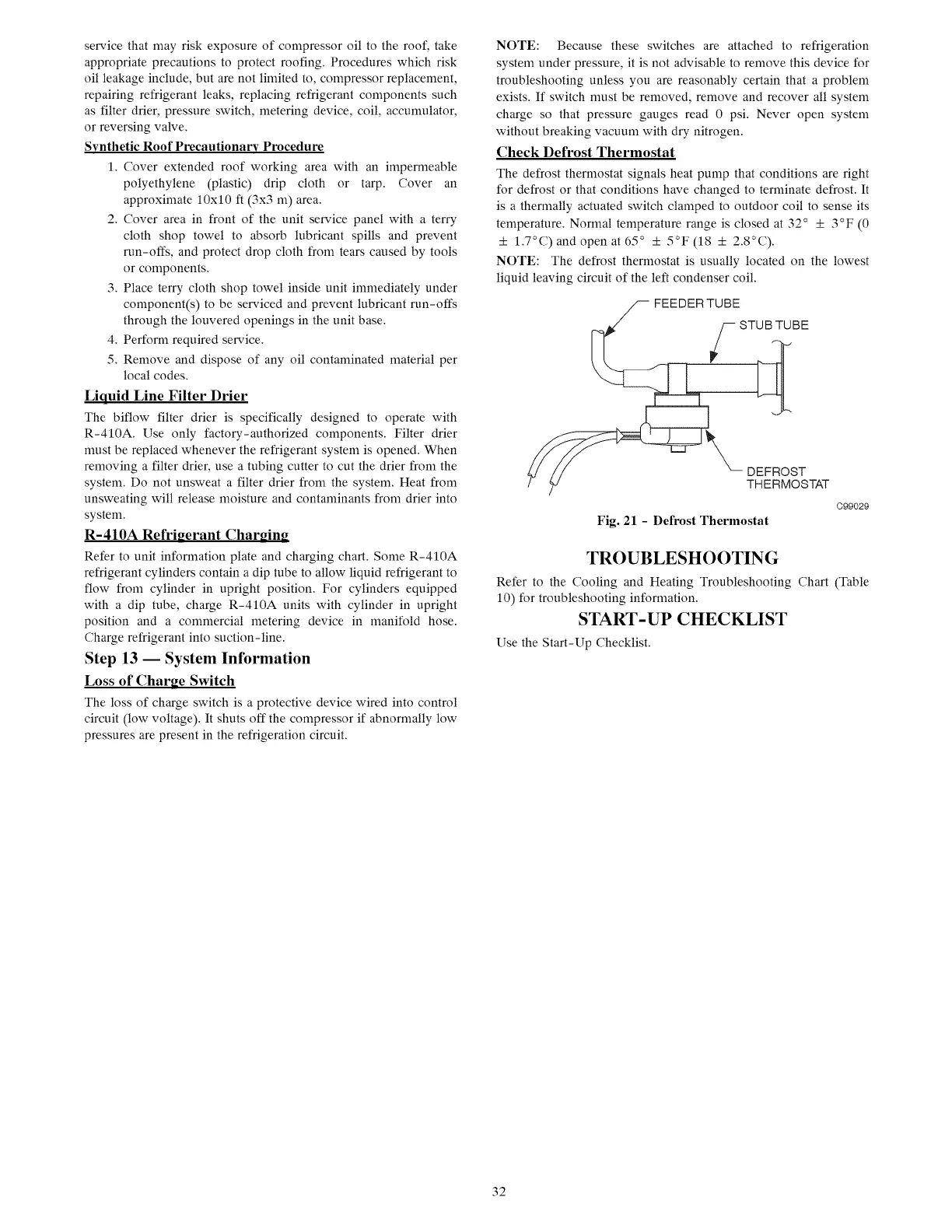
Check Defrost Thermostat
The defrost thermostat signals heat pump that conditions are right
for defrost or that conditions have changed to terminate defrost. It
is a thermally actuated switch clamped to outdoor coil to sense its
temperature. Normal temperature range is closed at 32 ° + 3°F (0
+ 1.7°C) and open at 65 ° + 5°F (18 + 2.8°C).
NOTE: The defrost thermostat is usually located on the lowest
liquid leaving circuit of the left condenser coil.
FEEDERTUBE
STUB TUBE
DEFROST
THERMOSTAT
Fig. 21 - Defrost Thermostat
C99029
TROUBLESHOOTING
Refer to the Cooling and Heating Troubleshooting Chart (Table
10) for troubleshooting information.
START-UP CHECKLIST
Use the Start-Up Checklist.
32


 To Next Page
 Loading...