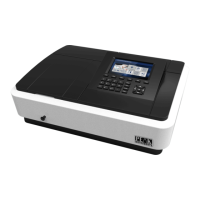
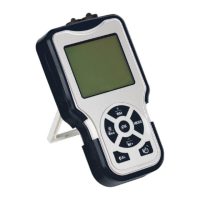
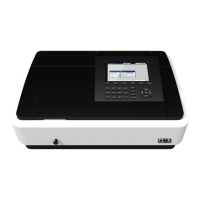
The E-1000 Series Spectrophotometer is a UV-Vis spectrophotometer designed for analytical testing in various scientific and industrial fields. It utilizes the principle of light absorption by substances to measure transmittance, absorbance, and concentration. The device is equipped with an improved CT monochromator, offering a wide spectral range and excellent quality. Its concealed microprocessor system, combined with robust optical and electrical systems, provides an effective and intuitive means for laboratory analysis.
Function Description:
The spectrophotometer measures the absorption of light at different wavelengths by a solution. It operates based on Lambert-Beer's law, which states that the absorbance of a solution is directly proportional to the product of its concentration and thickness when a parallel monochromatic light passes through it. The device can perform measurements in Transmittance (T), Absorbance (A), and Concentration (C) modes, as well as calculate a Factor (F) for concentration measurements.
Key operational modes include:
- Transmittance (T) Mode: Measures the percentage of light that passes through a sample. To use this mode, the instrument is warmed up, reference and sample solutions are placed in cuvettes, and a black block is used to set 0%T. The reference solution is then used to set 100%T, after which the sample's transmittance is measured.
- Absorbance (A) Mode: Measures the amount of light absorbed by a sample. Similar to transmittance, the instrument is warmed up, solutions are prepared, and a black block sets 0%T. The reference solution sets 0.000 Absorbance, and then the sample's absorbance is measured.
- Quantitation (C) Mode: Measures the concentration of a sample. This can be done in two ways:
- Using Standard Samples: After setting 0.000 Absorbance with a reference solution, a known standard solution is used to set its concentration value. The instrument then automatically calculates a factor (F) and displays the concentration of the unknown sample.
- Using a Factor (Coefficient): Similar to using standard samples, but instead of setting a concentration, a known factor value is input. The instrument then uses this factor to calculate the concentration of the unknown sample.
The device features a large-screen LCD (70x40mm blue backlit) that displays test data and storage status. Navigation and control are managed through dedicated function buttons:
- ESC: Exits the current function.
- Mode: Selects between Transmittance, Absorbance, Concentration, and Factor modes.
- 0%T: Sets 0%T in Transmittance mode (using a black block) and acts as a descending key in Factor and Concentration modes.
- 100%T: Sets 100%T in Transmittance mode (using a reference solution) or 0.000 Absorbance in Absorbance mode, and acts as an ascending key in Factor and Concentration modes.
- Save: Stores the displayed test data.
- Enter/Print: Confirms settings in Factor and Concentration modes and prints current values in T, A, C, and F modes.
Important Technical Specifications:
The E-1000 Series comes in two models: E-1000V (Visible) and E-1000UV (UV-Visible).
| Specification |
E-1000V |
E-1000UV |
| Display |
70*40mm blue backlit LCD |
70*40mm blue backlit LCD |
| Wavelength Range |
320 - 1020nm |
190 - 1020nm |
| Slit Width |
4nm |
4nm |
| Wavelength Accuracy |
±2nm |
±2nm |
| Wavelength Repeatability |
≤1nm |
≤1nm |
| Photometric Accuracy |
0.5%T |
0.5%T |
| Photometric Repeatability |
0.2%T |
0.2%T |
| Stray light |
≤0.15%T@ 360nm |
≤0.15%T@ 360nm |
| Stability |
0.002A@ 500nm |
0.002A@ 500nm |
| Output Port |
RS232 |
RS232 |
| Light Source |
Tungsten Halogen Lamp |
Tungsten Halogen/ Deuterium Lamp |
| Power Requirements |
220V/50HZ, 110V/60HZ |
220V/50HZ, 110V/60HZ |
Usage Features:
- Installation: The instrument should be placed on a level platform, away from direct sunlight, electromagnetic devices, and high-power electrical devices. The environment should be free of dust, corrosive gases, and vibrations. Adequate air circulation around the instrument is necessary. It requires an independent power outlet with good grounding and may need a stable power supply if local voltage is unstable.
- Warm-up Time: A 30-minute warm-up period is required after turning on the instrument for normal operation.
- Zero Calibration: It is crucial to set zero (0%T or 0.000 Abs) using a black block or reference solution whenever the instrument is turned on or the wavelength is changed. This calibrates the dark current and selects suitable magnification.
- Data Storage: The "Save" key stores the displayed test data (A/T/C/F). The storage position number is indicated by "M+" on the display. Holding the "Save" key shows the total stored data quantity. Stored data can be read by selecting the position using the 0%T and 100%T keys and pressing "Enter."
- Data Deletion: All saved data can be deleted by holding the ESC key for 3 seconds or more after turning on the instrument.
- Printing: The instrument can connect to a thermo printer via a serial port. Pressing "Enter" prints the current value in T/A mode or the stored/read values. The printer is an optional accessory.
- Concentration Input: For concentration (C) and factor (F) values, integer numbers are required. Fractional numbers must be converted to integers before input and then converted back after the test.
Maintenance Features:
The manual emphasizes proper installation and environmental conditions to ensure the instrument's longevity and accurate performance. While specific maintenance steps are not detailed, the importance of a stable power supply, good grounding, and a clean, non-corrosive environment suggests general care practices. Regular calibration (setting zero and 100%T/0.000Abs) is a critical operational step that also serves as a form of routine maintenance to ensure measurement accuracy. The design with a concealed microprocessor and excellent optical/electrical systems implies a robust and reliable internal structure, reducing the need for frequent internal maintenance.

 Need help?
 General

 To Next Page