9
RESOLUCIÓN DE PROBLEMAS
Problema Causa Remedio
El vehículo no
arranca.
Conexiones
inapropiadas de las
pinzas de los cables.
Gire las pinzas de los cables para un lado y el otro para
hacer un buen contacto.
Carga de la batería del
vehículo muy baja.
Espere de 3 a 4 minutos antes de arrancar el vehículo
de nuevo.
Baja carga de batería
en el Arrancador con
Cables de Puente.
Recargue completamente el Arrancador con Cables de
Puente.
Batería del vehículo
defectuosa.
Reemplácela por una batería nueva.
Tabletas y
teléfonos
inteligentes
están cargando
lentamente.
Tabletas y teléfonos
inteligentes no admiten
carga a alta velocidad.
Consulte con el fabricante de la tableta/teléfono
inteligente.
La Alarma
- Alerta de
Carga Baja
(LCA) está
encendida.
Carga baja de la
batería.
Pulse el botón de estado de la batería para posponer
durante 24 horas.
Oprima y sostenga el botón de estado de la batería para
apagar la función LCA.
Cargue completamente la batería para apagar la alarma
LCA.
CUIDADOS Y MANTENIMIENTO
Almacenaje
Almacene el Arrancador con Cables de Puente a temperatura ambiente. Después de usarlas,
asegúrese de que las pinzas de batería queden guardadas en los porta pinzas apropiados de la
carcasa ubicados al lado de la unidad.
AVISO
Por causa de la auto-descarga inherente, las baterías de plomo-ácido se deben
cargar por lo menos cada 4 meses, especialmente en un medio cálido. El dejar la batería
descargada o si no se carga cada 4 meses, puede resultar en daños permanentes a la batería
y escaso rendimiento del arranque con cables de puente.
Reemplazo de la Batería/Descarte
El Arrancador con Cables de Puente fue diseñado para proporcionarle años de servicio. Sin
embargo, cuando la batería interna llegue al fin de su vida útil de servicio, el Arrancador con Cables
de Puente no sirve para nada. La batería interna no fue diseñada para ser reemplazada por el
usuario.
Puesto que la batería interna contiene plomo, el Arrancador con Cables de Puente se
deberá reciclar o descartar con seguridad en un centro de reciclaje local. Ejemplos de
lugares que aceptarán artículos como este son: centros de reciclaje del condado o
municipales, distribuidores de chatarra y minoristas que venden baterías automotrices
de plomo-ácido.
ADVERTENCIA
Contiene una batería de plomo-ácido sellada. La batería tiene que ser
reciclada. Lávese completamente las manos después de manipular la batería.
Pb
INFORMACIÓN DE LA FCC
Este producto cumple con la Parte 15 de las Reglas de la Comisión Federal de Comunicaciones
(FCC). La operación está sujeta a las siguientes dos condiciones: (1) este dispositivo no deberá
causar interferencia dañina, y (2) este dispositivo deberá aceptar cualquier interferencia recibida,
incluyendo interferencia que pueda causar la operación indeseada.
9
CARE AND MAINTENANCE
Storage
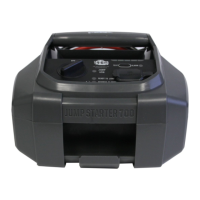
Store the Jump-Starter at room temperature. Make sure the battery clamps are stored on the
appropriate case clamp posts on the side of the unit after use.
Due to inherent self-discharge, lead acid batteries should be charged at least every
4 months, especially in a warm environment. Leaving a battery in a discharged state, or if not
recharged every 4 months, may result in permanent battery damage and poor jump-starting
performance.
Battery Replacement / Disposal
The Jump-Starter is designed to provide years of service. However, when the internal battery reaches
the end of its service life, the Jump-Starter itself is no longer of use. The internal battery is not
designed to be user replaceable.
Because the internal battery contains lead, the Jump-Starter should be recycled or
safely disposed of at a local recycling center. Examples of places that will accept items
like this are: county or municipal recycling drop-off centers, scrap metal dealers and
retailers who sell automotive replacement lead-acid starter batteries.
Contains sealed lead-acid battery. Battery must be recycled. Wash hands
thoroughly after handling battery.
Pb
FCC INFORMATION
This product complies with Part 15 of the FCC Rules. Operation is subject to the following two
conditions: (1) this device may not cause harmful interference, and (2) this device must accept any
interference received, including interference that may cause undesired operation.
Changes or modifications to this unit not expressly approved by the party
responsible for compliance could void the user’s authority to operate the equipment.
This product has been tested and found to comply with the limits for a Class B
digital device, pursuant to Part 15 of the FCC Rules. These limits are designed to provide
reasonable protection against harmful interference in a residential installation. This equipment
generates, uses and can radiate radio frequency energy and, if not installed and used in
accordance with the instructions, may cause harmful interference to radio communications.
However, there is no guarantee that interference will not occur in a particular installation. If
this equipment does cause harmful interference to radio or television reception, which can be
determined by turning the equipment off and on, the user is encouraged to try to correct the
interference by one or more of the following measures:
• Reorient or relocate the receiving antenna.
• Increase the separation between the equipment and receiver.
• Connect the equipment into an outlet on a circuit different from that to which the receiver is
connected.
• Consult the dealer or an experienced radio/TV technician for help.


 To Next Page
 Loading...