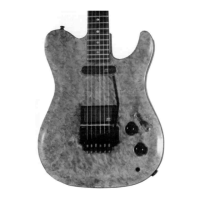
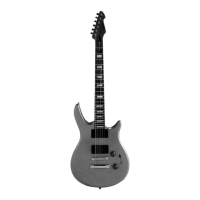
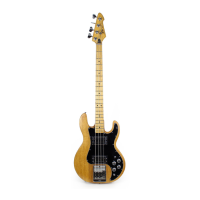
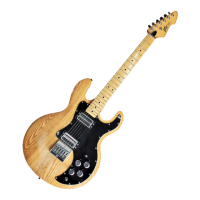
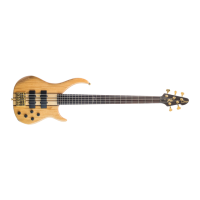
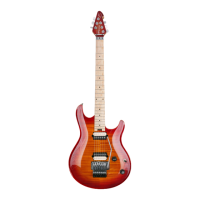
This document is an operating guide for the Peavey Generation S-3 electric guitar.
Function Description
The Peavey Generation S-3 is an electric guitar designed for musical performance. It features a hum-cancelling pickup system and controls for volume, tone, and pickup selection, allowing for a wide range of tonal possibilities. The instrument is designed to be played in tune across the neck, with adjustable components for personalized setup.
Important Technical Specifications
- Body: Bookmatched, flame maple top/Alder back with resonant, hollow tone chambers.
- Neck: Bilaminated satin finish maple neck.
- Fingerboard: 12" radius maple fingerboard.
- Scale Length: 25½" scale.
- Frets: 22 nickel-silver frets.
- Pickups: H.C.S.™ Hum-cancelling pickup system (single coil type design, hum-cancelling alone or when used together, no external power source or batteries required).
- Controls:
- One master volume control.
- One tone control (unique circuitry, U.S. Patent No. 4,164,163, enables single coil or H.C.S.™ operation).
- Five-position pickup selector switch.
- Bridge: Chrome plated fixed bridge.
- Machine Heads: Premium die-cast.
Usage Features
Pickup Adjustment:
The height of the pickups can be adjusted by turning the height adjusting screws on the pickup or trim ring. Turning clockwise raises the pickup, while turning counterclockwise lowers it.
Controls:
- Volume Control: This acts as the master volume, controlling the total signal level from all pickups to the output jack. Rotating clockwise increases volume, and counterclockwise reduces it.
- Tone Control: This unique tone circuitry allows for single coil or H.C.S.™ (hum-cancelling system) operation in any pickup selection.
- Rotating the tone control fully clockwise (position 10) activates the single coil mode, producing a greater degree of highs.
- Rotating the tone control counterclockwise to approximately position 7 activates the H.C.S. circuit for noise-free operation.
- Further counterclockwise rotation reduces highs while maintaining noise-free operation.
- Pickup Selector Switch: This five-position switch allows selection of individual pickups or combinations of multiple pickups:
- First Position (Toward the neck): Selects output of the neck pickup only.
- Second Position (One click back): Selects output of neck and center pickups.
- Third Position (Center): Selects output of center pickup only.
- Fourth Position (One click back of center): Selects output of center and bridge pickups.
- Fifth Position (Toward bridge): Selects output of bridge pickup only.
Adjustments (General Caution):
The instrument is factory-adjusted for accurate intonation and playing ease. However, playing style or requirements may necessitate additional adjustments. These adjustments should ideally be made by a Peavey Dealer, but can be attempted by the user with care, adhering strictly to the instructions provided. Users are warned to read and understand all instructions thoroughly before attempting any adjustments.
Adjusting Torsion Rod:
All guitar necks require a slight bow to prevent string buzzing. To adjust the neck's "straightness," a Peavey torsion rod wrench No. 75031006 is needed.
- Tune the instrument to standard (A-440) pitch.
- Fret the sixth string (E) at the first and last frets.
- Check clearance between the string and the eighth fret; it should be between 0.012" and 0.025".
- To increase clearance, loosen (counterclockwise) the torsion rod nut. To decrease clearance (straighten the neck), tighten the nut.
- Caution: It is usually unnecessary to rotate the torsion rod nut more than one full turn in either direction; one-quarter to one-half turn is normally sufficient. Excessive rotation can damage the neck and torsion rod. If excessive force is needed, consult a Peavey Dealer or the factory.
- Repeat steps until proper clearance is achieved.
Neck Tilt Adjustment:
This adjustment works with bridge height to set overall string playing height and should be used whenever possible for string height adjustment.
- Slightly detune the guitar (1-2 full steps).
- Loosen the two neck screws closest to the headstock by approximately 1 turn.
- Loosen the remaining two neck screws closest to the bridge by approximately 2 turns.
- Adjust string height with the neck tilt screw (located inside the fifth hole in the neck plate) using a 1½" allen wrench. Clockwise rotation lowers strings, counterclockwise raises them. Adjust to fit playing style, noting that too low can cause buzz and rattle, while too high can cause intonation problems and decreased playability.
- After adjustment, securely tighten all four neck attaching screws.
- Tune to standard pitch and check for correct height and playability. Repeat if necessary.
Saddle Height Adjustment:
This is done via the back hex (allen) screw located on either side of the intonation screw.
String Intonation:
Accurate intonation ensures the instrument plays in tune across the neck. While "perfect intonation" is physically impossible on a fretted instrument, correct settings maximize accuracy.
Intonation is set by comparing the pitch of an open string to the pitch of the same string played one octave higher at the 12th fret. The "vibrating length" of the string is adjusted by moving the bridge saddle forward or backward.
- If the fretted note is sharper than the open note, increase vibrating length by moving the saddle to the rear (away from pickups).
- If the fretted note is flat, decrease vibrating length by moving the saddle forward (toward pickups).
The intonation screw moves the bridge saddle forward (raises pitch) or back (flattens pitch).
- Note: It is often easier to compare the 12th fret harmonic to the fretted note than the open note. A harmonic is played by lightly touching the string directly above the 12th fret while plucking, then quickly removing the finger.
- For greater ease and accuracy, electronic guitar tuners (meter or LED display types) are recommended.
- Note: Both torsion rod and string height settings interact closely with string intonation. These must be completed before setting string intonation at the bridge.
- Ensure torsion rod and string height settings are accurate.
- Tune guitar to standard (A-440) pitch.
- Hold the instrument in a normal playing position or place it on a clean flat surface, ensuring only the body is in contact to avoid affecting intonation settings.
- Play the 1st string open and compare its pitch to the same string played at the 12th fret (one octave apart).
- Note: It may be necessary to return the open string to standard pitch after altering the bridge position.
- Repeat steps for remaining strings.
- Repeat steps 1 through 5 as necessary until all strings are accurately intonated.
Maintenance Features
Care for the Instrument:
This is a high-quality musical instrument built from fine materials and modern production methods. With reasonable care, it should provide many years of service.
Temperature and Humidity:
It is crucial to protect the instrument from extremes or sudden changes in temperature or humidity. Store the instrument in its case when not in use.
Strings:
String life can be extended by frequent cleaning and wiping after use. Dirt and perspiration build up on the underside of strings, causing tuning and intonation problems, rust, and corrosion. Slide a rag between the strings and the fingerboard to clean them. For best performance, strings should be changed approximately once a month or every twenty-four playing hours, though some players may change them more often.
Finish:
The instrument has a durable and weather-resistant polyester/urethane finish, but still requires care. Automotive-grade waxes can protect, clean, and shine it. Between waxings, wipe the instrument with a dry, soft cloth.
Warnings and Dangers:
- Electrical Shock/Fire Hazard: Do not expose the appliance to rain or moisture. Read back cover for further warnings.
- Electrical Shock (General): All amplification accessories, microphones, mixers, etc., must be properly grounded and used with a 3-wire mains system. Do not contact other electrical apparatus when playing or touching the instrument, as electrical shock can occur if the other apparatus has improper grounding.
- Guitar Straps: Do not use improper or poorly designed guitar straps or other means of support. Improper, inferior, ill-fitting, or worn-out straps can cause the instrument to fall, resulting in bodily injury or damage to the instrument or associated equipment.
- Guitar Strings: Guitar strings are made from strong steel alloys, designed to be used under tension. They may break and spring away from the guitar under certain conditions. Do not tune or play the instrument with your face in close proximity to the strings, as serious injury could result if a string breaks.
- Bass Guitar Strings: Bass guitar strings are under considerable tension when tuned to concert (A-440) pitch. Exercise extreme care when tuning (especially above concert pitch) or when employing string bending or "popping" playing techniques. String breakage and personal injury risks exist under these conditions.
- Patch Cord: The patch cord between the guitar and the amplifier is an extremely important link for optimum performance. A high quality, well shielded cord should be used.
Warranty Information:
Peavey Electronics Corporation warrants this guitar to be free from defects in material and workmanship for one year from the date of purchase. This limited warranty applies only to the original retail purchaser and is subject to specific conditions, exclusions, and limitations.
- Warranty Void if: The product is purchased for resale, not from an authorized Peavey dealer, or if damaged by accident, unreasonable use, neglect, improper service/maintenance, or causes not related to material/workmanship defects.
- Exclusions: Does not cover guitar strings (considered reasonable maintenance).
- Remedy: Purchaser's exclusive remedy is repair or replacement of the guitar at Peavey's option. Service can be performed by an authorized Peavey Service Center or by returning the guitar (postage prepaid and insured, with problem description and proof of purchase) to Peavey Electronics Corporation, International Service Center, Hwy. 80 East, Meridian, MS 39301.
- Liability Limitation: Peavey is not liable for lost profits, incidental, or consequential damages arising from the use or inability to use the guitar, unless caused by Peavey's negligence (in which case, the limitation of remedy does not apply to personal injury or real/tangible property damage). Peavey's liability is limited to actual damages up to the purchase price or $500.00, whichever is greater.
- Disclaimer: This limited warranty is in lieu of all other expressed or implied warranties, including merchantability and fitness for a particular use. Implied warranties are not disclaimed during the one-year period from purchase if other conditions are met.
- State Laws: Some states do not allow limitations on implied warranty duration or exclusion/limitation of incidental/consequential damages, so these limitations may not apply to all users. This warranty grants specific legal rights, and other rights may vary by state.
- Registration: The warranty registration card and a legible copy of proof of purchase must be accurately completed, mailed to, and received by Peavey within fourteen (14) days from the date of purchase.
- Address Changes: If you move, notify Peavey of the change of address to facilitate receipt of bulletins or notifications. Mail address changes to: Peavey Electronics Corporation, P.O. Box 2898, Meridian, MS 39302-2898.
- Applicability: This limited warranty is given by Peavey Electronics Corporation for equipment purchased in the United States of America.

 Need help?
 General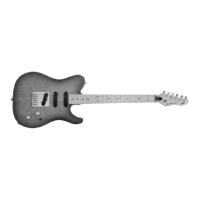

 To Next Page