EasyManua.ls Logo

Peavey Generation S-3 - Saddle Height Adjustment; String Intonation

Peavey Generation S-3
8 pages
Print Icon
To Next Page IconTo Next Page
To Previous Page IconTo Previous Page
Loading...
Neck
Tilt
The
neck
tit
adjustment
works
in
conjunction
with
the
bridge
height
adjustment
to
set
the
overall
string
playing
height.
This
ad-
justment
should
be
used
whenever
possible
to
set
string
height
rather
than
the
bridge
height
adjustment.
1.
Relieve
string
tension
slightly
by
detuning
guitar
(approx.
imately
1
to
2
full
steps).
2.
Loosen
two
neck
screws
(closest
to
headstock
of
guitar)
approximately
1
turn.
3.
Loosen
remaining
two
neck
screws
(closest
to
bridge)
ap-
proximately
2
turns.
4,
String
height
may
now
be
adjusted
with
the
neck
tilt
screw
which
is
located
inside
the
fiith
hole
in
the
neok
plate.
A
14”
allen
wrench
is
used
to
make
this
adjustment.
Turning
the
screw
clockwise
lowers
the
strings
closer
to
the
finger-
board.
String
height
should
be
adjusted
to
fit
your
own
particular
playing
style.
It
should
be
noted
that
setting
the
string
height
too
low
will
result
in
excessive
string
buzz
and
rattle,
especially
with
a
"heavy"
playing
technique.
Ex-
cessively
high
action
will
result
in
intonation
problems
and
decreased
playability.
5.
After
adjustment,
securely
tighten
all
four
neck
attaching
screws,
6.
Tune
guitar
to
standard
pitch.
Check
strings
for
correct
height
and
playability.
If
necessary,
repeat
steps
1
through
5
until
action
is
correct.
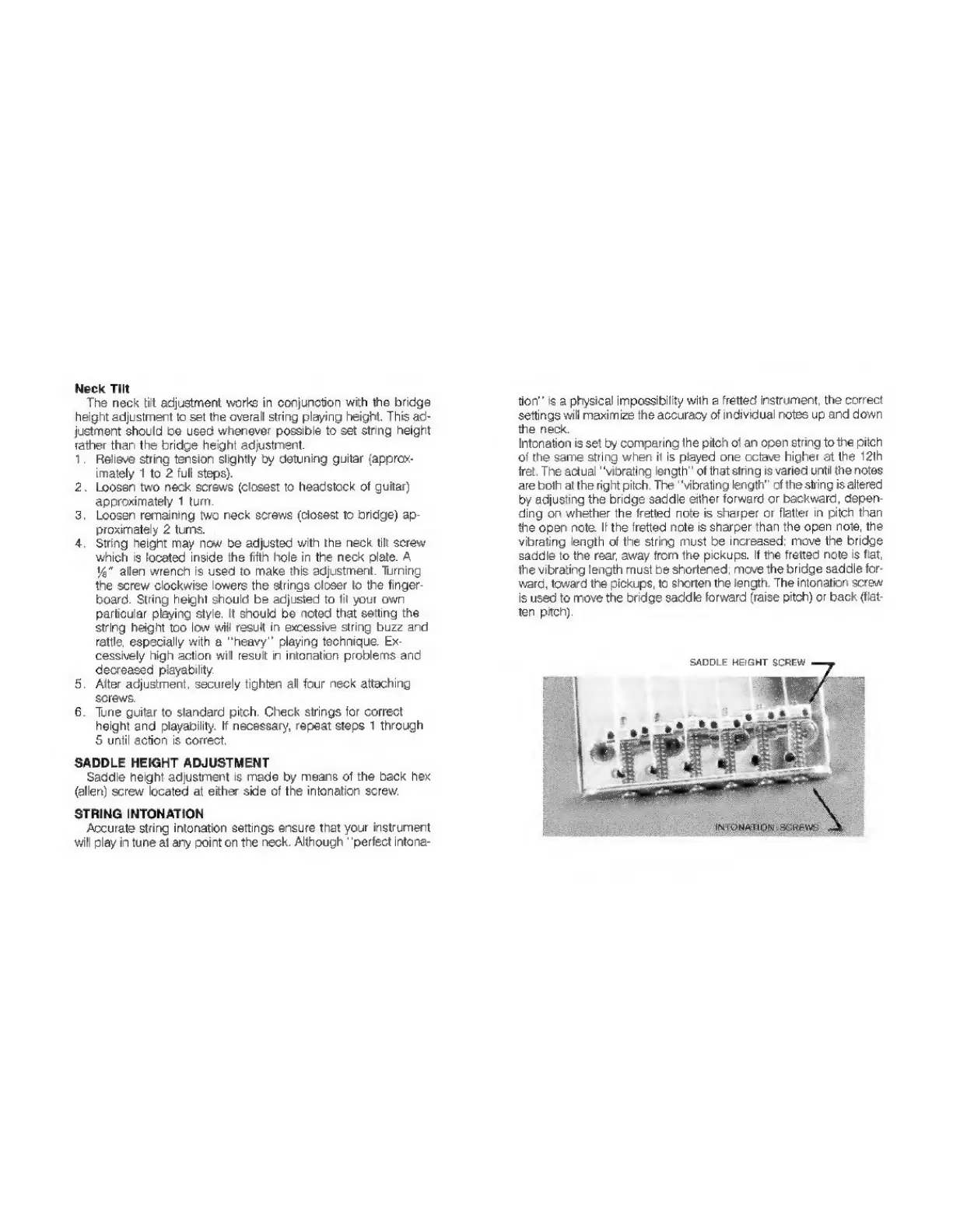
SADDLE
HEIGHT
ADJUSTMENT
Saddle
height
adjustment
is
made
by
means
of
the
back
hex
(ellen)
screw
located
at
either
side
of
the
intonation
screw.
STRING
INTONATION
Accurate
string
intonation
settings
ensure
that
your
instrument
will
play
in
tune
at
any
point
on
the
neck.
Although
''perfect
intona-
tion”
is
a
physical
impossibility
with
a
fretted
instrument,
the
correct
settings
will
maximize
the
accuracy
of
individual
notes
up
and
down
the
neck.
Intonation
is
set
by
comparing
the
pitch
of
an
open
string
to
the
pitch
of
the
same
string
when
it
is
played
one
octave
higher
at
the
12th
fret.
The
actual
“vibrating
length”
of
that
string
is
varied
unti
the
notes
are
both
at
the
right
pitch.
The
“vibrating
length”
of
the
string
is
altered
by
adjusting
the
bridge
saddle
either
forward
or
backward,
depen-
ding
on
whether
the
fretted
note
is
sharper
or
flatter
in
pitch
than
the
open
note.
If
the
fretted
note
is
sharper
than
the
open
note,
the
vibrating
length
of
the
string
must
be
increased;
move
the
bridge
saddle
to
the
rear,
away
from
the
pickups.
If
the
fretted
note
is
flat,
the
vibrating
length
must
be
shortened;
move
the
bridge
saddle
for-
erd,
toward
the
pickups,
to
shorten
the
length.
The
intonation
screw
is
used
to
move
the
bridge
saddle
forward
(raise pitch)
or
back
(fiat:
ten
pitch).
SADDLE
HEIGHT
SCREW

Related product manuals