EasyManua.ls Logo

Pentax Zoom 280-P - Exposure Compensation

Pentax Zoom 280-P
56 pages
Print Icon
To Next Page IconTo Next Page
To Previous Page IconTo Previous Page
Loading...
Exposure
Compensation
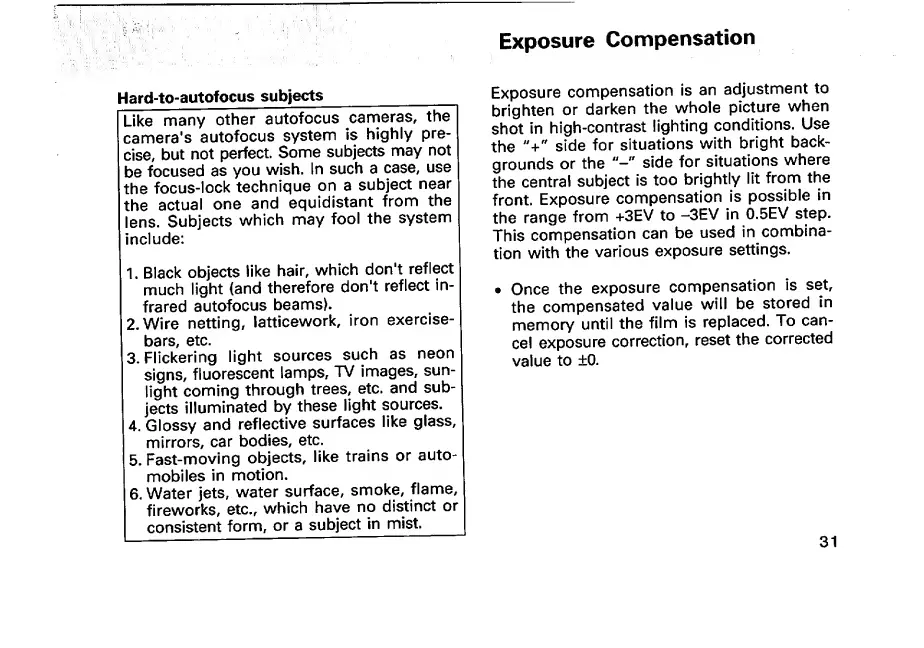
Hard-to-autofocus
subjects
_
Like
many
other
autofocus
carneras,
the
camera's
autofocus
system
is
highly
pre¬
cise,
but
not
perfect.
Some
subjects
may
not
be
focused
as
you
wish.
In
such
a
case,
use
the
focus-lock
technique
on
a
subject
near
the
actual
one
and
equidistant
from
the
lens.
Subjects
which
may
fool
the
system
include:
1.
Black
objects
like
hair,
which
don't
reflect
much
light
(and
therefore
don't
reflect
in¬
frared
autofocus
beams).
2.
Wire
netting,
latticework,
iron
exercise-
bars,
etc.
3.
Flickering
light
sources
such
as
neon
signs,
fluorescent
lamps,
TV
images,
sun¬
light
coming
through
trees,
etc.
and
sub¬
jects
illuminated
by
these
light
sources.
4.
Glossy
and
reflective
surfaces
like
glass,
mirrors,
car
bodies,
etc.
5.
Fast-moving
objects,
like
trains
or
auto¬
mobiles
in
motion.
6.
Water
jets,
water
surface,
smoke,
flame,
fireworks,
etc.,
which
have
no
distinct
or
consistent
form,
or
a
subject
in
mist.
Exposure
compensation
is
an
adjustment
to
brighten
or
darken
the
whole
picture
when
shot
in
high-contrast
lighting
conditions.
Use
the
side
for
situations
with
bright
back¬
grounds
or
the
side
for
situations
where
the
central
subject
Is
too
brightly
lit
from
the
front.
Exposure
compensation
Is
possible
In
the
range
from
+3EV
to
-3EV
in
0.5EV
step.
This
compensation
can
be
used
in
combina¬
tion
with
the
various
exposure
settings.
Once
the
exposure
compensation
is
set,
the
compensated
value
will
be
stored
in
memory
until
the
film
is
replaced.
To
can¬
cel
exposure
correction,
reset
the
corrected
value
to
±0.

Related product manuals