EasyManua.ls Logo

Perfomance Tool W1606 - User Manual

Perfomance Tool W1606
8 pages
Print Icon
To Next Page IconTo Next Page
Loading...
WARNING
It is the owner and/or operators’ responsibility to study all WARNINGS, operating, and
maintenance instructions contained on the product label and instruction manual prior to
operation of this service jack. The owner/operator shall retain product instructions for future
reference.
The owner and/or operator are responsible for maintenance, maintaining all decals or warning
labels and while in use, maintaining the unit in good working order. If the owner and/or operator
are not fluent in English, the product warnings and instructions shall be read and discussed with
the operators’ native language by the purchaser/owner or his designee. Make sure that the
operator comprehends its contents. Safety information shall be emphasized and understood prior
to usage. The service jack shall be inspected per the operating instructions.
Users of this service jack must fully understand these instructions. Each person operating this
service jack must also be of sound mind and body and must not be under the influence of any
substance that might impair their vision, dexterity, or judgment.
Protect yourself and others by observing all safety information.
Failure to comply with instructions could result in personal injury and/or property damage!
2 TON COMPACT
TROLLEY JACK
OWNERS MANUAL
Stock Number W1606
On occasion, after printing of our literature is completed, our manufacturers may make changes and/or
modifications to merchandise which will not be reflected in this manual. Although we strive to maintain
complete and accurate information, it is possible in some instances, that the product may differ slightly from
printed specifications. Illustrations are intended for reference only. Actual merchandise may vary. Wilmar is
not responsible for typographical errors.

Questions and Answers

Summary

Safety Guidelines and Definitions

Unpacking and Inspection

Specifications

Important Safety Information

Before Using Your Jack

Pre-operation checks and procedures before using the jack.

Operation

To Raise

Steps for lifting the vehicle safely.

To Lower

Steps for safely lowering the vehicle.

Care and Maintenance

Maintenance Procedures

Steps for regular jack maintenance and fluid checks.

Troubleshooting

Common Symptoms and Solutions

Addresses common jack performance issues and their resolutions.

Replacement Parts List

Replacement Parts Kits

Lists available repair kits and specific replacement parts.

Replacement Parts List - Ram Assembly

Limited Warranty

Overview

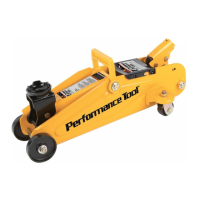
This document describes the Performance Tool 2 Ton Compact Trolley Jack, Stock Number W1606, an automotive lifting device designed for personal, family, or household use.

Function Description

The 2 Ton Compact Trolley Jack is a hydraulic lifting device used to raise vehicles or other objects for maintenance or repair. It is designed to lift a load to a desired height, after which the load MUST be immediately supported by jack stands. It is not intended to support heavy loads for extended periods. The jack operates by pumping a handle to raise the saddle, and a release valve allows for controlled lowering of the load.

Important Technical Specifications

  • Capacity: 4,000 lbs. (2 tons)
  • Minimum Lift Height: 5 1/4 in.
  • Maximum Lift Height: 13 in.
  • Base Length: 17 in.
  • Base Width: 8 in.
  • Hydraulic Fluid: SAE 20 hydraulic fluid for refills.

Usage Features

The trolley jack is designed for ease of use with several key operational features:

Before Use:

  • Air Purging: Before initial use or if the jack malfunctions due to trapped air, the hydraulic system needs to be purged. This involves opening the release valve (counter-clockwise, no more than two turns) and pumping the jack handle approximately 6 full strokes to distribute hydraulic fluid. This process should be repeated as needed.
  • Inspection: A thorough inspection for any damage (broken, cracked, bent, loose, or missing parts) is required before each use. Damaged equipment must not be used and should be repaired by qualified personnel.
  • Testing: The jack should be tested for proper operation before actual use.

To Raise a Load:

  1. Vehicle Preparation: Park the vehicle on a hard, level surface, turn off the engine, place the transmission in PARK (automatic) or lowest gear (manual), set the emergency brake, and chock the wheels that are not being lifted.
  2. Placement: Position the jack saddle under the vehicle's manufacturer-recommended lift points.
  3. Centering Load: Ensure the load is centered on the saddle to prevent instability.
  4. Closing Release Valve: Place the pump handle over the release valve and turn it clockwise to close.
  5. Lifting: Insert the handle into the handle socket and pump to raise the load to the desired height.
  6. Immediate Support: ALWAYS support the load with appropriate jack stands immediately after lifting. Jack stands must be placed under the vehicle's frame or recommended lifting points and adjusted to the same height if two are used.

To Lower a Load:

  1. Clearance: Remove all tools, parts, and equipment from under the vehicle.
  2. Positioning: Position the jack saddle under the lifting point.
  3. Slight Raise: Place the pump handle over the release valve, turn it clockwise to close, and pump the handle to raise the vehicle slightly above the jack stand(s).
  4. Remove Jack Stands: Collapse and remove the jack stand(s).
  5. Controlled Descent: SLOWLY turn the release valve counter-clockwise with the handle (no more than two full turns) to allow a controlled descent of the vehicle to the ground.
  6. Storage: Lower the jack completely and store it in a safe, dry location out of reach of children.

Safety Features:

  • Warning Labels: The manual emphasizes the importance of reading and understanding all warnings, operating, and maintenance instructions. Signal words (DANGER, WARNING, CAUTION, NOTICE) are used to highlight safety information.
  • Load Support: Explicitly states that the jack is a lifting device only and the load MUST be supported by jack stands immediately after lifting.
  • Overload Protection: Users are warned not to exceed the rated capacity of 4,000 lbs, as overloading can cause damage or failure. The jack includes an overload valve spring (part #35 in Ram Assembly) as a component of its hydraulic system, which may contribute to overload protection.
  • Controlled Lowering: Instructions specify slow, controlled lowering of the load.
  • Personal Protective Equipment (PPE): Recommends wearing ANSI approved safety goggles and heavy-duty work gloves during use.
  • Work Area Safety: Emphasizes keeping the work area clean, well-lit, and free of bystanders, children, and visitors.
  • No Adjustments to Safety Valve: Users are explicitly warned not to adjust the safety valve.

Maintenance Features

Regular maintenance is crucial for the longevity and proper functioning of the trolley jack. Monthly maintenance is recommended.

General Maintenance:

  • Inspection: Before each use, inspect the jack for any broken, cracked, bent, loose, or missing parts. Any damaged jack must be removed from service and repaired by qualified personnel.
  • Part Replacement: Use only identical Performance Tool replacement parts for repairs.
  • Lubrication: Keep the jack clean and well lubricated at points illustrated in Figure 3 of the manual.
  • Ram and Pump Piston Position: When not in use, the ram and pump piston should be in the fully down position to prevent corrosion of machined surfaces.
  • Cleaning: Clean the jack with a clean cloth using a detergent or mild solvent.

Hydraulic Fluid Maintenance:

  • Fluid Level Check: With the jack fully lowered, check the fluid level. It should be up to the bottom of the oil fill port.
  • Fluid Type: Use only SAE 20 hydraulic fluid for refills.
  • Oil Change: Change the hydraulic oil at least once every three years.
    1. With the jack fully lowered, remove the oil filler plug.
    2. Tip the jack to drain all old hydraulic oil, disposing of it according to local regulations.
    3. With the jack upright, fill the housing with new, high-quality hydraulic oil until it just begins to run out of the oil fill hole. Exercise extreme caution to prevent dirt or foreign matter from entering the system.
    4. Reinstall the oil filler plug.

Troubleshooting: The manual provides a troubleshooting guide for common issues such as:

  • Will not lift load
  • Will not hold load
  • Will not lift to full height
  • Pump feels "spongy" under load
  • Handle raises under load
  • Handle lowers under load

Solutions typically involve checking the hydraulic fluid level, purging air from the system by opening the release valve and pumping the handle, or seating the valves by closing the release valve, manually raising the lifting arm, and then allowing it to descend. Users are warned to remove the jack from service before making any adjustments.

Parts List: Detailed replacement parts lists are provided for both the main jack assembly (Figure 5) and the ram assembly (Figure 6), including part numbers and descriptions, to facilitate repairs and maintenance. Key replacement parts like the Ram Repair Kit, Return Spring, Caster Assembly, and Pump Handle are also listed separately.

Perfomance Tool W1606 Specifications

General IconGeneral
BrandPerfomance Tool
ModelW1606
CategoryJacks
LanguageEnglish

Related product manuals