Engines Operating on B20 Biodiesel
Refer to this Manual Fluid Recommendations, “Fuel
Specification” for the required service interval for
operating with B20.
Engines Operating on High Sulfur Fuel
Refer to this Manual Fluid Recommendations, “Fuel
Specification” for the required service interval for
operating with high sulfur fuel.
Lubricant Viscosity Recommendations
for Direct Injection (DI) Diesel Engines
The correct SAE viscosity grade of oil is determined
by the minimum ambient temperature during cold
engine start-up, and the maximum ambient
temperature during engine operation.
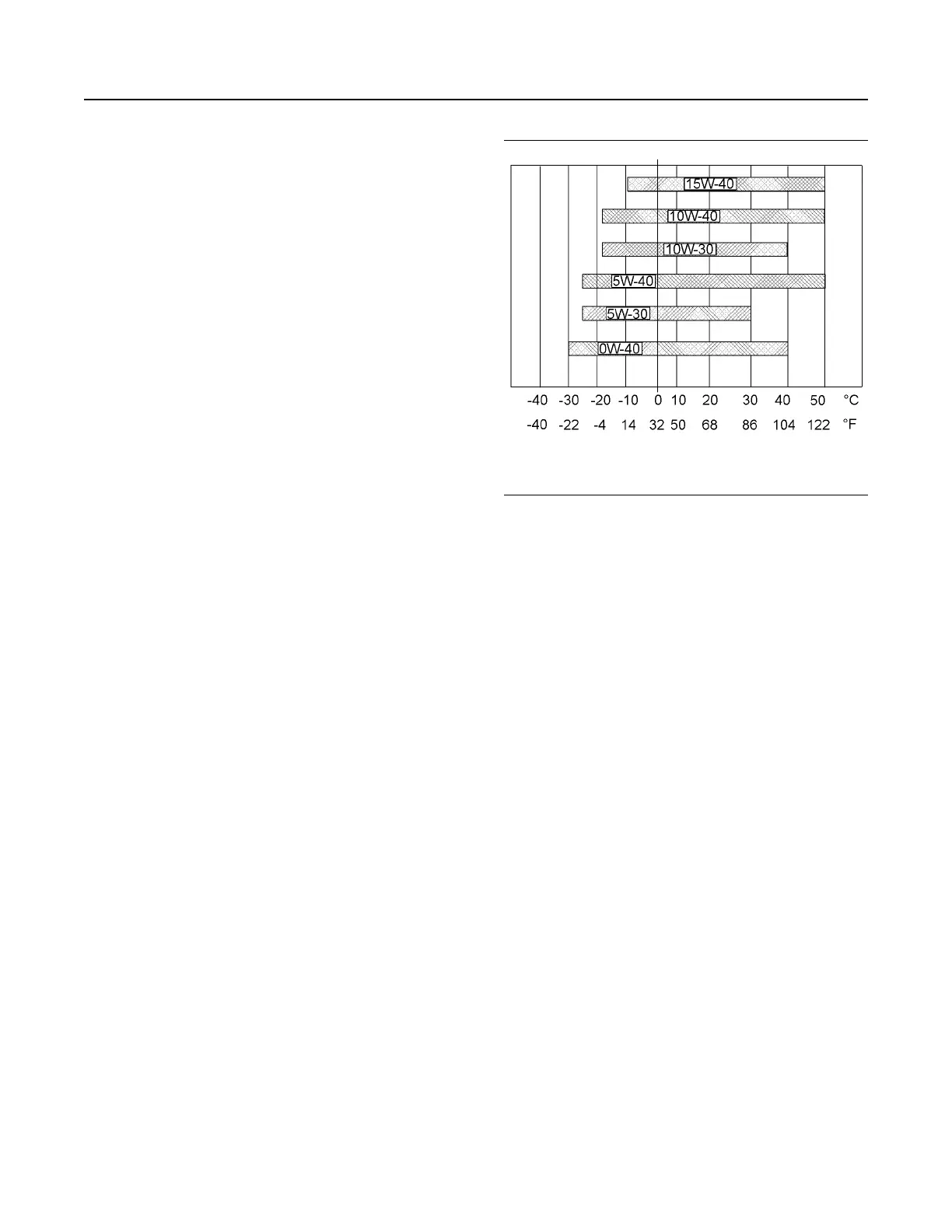
Refer to illustration 33 (minimum temperature) in
order to determine the required oil viscosity for
starting a cold engine.
Refer to illustration 33 (maximum temperature) in
order to select the oil viscosity for engine operation at
the highest ambient temperature that is anticipated.
Generally, use the highest oil viscosity that is
available to meet the requirement for the temperature
at start-up.
Illustration 33 g03347115
Lubricant Viscosities
Supplemental heat is recommended for cold soaked
starts below the minimum ambient temperature.
Supplemental heat may be required for cold soaked
starts that are above the minimum temperature that
is stated, depending on the parasitic load and other
factors. Cold soaked starts occur when the engine
has not been operated for a period of time. This
interval will allow the oil to become more viscous due
to cooler ambient temperatures.
Aftermarket Oil Additives
Perkins does not recommend the use of aftermarket
additives in oil. It is not necessary to use aftermarket
additives in order to achieve the engines maximum
service life or rated performance. Fully formulated,
finished oils consist of base oils and of commercial
additive packages. These additive packages are
blended into the base oils at precise percentages in
order to help provide finished oils with performance
characteristics that meet industry standards.
There are no industry standard tests that evaluate
the performance or the compatibility of aftermarket
additives in finished oil. Aftermarket additives may
not be compatible with the finished oils additive
package, which could lower the performance of the
finished oil. The aftermarket additive could fail to mix
with the finished oil. This failure could produce sludge
in the crankcase. Perkins discourages the use of
aftermarket additives in finished oils.
To achieve the best performance from a Perkins
engine, conform to the following guidelines:
• See the appropriate “Lubricant Viscosities”. Refer
to the illustration 33 in order to find the correct oil
viscosity grade for your engine.
SEBU8731-04
63
Maintenance Section
Engine Oil Specification




 To Next Page