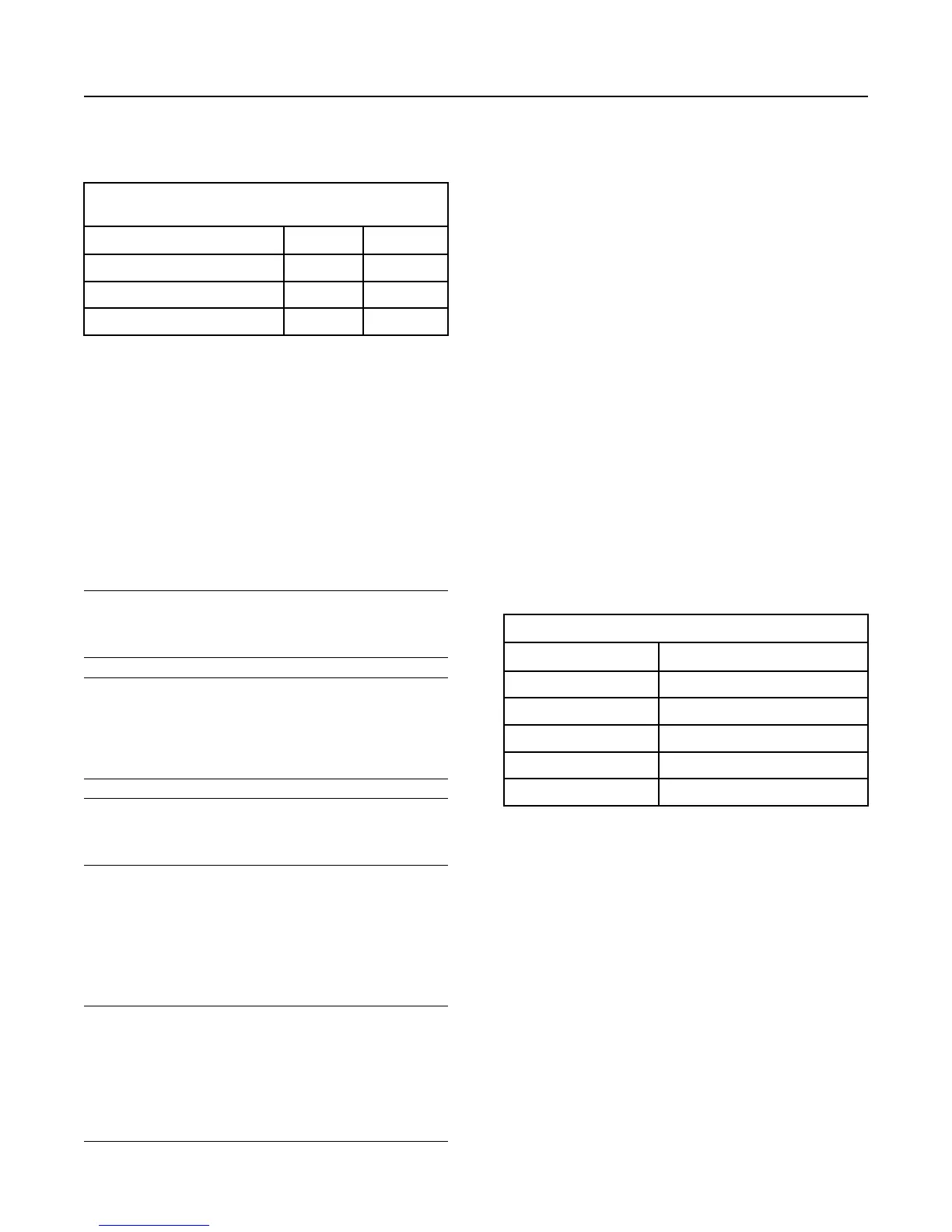
404F-22T Engine
Table 10
404F-22T Engine
Refill Capacities
Compartment or System
Liters
Quarts
Engine Only
3.91 4.13
External System Per OEM
(1)
Total Cooling System
(2)
(1)
The External System includes a radiator or an expansion tank
with the following components: heat exchanger and piping. Re-
fer to the OEM specifications. Enter the value for the capacity of
the External System in this row.
(2)
The Total Cooling System capacity includes the capacity for the
Engine plus the External System. Enter the value for the ca-
pacity of the Total Cooling System in this row.
i05191400
Fluid Recommendations
General Coolant Information
NOTICE
Never add coolant to an overheated engine. Engine
damage could result. Allow the engine to cool first.
NOTICE
If the engine is to be stored in, or shipped to an area
with below freezing temperatures, the cooling system
must be either protected to the lowest outside temper-
ature or drained completely to prevent damage.
NOTICE
Frequently check the specific gravity of the coolant for
proper freeze protection or for anti-boil protection.
Clean the cooling system for the following reasons:
• Contamination of the cooling system
• Overheating of the engine
• Foaming of the coolant
NOTICE
Never operate an engine without water temperature
regulators in the cooling system. Water temperature
regulators help to maintain the engine coolant at the
proper operating temperature. Cooling system prob-
lems can develop without water temperature
regulators.
Many engine failures are related to the cooling
system. The following problems are related to cooling
system failures: Overheating, leakage of the water
pump and plugged radiators or heat exchangers.
These failures can be avoided with correct cooling
system maintenance. Cooling system maintenance is
as important as maintenance of the fuel system and
the lubrication system. Quality of the coolant is as
important as the quality of the fuel and the lubricating
oil.
Coolant is normally composed of three elements:
Water, additives and glycol.
Water
Water is used in the cooling system in order to
transfer heat.
Distilled water or deionized water is
recommended for use in engine cooling systems.
DO NOT use the following types of water in cooling
systems: Hard water, softened water that has been
conditioned with salt and sea water.
If distilled water or deionized water is not available,
use water with the properties that are listed in Table
11 .
Table 11
Acceptable Water
Property
Maximum Limit
Chloride (Cl) 40 mg/L
Sulfate (SO
4
) 100 mg/L
Total Hardness
170 mg/L
Total Solids
340 mg/L
Acidity pH of 5.5 to 9.0
For a water analysis, consult one of the following
sources:
• Local water utility company
• Agricultural agent
• Independent laboratory
Additives
Additives help to protect the metal surfaces of the
cooling system. A lack of coolant additives or
insufficient amounts of additives enable the following
conditions to occur:
58 SEBU8609
Refill Capacities
Fluid Recommendations



 To Next Page