Need help?
Do you have a question about the Perle IOLAN SCR1618 RDAC and is the answer not in the manual?
Connect power sources to the IOLAN SCR and observe initial LED sequences during boot-up.
Utilize setup mode via a web browser for initial configuration after connecting power.
Connect Ethernet devices using CAT5e cables to the IOLAN's Ethernet ports.
Connect serial devices using straight-through serial cables to the IOLAN's serial ports.
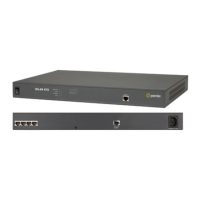
Visual overview of the IOLAN SCR's front and back panels, highlighting ports and indicators.
Explanation of the status and activity indicated by the device's various LEDs.
Details on supported SFPs for fiber and copper connections.
Ensuring proper TX/RX crossover for fiber connections and link establishment.
The Perle IOLAN SCR1618 RDAC is a robust and versatile device designed for secure console management and remote access to network infrastructure. It serves as a central point for managing serial devices, Ethernet-connected equipment, and providing secure out-of-band access, making it an essential tool for data centers, remote offices, and network operations centers. This quick start guide provides an overview of its setup and basic functionalities, aiming to get users up and running quickly for initial configuration or product evaluation. For comprehensive details, users are directed to the IOLAN SCR User's Guide, Command Line Reference Guide, and Hardware Installation Guide available on the Perle website.
The IOLAN SCR1618 RDAC primarily functions as a secure console server, enabling remote management of serial devices such as servers, routers, switches, and other network appliances. It integrates both serial and Ethernet connectivity, allowing administrators to access and control these devices over a network, even when the primary network is down. The "RDAC" in its name signifies its capabilities for Remote Device Access and Control, highlighting its role in maintaining network uptime and facilitating troubleshooting.
The device is equipped with 16 RS232 RJ45 serial ports, which are used to connect to the console ports of various network equipment. This allows for direct, command-line interface (CLI) access to these devices, providing a powerful means for configuration, monitoring, and diagnostics. In addition to serial connectivity, the IOLAN SCR1618 RDAC features 18 Ethernet ports (1-18), including two SFP ports (17 and 18), which support 1 Gbps fiber, 2.5 Gbps fiber, and SGMII copper. These Ethernet ports facilitate network connectivity for the IOLAN itself and can also be used to connect other Ethernet devices, extending its utility beyond just serial console management.
One of the key features of the IOLAN SCR series is its emphasis on security. While this quick start guide focuses on basic setup, the full documentation details advanced security protocols and authentication methods that ensure secure remote access, protecting sensitive network infrastructure from unauthorized access. The device is designed to be highly reliable, supporting dual power inputs for redundancy, which is crucial for maintaining continuous operation in critical environments.
Setting up the IOLAN SCR1618 RDAC involves a straightforward process, beginning with power connection. The device supports either single or dual power sources, with LED indicators (PWR 1 and PWR 2) to confirm power availability. Once powered on, the device cycles through a boot sequence, and its status is indicated by LED 1 and LED 2. LED 1, when solid green, signifies that the system is ready for normal operation. LED 2 provides information about WAN high-availability modes, indicating whether failover or load-sharing is active, and if IP health is configured and active across interfaces.
For initial configuration, the IOLAN SCR is shipped in factory default mode, which simplifies the setup process. Users can connect a PC directly to any of the IOLAN's Ethernet ports and access a web-based setup interface by navigating to http://192.168.0.1 in a standard web browser. The PC should be configured to obtain an IP address automatically via DHCP for this initial connection. The setup screen presents a "Getting Started" option, guiding users through the necessary fields to configure the device. Upon saving these changes, the configuration is immediately applied, and the device transitions to a secure login screen, where users can access the full configuration interface using the credentials defined during the setup.
Connecting Ethernet devices to the IOLAN SCR is facilitated by its RJ45 Ethernet ports, which automatically detect and adjust to speeds of 10/100/1000 Mbps. The SFP ports (17 and 18) offer flexible connectivity options, supporting various fiber and copper SFP modules. When connecting fiber, it's essential to ensure proper TX to RX crossover for the cable. Link activity and status for both RJ45 Ethernet and SFP ports are indicated by corresponding LEDs, which illuminate solid green or flash to show link up and activity.
For serial device connectivity, the IOLAN SCR1618 RDAC utilizes RS232 RJ45 serial ports. Users connect their serial devices (workstations, servers, routers) using straight-through serial cables. The pinout diagram provided in the guide details the EIA-232 standard mapping for each pin, including common signals like CTS, DSR, RxD, GND, TxD, DTR, and RTS. This ensures correct wiring and communication between the IOLAN and the connected serial equipment.
The device's front view includes power switches, PWR LEDs, LEDs 1 and 2, Ethernet LEDs for ports 18 and 17, and an Admin port. The back view reveals the 16 serial ports (1-16), 18 Ethernet ports (1-18), a reset button, and dual AC power supplies. This physical layout is designed for easy access and management in a rack-mount environment.
The IOLAN SCR1618 RDAC is designed with several features that contribute to its ease of maintenance and long-term reliability. The dual AC power supplies are a critical maintenance feature, offering redundancy. If one power supply fails, the other can take over, ensuring continuous operation of the console server and uninterrupted access to managed devices. The PWR LEDs (PWR 1 and PWR 2) provide immediate visual feedback on the status of each power supply, allowing administrators to quickly identify and address any power-related issues.
The comprehensive LED indicators on both the front and back of the unit are invaluable for diagnostics and maintenance. LED 1 indicates the overall system status, confirming when the device is fully booted and ready. LED 2 provides insights into the WAN high-availability configuration, which is crucial for maintaining network resilience. Ethernet port LEDs indicate link status and activity, helping to troubleshoot network connectivity issues. These visual cues allow administrators to quickly assess the operational status of the device without needing to log in, facilitating rapid problem identification.
The reset button on the back of the unit provides a physical means to restart the device, which can be useful for troubleshooting or recovering from certain states. While not a primary maintenance tool for daily operations, it serves as an important recovery option.
The web-based management interface, accessible via a standard browser, simplifies ongoing configuration and monitoring. Once the initial setup is complete and secure login credentials are established, administrators can access the full configuration interface to manage serial ports, Ethernet settings, security policies, and other advanced features. This remote access capability is a cornerstone of the IOLAN SCR's design, enabling maintenance tasks to be performed from any location, reducing the need for on-site visits.
Furthermore, the availability of detailed documentation, including the IOLAN SCR User's Guide and Command Line Reference Guide, provides comprehensive resources for advanced configuration, troubleshooting, and maintenance procedures. These guides cover topics ranging from basic setup to complex network integrations, ensuring that administrators have the information needed to effectively manage and maintain the device throughout its lifecycle. The support for SFP modules also allows for flexible upgrades and replacements of network interfaces, adapting to evolving network requirements without replacing the entire unit.
 General
| Ports | 16 |
|---|---|
| Serial Interface | RS-232/422/485 |
| Data Rate | Up to 230.4 kbps per port |
| Power Supply | 100-240 VAC, 50-60 Hz |
| Device Type | Serial Console Server |
| Connector Type | RJ45 |
| Protocols | Telnet, SSH |
| Operating Temperature | 0°C to 50°C |
| Management Protocols | SNMP, CLI, Web Manager |
| Security | SSH, SSL |
| Certifications | FCC, CE, RoHS, UL |


 To Next Page