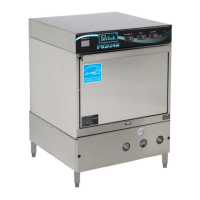
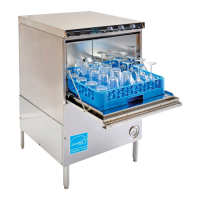
Commercial Glasswasher Installation & Operation Manual
Printed in USA 6
GETTING STARTED
Receiving and Installation
The glasswasher is shipped from the factory in a corrugated box on a wooden pallet. The installation
guidelines give a systematic procedure for setting up the machine.
Start by removing the packaging material. Unwrap the machine and check for the following component
parts:
The Wash Tank Scrap Screen is shipped inside the wash cavity of the machine. This screen must be in
place during operation. It has been designed to perform two basic functions:
1. Strain water that is circulating through the spray arms and pump assembly.
2. A basket to catch broken glass, or heavy solids that may plug the impeller.
Set the machine in place, and level from side-to-side and front-to-back.
Electrical
1
Single-phase 230 volt, 60 Hz dedicated circuit should be used to supply electrical energy to the
PKHT24 Glasswasher (see specifi cation sheet on page 4). This system requires three power wires,
which include a current carrying neutral. An additional fourth wire must be provided for ground. Approxi-
mately 4-feet of ¾” fl exible conduit with power leads (L-1, L-2, Neutral and Ground) extending out of the
conduit are provided for easily connecting the power at installation. The power connection must be
located such that there is suffi cient length of the fl exible conduit remaining to permit the machine to be
moved for cleaning.
Plumbing
2
The machine is equipped with a 1/2” NPT connection located at the lower left-hand corner (facing the
back) of the machine. A 140°F water line should be plumbed to this point (see specifi cation sheet). The
water line used must be of suffi cient length and fl exibility to permit the machine to be moved for
cleaning.
1,2
All electrical and plumbing connections must be made by a qualifi ed person who will comply with all available federal, state,
and local health, electrical, plumbing and safety codes.


 To Next Page