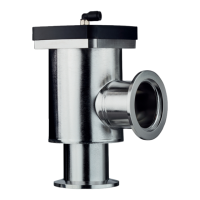
This document describes the Pfeiffer Vacuum EVA 016 H/HX, EVA 025 H/HX, and EVA 040 H/HX angle valves, which are designed for use as fore vacuum, bypass, or venting valves in high vacuum pumping stations and vacuum lines. These valves feature a rapid-action rotary knob for manual operation.
Function Description
The core function of these angle valves is to control gas flow within a vacuum system. The rotary movement of the knob for opening and closing the valve is ingeniously transformed into a longitudinal movement by means of a special sliding block. This mechanism allows for precise and controlled operation. The valves are designed to be integrated into a vacuum system in place of a small flange fitting of the same nominal diameter.
When the valve is in the "CLOSED" position, a pressure difference in the closing direction increases the torque required at the rotary knob linearly. This characteristic provides a tactile feedback to the user regarding the pressure conditions within the system.
Important Technical Specifications
The manual provides detailed technical specifications for the different models (EVA 016 H/HX, EVA 025 H/HX, EVA 040 H/HX), covering various aspects:
Flange Connection:
- EVA 016 H/HX: DN 16 ISO-KF
- EVA 025 H/HX: DN 25 ISO-KF
- EVA 040 H/HX: DN 40 ISO-KF
Conductance for Molecular Flow (Air):
- EVA 016 H/HX: 3 l/s
- EVA 025 H/HX: 15 l/s
- EVA 040 H/HX: 38 l/s
Tightness:
All models achieve a tightness of 1x10⁻⁹ mbar l/s.
Mounting Orientation:
The valves can be mounted in any orientation.
Cycles to First Maintenance (under clean operating conditions):
All models are rated for 1,500,000 cycles before requiring maintenance.
Maximum Pressure Difference:
- In closing direction: 3 bar for all models.
- In opening direction: 2 bar for all models.
Maximum Overpressure:
- EVA 016 H/HX: 8 bar
- EVA 025 H/HX: 6 bar
- EVA 040 H/HX: 4 bar
Can be Opened to a Pressure Difference of:
2 bar for all models.
Rotation Through the Range of Movement:
The rotary knob requires a 135° rotation for the full valve stroke across all models.
Ambient Temperature:
5°C to 60°C (or -15°C if the ambiance is free of condensable gases).
Bakeout Temperature:
- Housing: 150°C
- Actuator: 120°C
Materials:
- Housing:
- H models: Al alloy (3.2315.61)
- HX models: Stainless steel (1.4301)
- Bellows: Stainless steel (1.4404 / AISI 316L) for all models.
- Seals: Viton for all models.
Dimensions (A, H, D):
- EVA 016 H/HX: A=40, H=101, D=Ø50
- EVA 025 H/HX: A=50, H=130, D=Ø64
- EVA 040 H/HX: A=65, H=159, D=Ø82
Weight:
- EVA 016 H/HX: 0.3 kg (H), 0.5 kg (HX)
- EVA 025 H/HX: 0.4 kg (H), 1.2 kg (HX)
- EVA 040 H/HX: 0.8 kg (H), 2.0 kg (HX)
Usage Features
The valves are designed for straightforward installation and operation.
- Mounting: When installing the angle valve, it's crucial to observe special regulations regarding cleanliness and damage prevention for vacuum components. For KF flange connections with elastomer sealing rings (e.g., O-rings) and overpressures greater than 4 bar, the sealing ring must be equipped with an outer centering ring. For overpressures greater than 1 bar, a clamp that can only be opened and closed with a tool (e.g., a hose clip clamping ring) must be used.
- Operation: The valve is operated by rotating the knob. The 135° rotation range allows for full opening or closing. The linear increase in torque with rising pressure difference in the closing direction provides a clear indication of system conditions.
- Product Identification: For communication with Pfeiffer Vacuum, it is essential to provide the information from the product nameplate, including the type, number, and F-number. This information should be transferred to the manual for easy reference.
Maintenance Features
Under clean operating conditions, the product requires no maintenance during its rated cycle life. However, for any necessary maintenance or repair, the following guidelines are provided:
- Returning Products: If a product needs to be returned for maintenance or repair, it must be sealed hermetically at all openings, packed in an appropriate, tight, and solid container, and accompanied by a completed declaration of contamination. Products not clearly declared as "free of harmful substances" will be decontaminated at the customer's expense.
- Disassembly Steps:
- Remove the protective covers. These covers are needed during maintenance work.
- Remove the valve from the vacuum system by dismounting the flange connections.
- Set the rotary knob to the "CLOSED" position.
- Remove the cap.
- Remove the rotary knob.
- Mount the angle valve in a press, ensuring it is slightly preloaded.
- Equalize the spring force "F" with the press and then remove the screws. Pay attention to the specific spring force for each model (EVA 016 H/HX ≈72 N, EVA 025 H/HX ≈135 N, EVA 040 H/HX ≈228 N).
- Carefully relieve the spring force "F" with the press.
- Remove the top cover.
- Remove the complete bellows assembly.
- Cleaning: Persistent contaminations should be removed with a cleaning agent in conformity with local regulations, followed by drying. Sealing surfaces should be carefully cleaned with a lint-free cloth wet with alcohol and dried. O-rings should be treated with a lint-free cloth wet with vacuum oil.
- Safety: Personnel performing maintenance work must be informed about the state of contaminated vacuum units and components. When using cleaning agents, applicable handling and disposal regulations and safety measures must be strictly followed. Special attention to cleanliness and damage prevention is required when working with vacuum components.
- Disposal: For professional decommissioning, contact the nearest Pfeiffer Vacuum Service Center.

 Need help?
 General



 To Next Page