Chapter 5: Working with Phantom CineMags | 27
WORKING WITH
PHANTOM CINEMAGS
INTRODUCTION
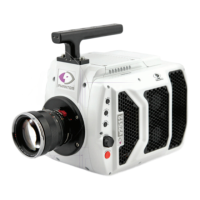
The Phantom UHS-12 and UHS-40 cameras offer a CineMag compatibility option. Cameras
that have CineMag compatibility may use either a CineMag IV or CineMag V. Only UHS-11
and UHS-10 cameras are compatible with CineMag II.
The Phantom CineMag is a high-speed solid-state storage module, compatible with the
Phantom Ultrahigh-Speed cameras for recording, and the CineStation IV for downloading.
It differs significantly from a traditional hard drive or solid-state disk in that there is no file
system.
For high-speed recording, you must record to the camera’s RAM buffer first, review, and
then transfer to the CineMag—this is known as ‘Loop’ mode. For lower speed recording,
the camera can run in ‘Run/Stop’ mode, writing direct to the CineMag and allowing several
minutes of recording. A 2TB CineMag V allows up to 880 fps at full resolution in a UHS-12
camera, and 226 fps at full resolution in a UHS-40 camera in ‘Run/Stop’ mode.
It is not possible to delete individual clips from a CineMag because all frames are recorded
contiguously. Once the CineMag is full, you can only re-record on it by deleting its entire
contents. For this reason, it is recommended that RAM Cines are reviewed and trimmed by
setting in and out points prior to transfer from the RAM buffer to the CineMag.
.Cine files are downloaded over Ethernet (either 1Gb or 10Gb) using Windows-based
Phantom PCC.


 To Next Page
 Loading...