Chapter 7: Programmable I/O Signal Architecture | 45
PROGRAMMABLE I/O
SIGNAL ARCHITECTURE
‘PROGRAMMABLE’ VERSUS ‘ASSIGNABLE’
Phantom cameras have long employed the use of auxiliary ports where one BNC port,
whether on the camera body, capture cable or Break-out-Box, can be assigned to one of a
few different signals. This has been necessary due to an increasing number of signals and
a limited amount of physical space on the camera and pins on the capture connector.
On those cameras, the port is labeled ‘Aux’ and the ‘Camera Signals’ menu in PCC is used
to select the signal. This feature can be referred to as ‘Assignable I/O.’
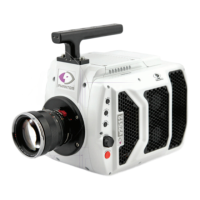
The Phantom UHS-12 and UHS-40 cameras incorporate a pulse processor, which
contributes to a powerful feature called ‘Programmable I/O.’ In addition to assigning
different signals, the signal characteristics can be modified to interface with external
devices.
In most cases, the signal polarity, filter time, delay, pulse width and edge (rising versus
falling) can be set. Setting these characteristics is referred to as ‘Pulse Processor Control.’
PROGRAMMABLE I/O
Programmable I/O ports can be identified on the camera body with a ‘/P.’ Both models have
a fixed trigger and Timecode-in port, along with four Programmable I/O ports (3 FSYNC /P,
4 STROBE /P, 5 READY /P, 6 TC OUT /P).
Each port is to be identified in the PCC ‘Camera Signals’ menu using the port number. Each
Programmable I/O signal has a default which will be set after a factory reset or by using
the ‘signal default’ function in PCC.



 To Next Page
 Loading...