The P-587 Positioner (PZ251E) is a 6-axis nanopositioner designed for high-precision motion and positioning applications. It features a long travel range, parallel metrology, and capacitive sensors, making it suitable for demanding laboratory and industrial environments.
Function Description
The P-587 is a laboratory device intended for indoor use in an environment free of dirt, oil, and lubricants. It is designed for fine positioning, with the ability to move small objects quickly and precisely. The positioner can be mounted horizontally (standing on a surface, not suspended) and provides motion in two axes (X, Y), vertically in one axis (Z), and rotationally in three axes (θx, θy, θz).
The device is driven by PICMA® piezo actuators, which feature all-ceramic insulation for enhanced performance and lifetime compared to conventional actuators. This ceramic insulation protects the monolithic piezoceramic block from humidity and failure dueto increased leakage current, ensuring high reliability even under extreme ambient conditions. Unlike motorized drives, piezo actuators offer backlash-free, maintenance-free, and wear-free operation due to the absence of rotating parts or friction.
Flexure guides are employed for friction-free motion and high guiding accuracy. These elements, based on the elastic deformation of a solid material like steel, eliminate static and sliding friction. They are stiff, have a high load capacity, are maintenance-free, wear-free, 100% vacuum compatible, and function across a wide temperature range without requiring lubricants.
Capacitive sensors are integrated for direct metrology, measuring position directly on the motion platform without contact. This non-contact measurement eliminates friction and hysteresis, contributing to excellent linearity and high position resolution. When paired with suitable electronics, these sensors achieve optimal resolution, stability, and bandwidth.
An ID chip is embedded in the D-sub connector of the P-587. This chip stores calibration data and specific product information from the factory. Upon power-on, digital electronics read this data, allowing any suitable digital electronics to be connected to the P-587 without the need for recalibration.
Important Technical Specifications
- Active Axes: X, Y, Z, θx, θy, θz
- Integrated Sensor: Capacitive
- Travel Range (Closed Loop):
- X, Y: 800 µm
- Z: 200 µm
- Tip/Tilt (θx, θy): ±0.5 mrad
- Tip/Tilt (θz): ±0.5 mrad
- Resolution (Open Loop / Closed Loop):
- X, Y: 0.9 / 2.2 nm (typ.)
- Z: 0.4 / 0.7 nm (typ.)
- θx, θy: 0.05 / 0.1 µrad (typ.)
- θz: 0.1 / 0.3 µrad (typ.)
- Linearity Error:
- X, Y, Z: 0.01 % (typ.)
- θx, θy, θz: 0.1 % (typ.)
- Repeatability:
- X, Y: ±3 nm (typ.)
- Z: ±2 nm (typ.)
- θx, θy: ±0.1 µrad (typ.)
- θz: ±0.15 µrad (typ.)
- Flatness: <15 nm (typ.)
- Stiffness (X/Y/Z): 0.55 / 0.55 / 1.35 N/µm
- Resonant Frequency (X/Y/Z, no load): 103 / 103 / 235 Hz (±20%)
- Resonant Frequency (X/Y/Z, under load, 500 g): 88 / 88 / 175 Hz (±20%)
- Resonant Frequency (X/Y/Z, under load, 2000 g): 65 / 65 / 118 Hz (±20%)
- Load Capacity: 5 kg (max.)
- Ceramic Type: PICMA®
- Electrical Capacitance (X/Y/Z): 81 / 81 / 18.4 µF (±20%)
- Operating Temperature Range: -20 to 80 °C
- Material: Aluminum
- Mass: 7.2 kg (±5%)
- Cable Length: 3.0 m (±10 mm)
- Sensor / Voltage Connection: 2 x D-sub 25W3 (m)
- Recommended Electronics: E-712 (Modular digital piezo controller)
- Maximum Operating Voltage: -20 to +120 V
- Maximum Operating Frequency (unloaded):
- X axis: 23 Hz
- Y axis: 23 Hz
- Z axis: 44 Hz
- Maximum Power Consumption:
- X1, X2, Y1, Y2: 40 W each
- Z1, Z2, Z3, Z4: 8.5 W each
- Ambient Conditions:
- Area of application: For indoor use only
- Maximum altitude: 2000 m
- Air pressure: 1100 hPa to 700 hPa
- Relative humidity: Highest relative humidity 80 % for temperatures up to 31 °C, decreasing linearly to 50 % relative humidity at 40 °C
- Overvoltage category: II
- Protection class: I
- Degree of pollution: 1
- Degree of protection according to IEC 60529: IP20
Usage Features
- Installation: The P-587 must be mounted on a flat surface with a recommended flatness of ≤20 µm to prevent warping and maintain accuracy. For applications with large temperature fluctuations, the mounting surface should have similar thermal expansion properties. Loads should be fixed carefully, avoiding excessive torques and ensuring the center of the load is optimally positioned to prevent damage to flexure guides and piezo actuators. Screws of appropriate length and torque (1.2 Nm to 1.5 Nm for M4) must be used.
- Protective Earth Conductor: The P-587 has an M4 hole for connecting a protective earth conductor (cable cross section ≥0.75 mm²). This connection is crucial to prevent electric shock in case of malfunction. The contact resistance at all connection points for the protective earth conductor must be <0.1 Ω at 25 A.
- Electronics Connection: The P-587 connects to suitable electronics (e.g., E-712 modular digital piezo controller) using specific D-sub 25W3 cables (K030B0055). Connections must adhere to specified pin assignments for XY ROT and Z TIP TILT axes to ensure correct operation and prevent damage.
- Operation: The P-587 should only be operated with original controllers/drivers and accessories from PI, within the specified operating voltage range. Uncontrolled oscillation, indicated by a humming noise, can occur if servo control parameters are incorrectly set or if operated near resonant frequency. In such cases, the servo mode should be switched off immediately in closed-loop operation, or the P-587 stopped immediately in open-loop operation.
- Discharging: The piezo actuators must be discharged before installation, when not in use (but electronics are on for temperature stability), or before demounting/cleaning. This is done via the discharge resistor inside PI electronics.
Maintenance Features
- Maintenance-Free Design: The P-587 is designed to be maintenance-free due to its robust mechanical components and piezo actuators. Loosening screws can lead to misalignment and loss of positioning accuracy, so the device should not be opened unless explicitly instructed.
- Cleaning: The P-587 can be cleaned by wiping its surfaces with a cloth dampened with a mild cleanser or disinfectant (e.g., isopropyl alcohol). Ultrasonic cleaning is prohibited as it can damage the device. Before cleaning, the P-587 must be disconnected from the electronics, and care must be taken to prevent cleaning liquids from penetrating the housing to avoid damage and electric short-circuiting.
- Troubleshooting: A troubleshooting guide is provided to address common issues such as no or limited motion, reduced accuracy, or oscillation. Solutions often involve checking cable connections, ensuring loads are within specifications, adjusting sensor zero-points, or tuning servo control parameters. If problems persist, contacting customer service is recommended.

 Need help?
 General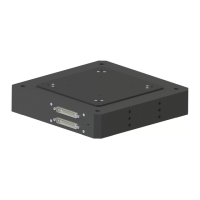

 To Next Page