12
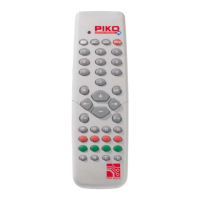
The address used as the loco address consists of the last (up to 3) digits entered provi-
ded this address is between 0 and 127. This means you can enter 8 digits if you like but
the PIKO Digi remote control only retains the last three. If an invalid address is entered
control remains with the previously selected locomotive.
Examples:
1.) input: [1] [f0]
On the loco with address 1 the lights are switched on.
2.) input: [6] [5] [4] [1] [2] [3] [+]
The loco with the address 123 increases its speed.
3.) input: [1] [2] [f0]
The loco address of the channel remains unchanged and the lights on the previously
selected loco are switched on.
Reason: in this example the loco key functions like a delete key i.e. the digits entered
are deleted when the loco key is pressed for the second time and the address enter-
ed is not valid.
If the loco address 0 is selected control is directed to a conventional loco without digital
decoder - if there is one - on the digital circuit. Thus it is possible to drive a loco
without decoder together with the locos fitted with decoders.
N.B./Warning:
If conventional locomotives without decoders are driven with the PIKO Digi 1 in digital
operation these locos make a low humming sound because the motor is continually
supplied with high frequency current.
This current can damage some engines e.g. bell-armature motors (Faulhaber, Escape etc)
and small N motors. On digital layouts these motors should always be used with a digi-
tal decoder.
3.2. Speed control
The speed of the loco is increased or decreased in steps with the keys or . If the
keys are held down the speed is altered in steps until either the key is released again,
the maximum speed is reached or the loco comes to a standstill.


 To Next Page