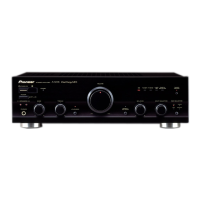
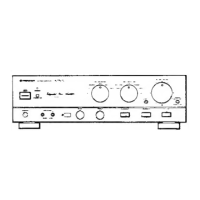
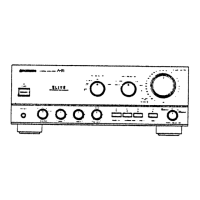
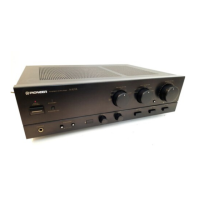
The Pioneer A-502R is a stereo amplifier designed for high-quality audio reproduction and versatile connectivity. It features a robust power output, advanced circuit designs, and remote-control capabilities, making it a central component for a home audio system.
Function Description:
The A-502R serves as the central hub for various audio components, allowing users to select different input sources, adjust volume and tone, and drive speaker systems. It supports a range of audio sources including CD players, tuners, turntables (PHONO), cassette decks (TAPE 1/DAT, TAPE 2), and other line-level devices.
A key feature is its "DIRECT" button, which bypasses all secondary circuits except for volume, ensuring the highest purity of sound by delivering a flat, uncolored audio signal. This is ideal for audiophiles seeking a faithful reproduction of the input source. When the DIRECT button is off, signals pass through various frequency adjusting circuits, allowing for tone customization.
The amplifier includes a "MUTING" function to temporarily lower the sound volume to one-hundredth (-20 dB), useful for quick interruptions. It also features "LOUDNESS" control, which boosts low and high frequencies at low volume levels to provide added punch, enhancing the listening experience when the volume is turned down.
For recording, the "REC SELECTOR" switch allows users to select the source for recording onto a cassette deck, independent of the currently selected playback source. This enables simultaneous listening to one source while recording another. Tape copying between two cassette decks (TAPE 1/DAT to TAPE 2, or TAPE 2 to TAPE 1/DAT) is also supported.
The amplifier can drive two sets of speaker systems (SPEAKERS A and SPEAKERS B), which can be selected independently or together. A PHONES jack is provided for private listening with headphones.
The A-502R incorporates a "Silent microprocessor system" where the clock stops when the computer is not in use, preventing digital noise from interfering with the audio signal. Its "Chamber construction" separates the AC power supply and audio circuits with a metal shield to reduce mains-borne noise and transformer flux leakage, further suppressing resonances and vibrations. The "AERO" Heat sink with rigid, curved fins helps suppress resonance for clear reproduction.
Important Technical Specifications:
- Power Output:
- DIN Continuous power output (both channels driven at 1 kHz): 100 W + 100 W (4 Ω, T.H.D. 1%), 70 W + 70 W (8 Ω, T.H.D. 1%).
- Continuous power output (both channels driven at 20 Hz to 20 kHz): 75 W + 75 W (4 Ω, T.H.D. 0.05%), 55 W + 55 W (8 Ω, T.H.D. 0.03%).
- Dynamic power output (on EIA dynamic test signal): 110 W/135 W (4 Ω/2 Ω).
- Total Harmonic Distortion (20 Hz to 20 kHz, 30 W, 8 Ω): 0.01%.
- Input Sensitivity/Impedance:
- PHONO (MM): 2.8 mV/50 kΩ.
- CD, TUNER, LINE, TAPE: 200 mV/50 kΩ.
- PHONO Overload Level (1 kHz, T.H.D. 0.1%): 150 mV.
- Output Level/Impedance (TAPE REC): 200 mV/1 kΩ.
- Frequency Response:
- PHONO (MM): 20 Hz to 20 kHz ±0.5 dB.
- CD, TUNER, LINE, TAPE: 5 Hz to 100 kHz, +9 dB (when DIRECT button is on).
- Tone Control (volume control set at -30 dB position):
- BASS: ±8 dB (100 Hz).
- TREBLE: ±8 dB (10 kHz).
- Loudness Contour (volume control set at -30 dB position): +6 dB (100 Hz)/+3 dB (10 kHz).
- Signal-to-Noise Ratio (IHF short circuit, A network):
- PHONO (MM, 5 mV input): 89 dB (when DIRECT button is on).
- CD, TUNER, LINE, TAPE: 107 dB (when DIRECT button is on).
- Signal-to-Noise Ratio (DIN, continuous power/50 mW):
- PHONO (MM): 72 dB/70 dB (when DIRECT button is on).
- CD, TUNER, LINE, TAPE: 95 dB/80 dB (when DIRECT button is on).
- MUTING: -20 dB.
- Power Requirements: a.c. 240 Volts, 50/60 Hz.
- Power Consumption: 500 W.
- Dimensions (W x D x H): 420 x 360 x 125 mm.
- Weight (without package): 8.4 kg.
- Speaker Impedance:
- SPEAKERS A or B only: 4 – 16 Ω.
- SPEAKERS A and B together: 8 – 32 Ω.
Usage Features:
- Remote Control: The amplifier comes with an accessory remote control unit that allows operation of the amplifier and other Pioneer components bearing the "SR" mark. This includes power ON/OFF, volume adjustment, input source selection, and control over connected cassette decks, CD players, and tuners. The remote operates within approximately 7 meters and a 30-degree angle from the unit's sensor window.
- Motorized Rotary Switches: Function controls utilize motorized rotary switches, which contribute to higher sound quality by minimizing signal degradation often associated with electronic switching.
- Adaptor Terminals: Dedicated ADAPTOR IN/OUT terminals allow for the connection of external audio processors like graphic equalizers, enabling further sound customization. Shorting bars are provided for these terminals and must be removed when an adaptor is connected and reinserted when not in use.
- Control Out Jack: This jack provides output for control signals, enabling synchronized operation with other Pioneer components featuring the "SR" mark.
- Timer Recording: The amplifier can be used with an audio timer for scheduled recordings. For this, the POWER switch must be set to the ON position (STANDBY indicator off) when making timer settings.
- Power Standby/On: The unit has a power switch that toggles between ON (fully operational) and STANDBY (main power flow cut, but a minute flow maintained for readiness). The STANDBY indicator lights when in standby mode.
Maintenance Features:
- External Surfaces: For general cleaning, a polishing cloth or dry cloth can be used to wipe off dust and dirt. For very dirty surfaces, a soft cloth dipped in a neutral cleanser diluted with water, wrung out well, should be used, followed by a dry cloth. Harsh chemicals like thinners, benzine, or insecticide sprays should be avoided as they can corrode the surfaces.
- Power Cord: The power cord should be handled by the plug, not by tugging the cord. It should not be placed under the unit or furniture, pinched, knotted, or tied with other cords. Regular checks for damage are recommended, and any damaged cord should be replaced by a PIONEER authorized service center or dealer.
- Battery Replacement: The remote control unit requires two size "AAA" batteries. When replacing, ensure correct polarity and avoid mixing new and used batteries or different types of batteries.
- Troubleshooting Guide: The manual provides a comprehensive troubleshooting section to help users diagnose and resolve common issues, such as no power, no sound, or remote control malfunction, before seeking professional service.
- Circuit Protection: The amplifier is designed to prevent damage from short circuits or electric shock, but users are warned not to allow speaker wire cores to protrude and touch other terminals or wires.
The Pioneer A-502R is designed for users who value high-fidelity audio, offering a blend of powerful performance, flexible connectivity, and user-friendly operation, all while incorporating features to ensure sound purity and system longevity.

 Need help?

 To Next Page
 General