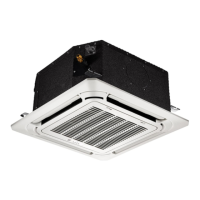
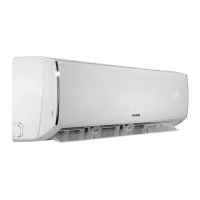
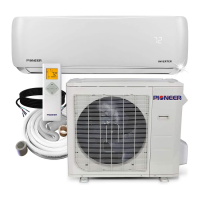
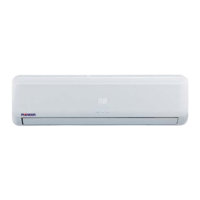
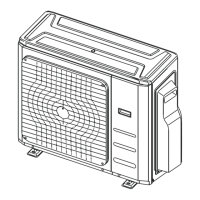
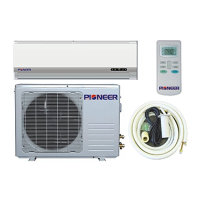
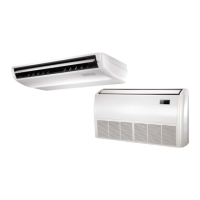
This document is an owner's manual for Pioneer Ceiling-Floor Type Ductless Split Systems, covering UB018, UB024, UB036, UB048 Indoor Units and UYB018, UYB024, UYB036, UYB048 System Sets. It provides essential information for safe and effective operation, maintenance, and troubleshooting of the air conditioner.
Function Description
The air conditioner is designed for cooling and heating (for heating-type models) or cooling only (for cooling-only type models) in residential or commercial spaces. It consists of an indoor unit, an outdoor unit, connecting pipes, and a remote controller. The system allows for adjustment of air flow direction, temperature settings, and various operational modes to achieve a comfortable environment.
The manual emphasizes critical safety precautions to prevent injury to users or others, as well as property damage. Incorrect operation due to ignorance of instructions may cause product damage or personal harm.
- Installation: The appliance must be installed in accordance with national wiring regulations by a qualified dealer to prevent water leakage, electric shock, or fire.
- Operation:
- Avoid prolonged exposure to direct airflow.
- Do not insert fingers, rods, or other objects into the air inlet or outlet, especially when the fan is rotating at high speed, to prevent injury.
- Never use flammable sprays (hair spray, lacquer, paint) near the unit as it may cause a fire.
- Do not touch the air outlet or horizontal blades while the swing flap is in operation to prevent fingers from getting caught or unit breakage.
- Do not place objects into the air inlet or outlet as they can become dangerous if they contact the high-speed fan.
- Do not inspect or service the unit yourself; always call a qualified service person.
- Do not operate the air conditioner with wet hands to avoid electric shock.
- Do not touch the heat exchanger fins as they are sharp and can cause cutting injuries.
- Do not place items susceptible to moisture damage underneath the indoor unit, as condensation may form if humidity is high, the drain outlet is blocked, or the filter is polluted.
- Ventilate the room sufficiently if any equipment with a burner is used simultaneously with the air conditioner to avoid oxygen deficiency.
- Arrange the drain hose for smooth drainage to prevent wetting of the building or furniture.
- Never touch the internal parts of the controller or remove the front panel, as some parts are dangerous and machine trouble may occur.
- Do not expose little children, plants, or animals directly to the airflow.
- Do not allow children to climb onto the outdoor unit or place objects on it, as falling or tumbling may result in injury.
- Do not operate the air conditioner when using room fumigation-type insecticide, as chemicals may deposit in the unit and endanger hypersensitive individuals.
- Do not place appliances that produce open flames in areas exposed to the unit's airflow or under the indoor unit, as it may cause incomplete combustion or unit deformation due to heat.
- Do not install the air conditioner where flammable gas may leak out, as it could cause a fire.
- The appliance is not intended for use by young children or infirm persons without supervision. Children aged 8 and above, and persons with reduced physical, sensory, or mental capabilities, or lack of experience and knowledge, can use the appliance if supervised and instructed on safe use and understanding of hazards. Children should not play with the appliance, and cleaning/maintenance should not be done by children without supervision.
- If the supply cord is damaged, it must be replaced by the manufacturer, service agent, or similarly qualified persons to avoid a hazard.
- Do not operate the air conditioner in wet rooms like bathrooms or laundry rooms.
- Electrical Safety:
- In case of electric shock, fire, or injury, or if abnormal odors are detected, turn off the power supply and call your dealer.
- Never let the indoor unit or remote controller get wet to avoid electric shock or fire.
- Ensure an earth leak detector is installed to prevent electric shock or fire.
- Ensure the air conditioner is grounded, and the earth wire is not connected to a gas or water pipe, lightning conductor, or telephone earth wire.
- Never replace a fuse with an incorrectly rated current or other wires; use of wire or copper fuses may cause unit breakdown or fire.
- Refrigerant Leak: If refrigerant leaks inside the room, contact with fire from a burner, heater, or cooker may result in harmful gas. Turn off combustible heating devices, ventilate the room, and contact the dealer. Do not use the air conditioner until a service person confirms the leak is repaired.
- Maintenance: Before cleaning, cease operation, turn off the breaker, or pull out the supply cord to prevent electrical shock and possible injury.
Important Technical Specifications
The manual outlines optimal operating temperature ranges for safe and effective performance:
- Cooling Operation:
- Outdoor Temperature: 0°C ~ 50°C (32°F ~ 122°F)
- Outdoor Temperature (low-temperature cooling models): -15°C ~ 50°C (5°F ~ 122°F)
- Room Temperature: 17°C ~ 32°C (62°F ~ 90°F)
- Heating Operation (Inverter++ Models):
- Outdoor Temperature: -25°C ~ 24°C (-12°F ~ 76°F)
- Room Temperature: 0°C ~ 30°C (32°F ~ 86°F)
- Drying Operation:
- Outdoor Temperature: 0°C ~ 50°C (32°F ~ 122°F)
- Room Temperature: 17°C ~ 32°C (62°F ~ 90°F)
Operating outside these conditions may cause the unit to function abnormally. Condensation on the unit's surface is normal with high room humidity.
Usage Features
- Temporary Operations: For fixed-frequency type units, a "TEMPORARY BUTTON" on the indoor unit's air-in grill control box allows temporary operation if the remote controller is misplaced or its batteries are exhausted. It cycles through FORCED AUTO, FORCED COOL, and OFF modes.
- FORCED AUTO: Operation lamp is lit, unit runs in FORCED AUTO mode. Remote controller operation is enabled.
- FORCED COOL: Operation lamp flashes, unit cools at HIGH wind speed for 30 minutes, then switches to FORCED AUTO. Remote controller operation is disabled.
- OFF: Operation lamp is off. Unit is OFF, remote controller operation is enabled.
- Air Flow Direction Adjustment:
- Horizontal Louver:
- Auto-swing: Press the SWING button for automatic up and down louver movement.
- Manual Swing: Adjust the louver to a desired angle for better cooling/heating effects.
- Cooling: Adjust the louver horizontally.
- Heating: Adjust the louver downwards (vertically).
- Vertical Louver:
- Auto-swing: Press the SWING H button for automatic left and right louver movement.
- Three-Minute Protection Feature: Prevents the air conditioner from activating immediately after operation (approximately 3 minutes) if restarted quickly.
- Power Failure: If power fails during operation, the unit stops. The OPERATION lamp on the indoor unit flashes when power is restored. To restart, press the ON/OFF button on the remote controller. If lightning or wireless telephones cause malfunction, disconnect and reconnect power, then restart with the remote controller.
- Refrigerant Leakage Detection (optional): The display area will show 'EC' (if applicable), and LED indication lamps will flash when the outdoor unit detects a refrigerant leak.
- Louver Angle Memory Function (optional): For some models, the unit remembers the previous horizontal louver angle after a power failure or ON/OFF button press. It restarts with that angle. It is recommended not to set the angle too small to prevent condensed water from dripping. Pressing the manual control button restores the standard angle.
Maintenance Features
- General Cleaning:
- Use a dry cloth to wipe the indoor unit and remote controller.
- A wet cloth can be used for very dirty indoor units.
- Do not use a damp cloth on the remote controller.
- Avoid chemically-treated dusters, benzene, paint thinner, polishing powder, or similar solvents, as they may damage or fade the unit's surface.
- Do not dry the air filter under direct sunshine.
- Maintenance After a Long Break Period (e.g., beginning of season):
- Check and remove any obstructions from indoor and outdoor unit inlet and outlet vents.
- Clean air filters and indoor unit casings (refer to "Cleaning the Air Filter" section).
- Turn on power at least 12 hours before operating for smoother operation.
- Maintenance Before a Long Stop Period (e.g., end of season):
- Run indoor units in fan-only operation for about half a day to dry the interior.
- Clean air filters and indoor unit casings.
- Cleaning the Air Filter:
- The air filter prevents dust and particles from entering the unit. A blocked filter reduces efficiency.
- Clean the filter every two weeks during long-term usage.
- Clean more frequently if the air conditioner is in a dusty place.
- If accumulated dust is too heavy, replace the filter (optional fitting).
- All filter cleaning should be performed by a suitable handyperson.
- For 3.2-10.5KW models: Open the air intake with a screwdriver, remove the filter, clean with water or a vacuum cleaner, dry in a cool place, then reinstall.
- For 14-16KW models: Directly pull out the air filter from the air inlet, clean with water or a vacuum cleaner, dry in a cool place, then reinstall.
- The air-in side should face up when using a vacuum cleaner and face down when using water.
Hints for Economical Operation
- Adjust airflow direction to avoid direct drafts.
- Set room temperature properly for comfort and to avoid supercooling/superheating.
- Close curtains during cooling to avoid direct sunlight.
- Keep doors and windows closed to retain cool/warm air.
- Set the timer for desired operating time.
- Avoid obstructions near air outlets or inlets to prevent lowered efficiency or sudden stops.
- If not using for a long time, disconnect power and remove remote controller batteries. Reconnect power 12 hours before restarting for smooth operation.
- Clean clogged air filters every two weeks to maintain efficiency.
Troubleshooting
The manual provides a table of symptoms, causes, and solutions for common issues, including:
- Unit does not start: Power failure, power switch off, blown fuse, exhausted remote controller batteries.
- Air flowing normally but not cooling completely: Incorrect temperature setting, 3-minute compressor protection.
- Units start or stop frequently: Low/excessive refrigerant, air/non-condensable gas in circuit, compressor malfunction, high/low voltage, blocked system circuit.
- Insufficient cooling results: Dirty heat exchanger/air filter, blocked inlet/outlet, open doors/windows, direct sunlight, too many heat sources, high outdoor temperature, refrigerant leakage/lack.
- Low heating effect: Outdoor temperature below 7°C, open doors/windows, refrigerant leakage/lack.
- System switches to Fan Mode during Cooling Mode: To prevent evaporator frosting or when room temperature drops to set point.
- White mist comes out of a Unit: High humidity during cooling with dirty indoor unit, or moisture from defrosting during heating.
- Noise of Air Conditioners cooling: Continuous low hissing (cooling/stop, drain pump), "pss-pss" squeaking (heating stop, plastic part expansion/contraction), continuous low hissing (refrigerant gas flow), hissing (refrigerant flow stoppage/change), changing operating noise tone (frequency change).
- Dust comes out of the Unit: Unit used after a long time, dust inside.
- Unit gives off strange odors: Unit absorbs room/furniture/cigarette smells.
- Outdoor Unit fan does not spin: Fan speed controlled to optimize operation.
Malfunctions of the Air Conditioner (Error Codes)
The manual includes a table (Table 8-1) listing various malfunctions, their display codes (nixie tube), timer lamp status, and running lamp flash frequency (flashes per second). Examples include:
- E0: Indoor EEPROM error
- E1: Communication malfunction between indoor and outdoor units
- E3: Indoor fan speed malfunction
- EC: Refrigerant leakage detection malfunction
- F0: Current overload protection
- P0: Inverter module IPM protection
- P1: High/Low voltage protection
- P5: Mode conflict
Malfunctions of Remote Controller
A table (Table 8-3) addresses remote controller issues:
- Fan speed cannot be changed: MODE is "AUTO" or "DRY".
- Remote controller signal not transmitted: Batteries exhausted.
- TEMP. indicator does not come on: MODE is "FAN ONLY".
- Display indication disappears after time lapse: Timer operation ended.
- TIMER ON indicator goes off after time lapse: Timer operation started.
- No receiving tone from indoor unit: Signal transmitter not properly directed to infrared receiver.


 To Next Page
 General