EasyManua.ls Logo

Piper cherokee WARRIOR - OPERATING TIPS AND ADVICE; Takeoff, Landing, System, and Fuel Tips

Piper cherokee WARRIOR
98 pages
Print Icon
To Next Page IconTo Next Page
To Previous Page IconTo Previous Page
Loading...
CHEROKEE
WARRIOR
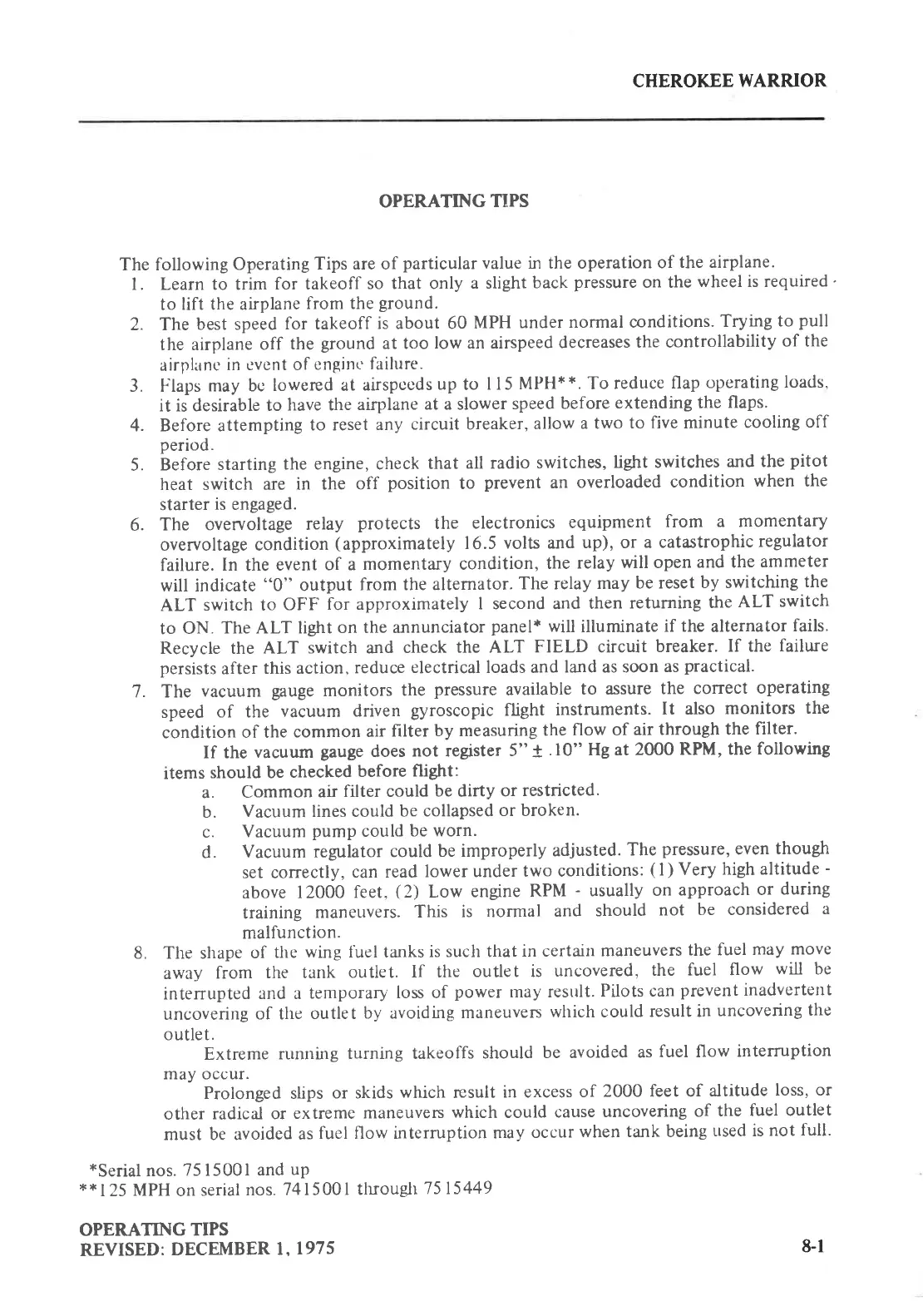
OPERATING
TIPS
The following
Operating
Tips are of
particular
value in the operation
of
the airplane.
l. Learn to trim
for takeoff
so that only
a slight
back
pressure
on the
wheel is required
'
to
lift the airplane
from the
ground.
2. The
best speed
for takeoff
is about 60
MPH
under
normal conditions.
Trying
to
pull
the airplane
off
the
ground
at too
low an airspeed
decreases
the controllability
of the
airplanc
in cvcnt of
enginc
failure.
3. t laps
may bg
lowered at
airspccds
up
to
I l5
MPH**. To
reduce
flap
operating
loads,
it is desirable
to
have the
airplane
at a slower
speed
before
extending
the
flaps.
4. Before attempting
to reset
any
circuit breaker,
allow
a two
to
five
minute
cooling
off
period.
5.
Before
starting
the engine, check
that
all radio
switches,
light switches
and the
pitot
heat switch
are in the
off
position
to
prevent
an
overloaded
condition
when the
starter
is
engaged.
6.
The
overuoltage
relay
protects
the
electronics
equipment
from
a momentary
overvoltage condition
(approximately
16.5
volts and
up), or a catastrophic
regulator
failure.
In
the
event
of a
momentary condition,
the
relay
will open
and the
ammeter
will indicate
"0"
output
from the alternator.
The relay
may
be reset
by switching
the
ALT
switch to
OFF
for approximately
I second and
then
returning
the
ALT
switch
to
ON.
The ALT light
on the annunciator
panel*
will
illuminate
if the
alternator
fails.
Recycle the
ALT switch and
check
the ALT
FIELD circuit
breaker.
If the
failure
persists
after
this action,
reduce
electrical loads and
land as soon
as
practical.
7
.
The
vacuum
gauge
monitors
the
pressure
available
to assure
the
correct
operating
speed
of the
vacuum
driven
gyroscopic
flight
instruments.
It also
monitors
the
condition
of the
common
air
filter
by measuring
the
flow of
air through
the
filter.
If the
vacuum
gauge
does
not register
5"
t
.10" Hg at
2000 RPM,
the
following
items
should be
checked
before
flight:
a.
Common
air
filter could
be dirty
or
restricted.
b.
Vacuum lines could
be collapsed
or broken.
c.
Vacuum
pump
could
be worn.
d.
Vacuum regulator
could
be improperly
adjusted.
The
pressure,
even
though
set correctly,
can read
lower under
two conditions:
(
I
)
Very
high altitude
-
above
12000
feet,
(2)
Low
engine
RPM
-
usually
on
approach
or
during
training
maneLlvers.
This
is normal
and
should
not
be considered
a
malfunction.
8. The shape
of
the
wing fuel tanks
is such that
in certain
maneuvers
the fuel
may
move
away
from
the tank
outlet.
lf the
outlet is
uncovered,
the fuel
flow
will be
interrupted
and a
temporary
loss of
power
may result.
Pilots can
prevent
inadvertent
uncovering
of the
outlet
by avoiding
maneuven
which could
result in
uncovering
the
outlet.
Extreme
mnning
turning takeoffs
should
be avoided
as
fuel flow
intemrption
may occur.
Prolonged slips
or skids
which
result
in excess
of
2000 feet of
altitude
loss, or
other
radical or
extreme
maneuvers
which
could
cause
uncovering
of
the
fuel outlet
must be avoided
as
fuel flow interruption
may
occur
when tank being
used is
not
full.
*Serial
nos.
75 15001
and
up
x*125
MPH
on
serial
nos.
7415001
tluough
7515449
OPERATING
TIPS
REVISED:
DECEMBER
l,
1975
8-l

Related product manuals