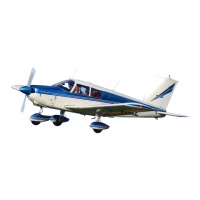
CHEROKEE WARRIOR
TAKEOFF
Just before
takeoff the following
items
should be
checked:
l. Fuel
-
on
proper
tank
2.
Electric
fuel
pump
-
on
3.
Engine
gauges
-
checked
4.
Flaps
-
set
5. Carburetor heat
-
off
6.
Mixture
-
set
7.
Seat backs
-
erect
8. Safety belts/harness
-
fastened
9. Trim
tab
-
set
10. Controls
-
free
I l. Door
-
latched
The takeoff technique
is
conventional. The trim tab should
be
set
slightly
aft of neutral
with the exact setting determined
by
the
loading of the
airplane. Allow
the airplane
to
accelerate
to 50 to
60
miles
per
hour,
then ease back
on the
wheel enough to let
the airplane
fly
itself
from the
ground.
Premature raising of the
nose
or raising
it to an
excessive angle
will result
in a
delayed takeoff. After takeoff,
let the airplane accelerate
to the desired climb
speed
by
lowering
the nose slightly.
Takeoffs are
normally
made
with
flaps up; however,
for short field
takeoffs
and for
takeoffs
under
difficult conditions
such as deep
grass
or a soft
surface,
distances can be reduced
appreciably
by lowering the flaps to 25
o
and rotating at lower airspeeds.
Short
Field, Obstacle Clearance:
Lower the flaps to 25
o.
Apply
full
power
before brake
release.
Accelerate to 66
MPH CAS
and
rotate, maintaining 66 MPH
CAS
until obstacle clearance
has
been
attained.
After the
obstacle has been cleared
accelerate to 87 miles
per
hour
and
then
slowly retract
the flaps.
Short
Field, No Obstacle:
Use of
partial
flaps does
not
decrease
minimum
ground
roll, therefore,
leave the
tlaps up or
lower the flaps to
25o as
desired. Apply
full
power
before
brake
release. Accelerate
to 65
MPH
CAS
with flaps
up
or
52
MPH
CAS
with
flaps
at 25'
and rotate.
After
breaking
ground,
accelerate
to best
rate
of
climb speed of
87
MPH CAS. Slowly
retract the flaps
while climbing
out.
Soft
Field,
Obstacle Clearance:
Lower the
flaps to 25". Accelerate airplane, lift nose
gear
off as soon as
possible,
and
lift
off at lowest
possible
airspeed. Accelerate
just
above
the
ground
to 66 MPH
CAS
to
climb
past
obstacle clearance
height.
Continue climbing
while accelerating to
the best
rate of climb speed,
87 miles
per
hour, and slowly retract the flaps.
Soft
Field, No Obstacle:
Lower
the flaps to 25'.
Accelerate
the
airplane
and
lift the nose
gear
off
as soon as
possible,
then lift off at the lowest
possible
airspeed.
Accelerate
just
above the
ground
to the
best
rate of climb speed, 87
miles
per
hour. Climb out
while
slowly
retracting the
flaps.
OPERATING
INSTRUCTIONS
REVISED:
APRIL
16.1976
NOTE
Mixture
full rich except a minimum
amount of leaning is
permitted
for
smooth engine
operation
when taking off
at high
elevation.
7-5



 To Next Page