EasyManua.ls Logo

Piper cherokee WARRIOR - BRAKE AND LANDING GEAR SERVICE; Brake Service and Fluid Checks; Landing Gear Strut Service

Piper cherokee WARRIOR
98 pages
Print Icon
To Next Page IconTo Next Page
To Previous Page IconTo Previous Page
Loading...
CHEROKEE
WARRIOR
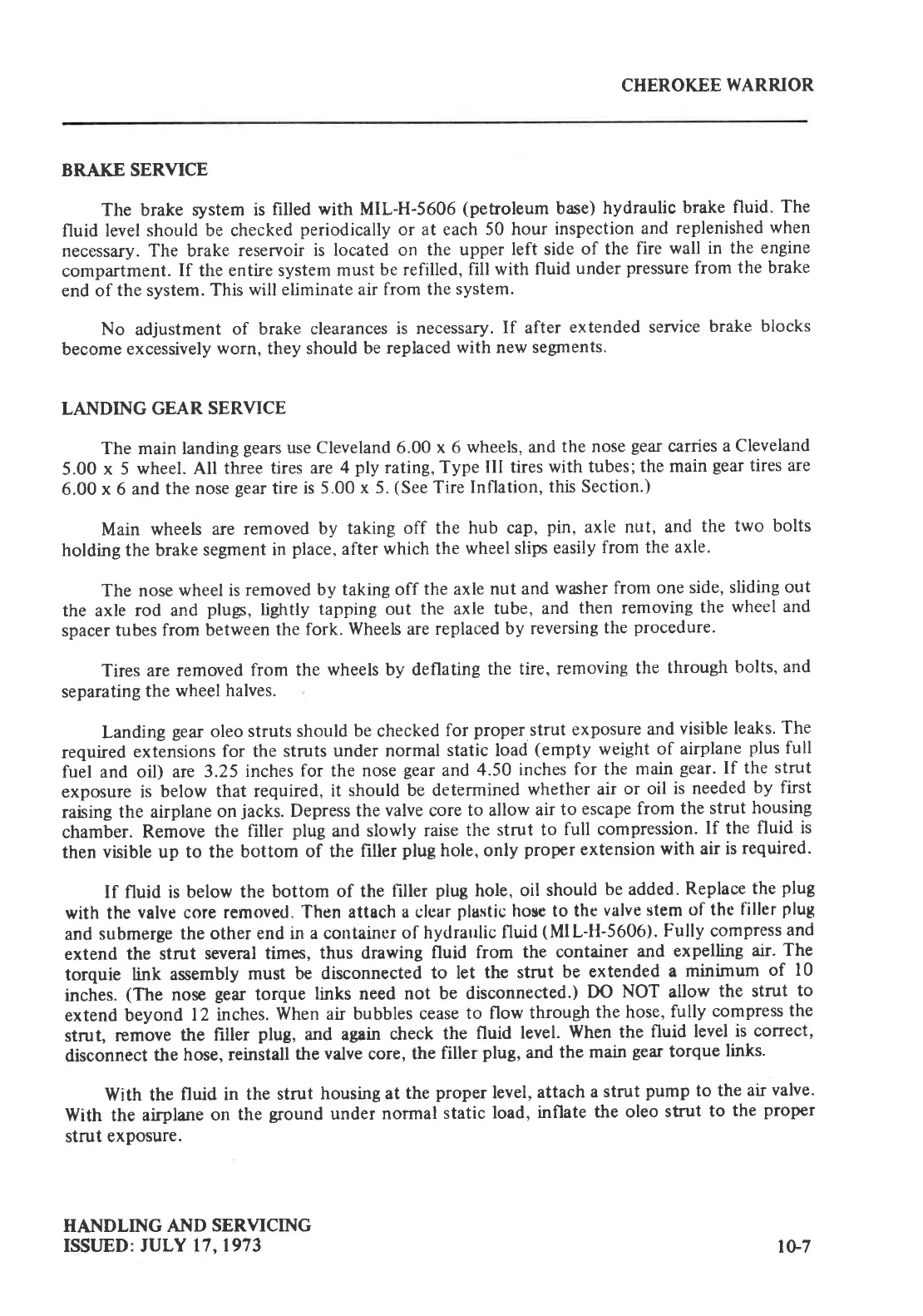
BRAKE SERVICE
The brake system
is filled
with MIL-H-5606
(peholeum
base)
hydraulic
brake
fluid.
The
fluid level
should be checked
periodically
or at each
50 hour
inspection
and
replenished
when
necessary. The brake
reservoir
is located on
the upper
left side
of the
fire
wall in the engine
compartment.
If
the
entire system
must be
refilled,
fill with
fluid
under
pressure
from
the brake
end of
the system.
This
will eliminate air
from the system.
No
adjustment
of brake
clearances
is necessary.
If
after
extended service
brake blocks
become
excessively
worn,
they
should be
replaced
with new segments.
LANDING
GEAR
SERVICE
The main landing
gears
use Cleveland 6.00
x 6
wheels, and
the nose
gear
carries
a Cleveland
5.00
x 5 wheel.
All three
tires are
4
ply
rating,
Type
III tires with
tubes;
the main
gear
tires are
6.00 x 6
and the
nose
gear
tire
is 5.00
x 5.
(See
Tire Inflation,
this Section.)
Main wheels
are removed
by
taking off
the hub cap,
pin,
axle
nut, and
the two
bolts
holding the brake
segment
in
place,
after
which the
wheel
slips
easily
from the axle.
The nose
wheel is
removed
by taking off
the axle
nut and
washer
from one side,
sliding
out
the axle
rod and
plugs,
lightly
tapping out
the axle
tube, and
then removing
the
wheel and
spacer tubes
from
between
the fork.
Wheels
are
replaced
by reversing
the
procedure.
Tires
are removed
from the
wheels by deflating
the tire,
removing
the
through
bolts, and
separating
the
wheel
halves.
Landing
gear
oleo
struts should
be checked
for
proper
strut
exposure
and
visible leaks.
The
required
extensions
for the
struts under
normal
static load
(empty
weight of
airplane
plus
full
fuel and
oil) are
3.25
inches
for the nose
gear
and
4.50
inches
for the
main
gear.
If the
strut
exposure
is
below that
required,
it
should be determined
whether
air
or oil
is needed
by first
raising
the airplane
on
jacks.
Depress the
valve core
to allow
air
to
escape
from the
strut
housing
chamber.
Remove
the filler
plug
and slowly
raise
the
strut to
full compression.
If the
fluid is
then
visible up to
the bottom
of the
filler
plug
hole, only
proper
extension
with air
is
required.
If fluid is
below the bottom
of the filler
plug
hole,
oil
should
be added.
Replace
the
plug
with the
valve
core
removed.
Then attach a clcar
plastic
hose to the
valve stem
of the
filler
plug
and
submerge
the other end
in a container
of hydraulic
fluid
(MlL-H-5606).
Fully compress
and
extend
the strut
several
times,
thus drawing
fluid from
the container
and
expelling
air.
The
torquie
link assembly
must be disconnected
to let
the strut
be
extended
a
minimum
of
l0
inches.
(The
nose
gear
torque
links
need
not be
disconnected.)
DO
NOT
allow
the strut
to
extend
beyond
l2 inches.
When air bubbles
cease
to flow
through
the hose,
fully
compress
the
strut,
remove
the
f,rller
plug,
and again
check
the
fluid
level.
When the
fluid level
is
correct,
disconnect
the
hose, reinstall
the
valve
core,
the
filler
plug,
and
the
main
gear
torque
links-
With
the
fluid in the
strut
housing at
the
proper
level,
attach
a
strut
pump
to the
air
valve.
With the
airplane
on
the
ground
under
normal
static
load,
inflate
the oleo
strut
to
the
proper
strut
exposure.
HANDLING AND
SERVICING
ISSLJED: JULY
17,1973
to-7

Related product manuals