EasyManua.ls Logo

Piper COMANCHE 260 - Approach and Landing Procedures

Piper COMANCHE 260
68 pages
Print Icon
To Next Page IconTo Next Page
To Previous Page IconTo Previous Page
Loading...
THE
PIPER
COMANCHE
SECTION
III
shown
on
the
fuel
flow
meter,
indicates
best
economy
for
that
percent
of
power
while
the
high
side
indicates
best
power.
During
climbing
operation
the
servo
regulator
will
sense
the
change
in
altitude
and
will
automatically
lean
the
mixture.
For
better
economy
manual
leaning
with
the
mixture
control
can
also
be
accomplished
if
desired.
Use
of
the
mixture
control
in
cruising
flight
reduces
fuel
consumption
significantly,
especially
at
higher
altitudes.
The
mixture
should
always
be
leaned
duringcruising
operationover
5000
feet
altitude,
and
normally
also
at
lower
altitudes
at
the
pilot's
discretion.
The
continuous
use
of
carburetor
heatduringcruising
flight
reduces
power
and
performance.
Unless
icingconditions
in
the
carburetor
are
severe,
do
not
cruise
with
the
heat
on.
Apply
heat
slowly
and
only
for
a
few
seconds
at
intervals
determined
by
icing
severity.
In
order
to
keep
the
airplane
in
best
lateral
trim
during
cruising,
the
fuel
should
be
used
alternately
from
each
tank.
If
auxiliary
tanks
are
installed,
it
is
suggested
that
the
fuel
in
the
two
auxiliary
tanks
be
used
first.
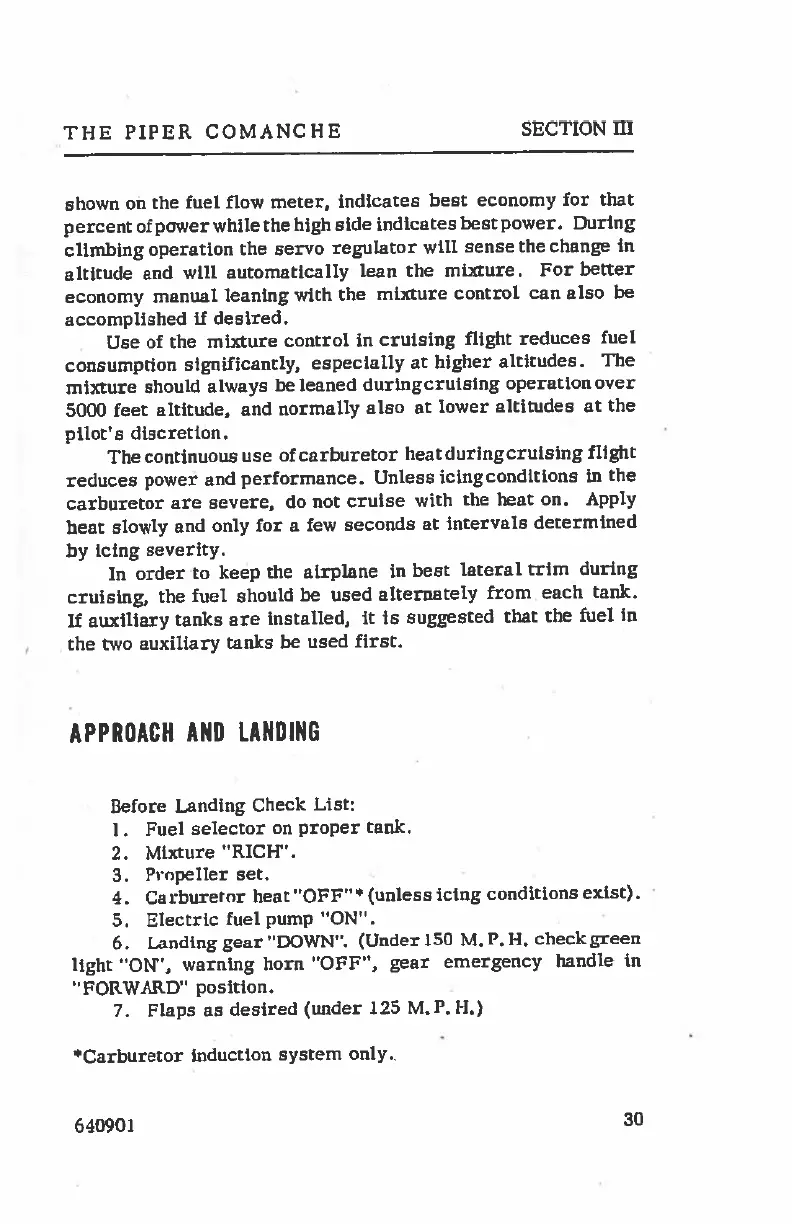
APPROACH
AND
LANDING
Before
Landing
Check
List:
Fuel
selector
on
proper
tank.
Mixture
"RICH".
Propeller
set.
.
Carburetor
heat"OFF"*
(unless
icing
conditions
exist).
.
Electric
fuel
pump
“ON".
Landing
gear
"DOWN".
(Under
150
M,
P,
H,
check
green
light
"ON"
warning
horn
"OFF",
gear
emergency
handle
in
"FORWARD"
position.
7.
Flaps
as
desired
(under
125
M,
P,
H.)
O\Ulith—'
*Carburetor
induction
system
only..
640901
30

Related product manuals