6
SETUP INSTRUCTIONS
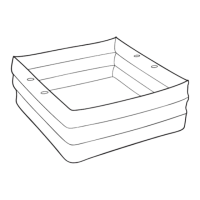
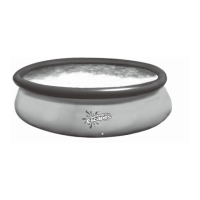
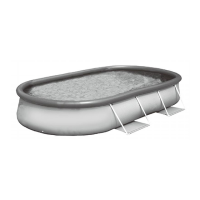
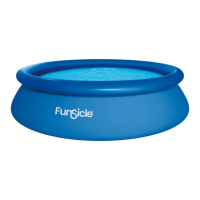
Before assembling your product, please take a few minutes to check the contents and become familiar with all the parts.
Site Preparation
• Select a level area, and completely remove all debris, twigs, stones, etc. DO NOT select an area under overhead electrical lines, trees, or within 15 feet of a house,
building, etc.
• The pool shall be located a minimum distance of 6ft (1.83m) from any electrical receptacle.
• All 125 volt, 15 and 20 ampere receptacles located within 20ft (6.0m) of the pool shall be protected by a ground fault circuit interrupter (GFCI).
The 20ft (6m) distance is measured via the shortest straight line distance the supply cord would follow without piercing a floor, wall, ceiling, doorway, window, or
other permanent barrier.
• Contact your local utilities, checking that no underground cables, telephone lines, gas lines, etc. run beneath the area you have selected.
WARNING - DO NOT overfill the pool and / or allow people to lay over or sit on pool wall - DOING SO CAN CAUSE PERMANENT INJURY!
DRAIN pool to the proper level after a heavy rain. The Maximum Water Level FILL LINE is printed on the pool liner.
TIP: It will be much easier to install your pool if you unfold it and let it lay in direct sunlight for about 2 hours prior to installation. This will help to ensure a
wrinkle-free fit because the pool material will be more pliable allowing it to form into shape during installation.
WARNING - IMPORTANT! SITE MUST BE LEVEL, STABLE, COMPACTED SOIL.
• The pool must be assembled on a smooth and level site of firm soil that is free of stones, gravel, sticks, blacktop, or other oil base compounds.
• Before setting up your pool, it is recommended that you clear the area of hardy grasses. Certain types of vigorous grasses such as St. Augustine and
Bermuda can grow through the liner. A ground cloth or tarp may be helpful in preventing this from occurring. Grass growing through the liner is not covered
under warranty.
• Do not install pool on a wooden deck or any type of wooden surface. You cannot use sand and/or uncompacted soil to provide a level surface for this pool;
it will only wash out.
• FAILURE TO FOLLOW ALL OF THESE INSTRUCTIONS WILL CAUSE POOL TO COLLAPSE AND WILL VOID THE WARRANTY!
EN
OWNER′S MANUAL
Safety Education Programs and Materials
Educational programs and materials (i.e., seminars, workshops, brochures, videos, instructional guides) are available from the APSP, other aquatic safety groups,
and by private firms. As a means of communicating useful safety information to pool owners/operators and users, industry members are permitted to provide such
information to owners/operators and to request or require owners/operators to sign a statement that they have received, read, and will follow the guidelines.
Other sources of safety information:
• www.cdc.gov
• www.cpsc.gov
• www.drowningpreventionalliance.com
• www.nspf.org
• www.safekids.org
NSF NSF International
P.O. Box 130140
789 N. Dixboro Road
Ann Arbor MI 481105
Contact: 800-673-6275 or 734-769-8010
www.nsf.org
ANSI American National Standards Institute
25 West 43rd Street, New York NY 10036
Contact: 212-642-4900
www.ansi.org
ASTM ASTM International (formerly American Society of Testing & Materials)
100 Barr Harbor Drive, P.O. Box C700 West Conshohocken, PA 19428-2959
Contact: 877-909-2786 (USA & CANADA) or 610-832-9585 (International)
www.astm.org
Filtration Systems
Any equipment connected to the circulation systems shall be positioned so as to prevent their being used as a means of access to the pool by young children. (See
the latest published edition of ANSI/APSP-8 Model Barrier Code for Residential Swimming Pools, Spas, and Hot Tubs.)
Barrier
Barrier is necessary to provide protection against potential drowning and near drowning, and barriers are not a substitute for the constant supervision of children.
(See latest published edition of ANSI/APSP-8 Model Barrier Code for Residential Swimming Pools, Spas, and Hot Tubs.)
Risk of Drowning, Entrapment, and Diving Accidents
Publications are available that describe the risk of drowning, entrapment, and diving accidents. Available publications related to pool safety include the
Association of Pool and Spa Professionals’ (APSP) booklets entitled: The Sensible Way to Enjoy Your Above-ground/On-ground Swimming Pool, Children
Aren’t Waterproof, Pool and Spa Emergency Procedures for Infants and Children, Layers of Protection, and the latest published edition of ANSI/APSP-8
Model Barrier Code for Residential Swimming Pools, Spas, and Hot Tubs.
Installer Responsibilities
All of these components shall be positioned so as to prevent their being used as a means of access to the pool by young children. All safety signs shall be affixed
above the water line according to manufacturer's instructions. (See the latest published edition of ANSI/APSP-8 Model Barrier Code for Residential Swimming Pools,
Spas, and Hot Tubs.)
APSP Association of Pool & Spa Professionals
(formerly National Spa and Pool Institute)
2111 Eisenhower Avenue, Ste. 500
Alexandria VA 22314-4679
Contact: 703-838-0083
www.apsp.org
NEC National Electrical Code (see NFPA)
NFPA National Fire Protection Association
1 Batterymarch Park, Quincy MA 02169-7471
Contact: 800-344-3555 (U.S. & CANADA) or 617-770-3000 (International)
www.nfpa.org
NSPI National Spa and Pool Institute (see APSP)
UL Underwriters Laboratories
333 Pfingsten Road, Northbrook IL 60062-2096
Contact: 877-854-3577 or 847-272-8800
www.ul.com
ASME American Society of Mechanical Engineers
Two Park Avenue, New York NY 10016-5990
Contact: 800-843-2763 (U.S. & CANADA) or 973-882-1170 (Outside N. America)
www.asme.org


 To Next Page
 Loading...