13
The speed and depth of cut will depend
largely on the type of material being
worked upon. Keep the cutting pressure
constant but do not crowd the router so
the motor speed slows excessively. It
may be necessary on exceptionally hard
woods or problem materials to make
more than one pass at various settings to
get the desired depth of cut.
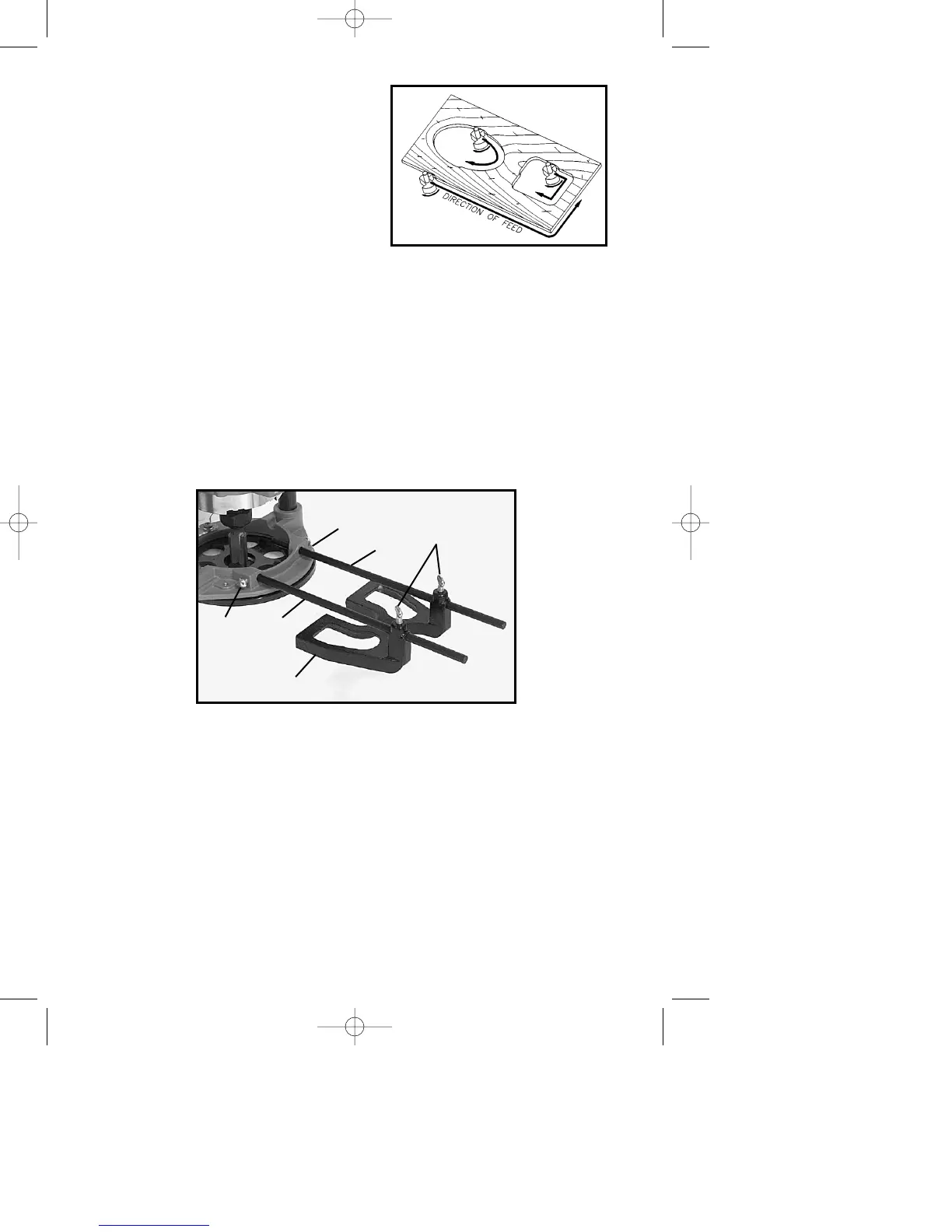
When making cuts on all four edges of
the workpiece, it is advisable to have the
first cut on the end of the piece across the grain. Thus, if chipping of wood
occurs at the end of a cut, it will be removed when making the next cut
parallel with the grain.
Periodically wipe columns clean with a dry cloth. DO NOT lubricate columns.
THE EDGE GUIDE
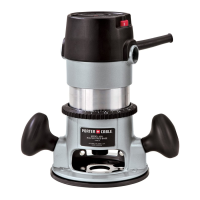
An edge guide is available as an accessory to aid in routing operations such
as: straight edge planing, parallel grooving, dado or slotting operations.
To assemble, insert guide rods (A) in holes in base, Fig. 18, and secure with
screws (B). The guide (C) is adjusted on the rods and secured in desired
position with thumb screws (D).
TEMPLET GUIDES
A wide variety of templet guides are available for use in pattern and templet
routing operations, Fig. 19 shows a typical combination bit, templet guide,
and locknut.
CAUTION: DISCONNECT TOOL FROM POWER SOURCE.
To install, insert templet guide in center hole in router base and secure in
place with the locknut.
BEFORE CONNECTING ROUTER TO POWER SOURCE. Install bit, adjust
depth of cut, and rotate router chuck by hand to be sure bit or collet do not
contact templet guide.
Fig. 17
Fig. 18
B
B
A
A
C
D



 To Next Page