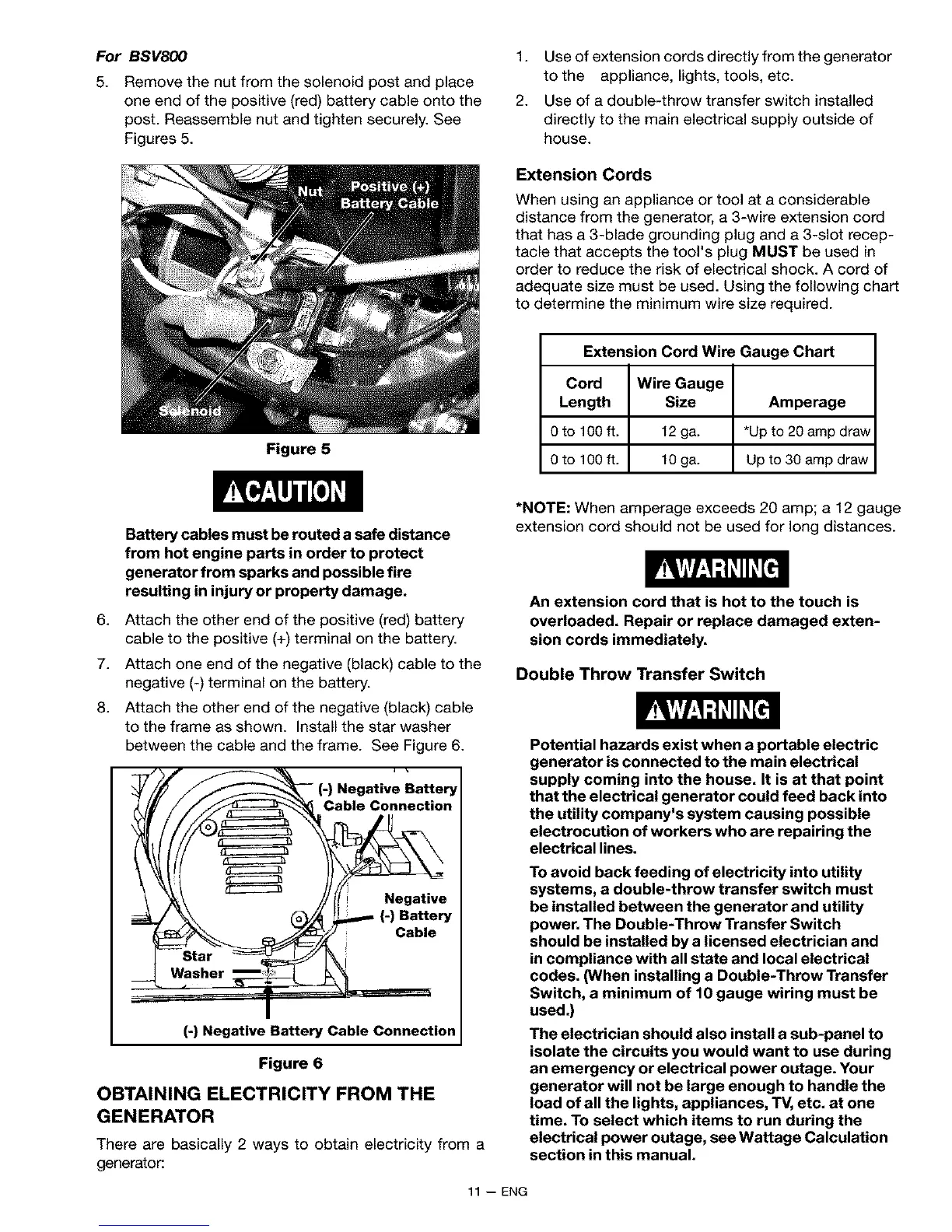
For BSV800
.
Remove the nut from the solenoid post and place
one end of the positive (red) battery cable onto the
post. Reassemble nut and tighten securely. See
Figures 5.
Figure 5
1. Use of extension cords directly from the generator
to the appliance, lights, tools, etc.
2. Use of a double-throw transfer switch installed
directly to the main electrical supply outside of
house.
Extension Cords
When using an appliance or tool at a considerable
distance from the generator, a 3-wire extension cord
that has a 3-blade grounding plug and a 3-slot recep-
tacle that accepts the tool's plug MUST be used in
order to reduce the risk of electrical shock. A cord of
adequate size must be used. Using the following chart
to determine the minimum wire size required.
Extension Cord Wire Gauge Chart
Cord Wire Gauge
Length Size Amperage
0to 100 ft. 12ga. *Up to 20 amp draw
0 to 100 ft. 10 ga. Up to 30 amp draw
Battery cables must be routed a safe distance
from hot engine parts in order to protect
generator from sparks and possible fire
resulting in injury or property damage.
6. Attach the other end of the positive (red) battery
cable to the positive (+) terminal on the battery.
7. Attach one end of the negative (black) cable to the
negative (-) terminal on the battery.
8. Attach the other end of the negative (black) cable
to the frame as shown. Install the star washer
between the cable and the frame. See Figure 6.
(-) Negative Battery
Cable Connection
Negative
Cable
(-) Negative Battery Cable Connection
Figure 6
OBTAINING ELECTRICITY FROM THE
GENERATOR
There are basically 2 ways to obtain electricity from a
generator:
*NOTE: When amperage exceeds 20 amp; a 12 gauge
extension cord should not be used for long distances.
An extension cord that is hot to the touch is
overloaded. Repair or replace damaged exten-
sion cords immediately.
Double Throw Transfer Switch
Potential hazards exist when a portable electric
generator is connected to the main electrical
supply coming into the house. It is at that point
that the electrical generator could feed back into
the utility company's system causing possible
electrocution of workers who are repairing the
electrical lines.
To avoid back feeding of electricity into utility
systems, a double-throw transfer switch must
be installed between the generator and utility
power. The Double-Throw Transfer Switch
should be installed by a licensed electrician and
in compliance with all state and local electrical
codes. (When installing a Double-Throw Transfer
Switch, a minimum of 10 gauge wiring must be
used.)
The electrician should also install a sub-panel to
isolate the circuits you would want to use during
an emergency or electrical power outage. Your
generator will not be large enough to handle the
load of all the lights, appliances, TV, etc. at one
time. To select which items to run during the
electrical power outage, see Wattage Calculation
section in this manual.
11 -- ENG



 To Next Page