materials such as keys, coins, hand tools
and the like. The US Department of
Transportation Hazardous Material
Regulations (HMR) actually prohibit
transporting batteries in commerce or on
airplanes (i.e., packed in suitcases and carry-
on luggage) UNLESS they are properly
protected from short circuits. So when
transporting individual batteries, make sure
that the battery terminals are protected and
well insulated from materials that could
contact them and cause a short circuit.
NOTE: Lithium-Ion batteries should not be
put in checked baggage.
Storage
RECOMMENDATIONS
The best storage place is one that is
cool and dry away from direct sunlight and
excess heat or cold.
2. Long storage will not harm the battery
pack or charger.
IMPORTANT CHARGING NOTES
be obtained if the battery pack is charged
battery pack in an air temperature below
This is important and will prevent serious
damage to the battery pack.
2. The charger and battery pack may become
warm to touch while charging. This is a normal
condition, and does not indicate a problem. To
facilitate the cooling of the battery pack after
use, avoid placing the charger or battery pack
in a warm environment such as in a metal
shed, or an uninsulated trailer.
3.
If the battery pack does not charge properly:
plugging in a lamp or other appliance.
connected to a light switch which turns
power off when you turn out the lights.
c. Move charger and battery pack to a
location where the surrounding air
d. If charging problems persist, take the
tool, battery pack and charger to your
local service center.
4. The battery pack should be recharged
when it fails to produce sufficient power on
jobs which were easily done previously.
DO NOT CONTINUE to use under these
conditions. Follow the charging procedure.
You may also charge a partially used pack
whenever you desire with no adverse
affect on the battery pack.
such as, but not limited to, steel wool, aluminum
foil, or any buildup of metallic particles should
be kept away from charger cavities. Always
unplug the charger from the power supply when
there is no battery pack in the cavity. Unplug
charger before attempting to clean.
water or any other liquid.
WARNING: Shock hazard. Do not
allow any liquid to get inside charger.Never
attempt to open the battery pack for any
reason. If the plastic housing of the
battery pack breaks or cracks, return to
a service center for recycling.
CHARGING PROCEDURE
PORTER-CABLE chargers are designed
to charge PORTER-CABLE battery packs.
Charge times are: PCC690L and PCC692L
in 35-100 mins., PCC691L in 65-200 mins.,
and PCC695L in 160-300 mins. depending
on the pack being charged.
outlet before inserting the battery pack.
2. Insert the battery pack into the charger.
3. The LED will flash indicating that
the battery is being charged.
4. The completion of charge is indicated
by the LED remaining on continuously.
The pack is fully charged and may be used at
this time or left on the charger.
Recharge discharged batteries as soon
as possible after use or battery life
may be greatly diminished. For longest
battery life, do not discharge batteries
fully. It is recommended that the batteries
be recharged after each use.
CHARGER DIAGNOSTICS
This charger is designed to detect certain
problems that can arise with the battery packs
or the power source. Problems are indicated
by one LED flashing in different patterns.
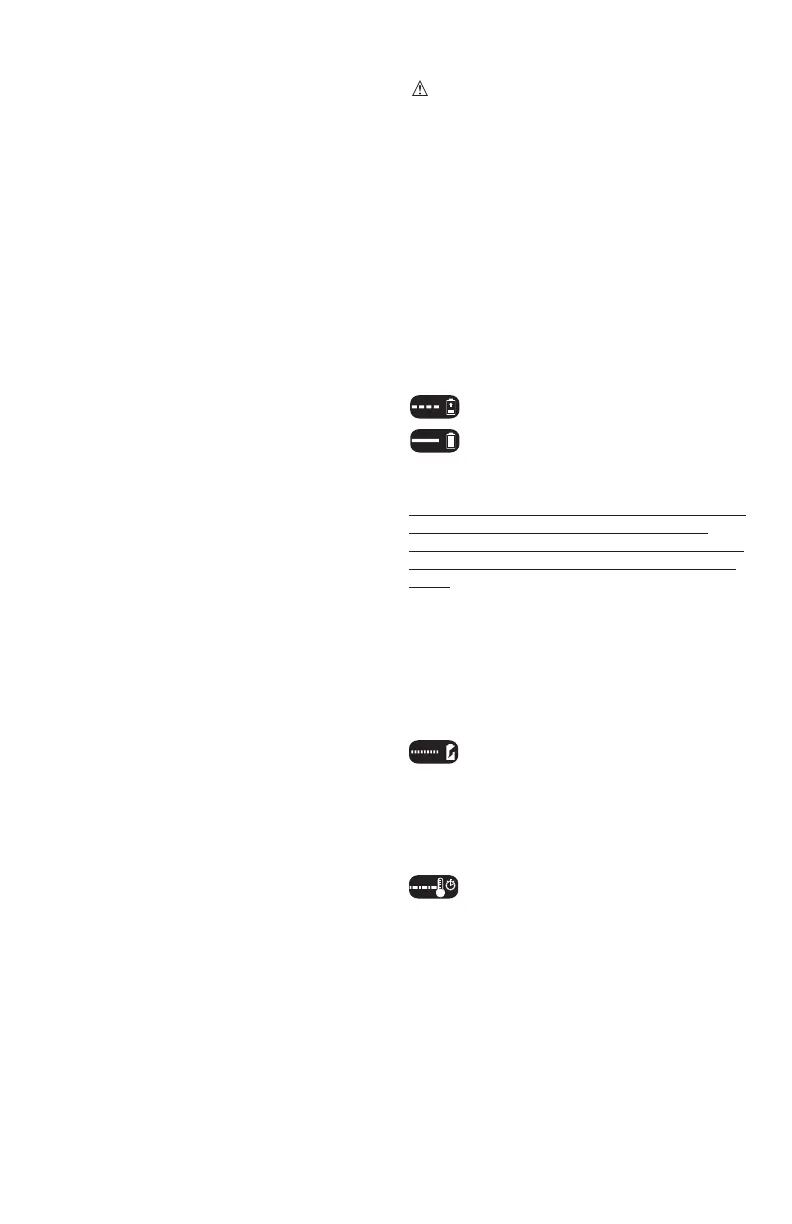
BAD BATTERY
The charger can detect a weak or
damaged battery. The LED flashes in
the pattern indicated on the label. If you see
this bad battery blink pattern, do not continue
to charge the battery. Return it to a service
center or a collection site for recycling.
HOT/COLD PACK DELAY
that is excessively hot or excessively
Pack Delay, suspending charging until the
battery has normalized. After this happens,
the charger automatically switches to the
maximum battery life. The light flashes in the
pattern indicated on the label.
LEAVING THE BATTERY IN
THE CHARGER
The charger and battery pack can be left
connected with the green LED glowing
indefinitely. The charger will keep the
battery pack fresh and fully charged.







 To Next Page