Posey Bed 8060 29
Introduction
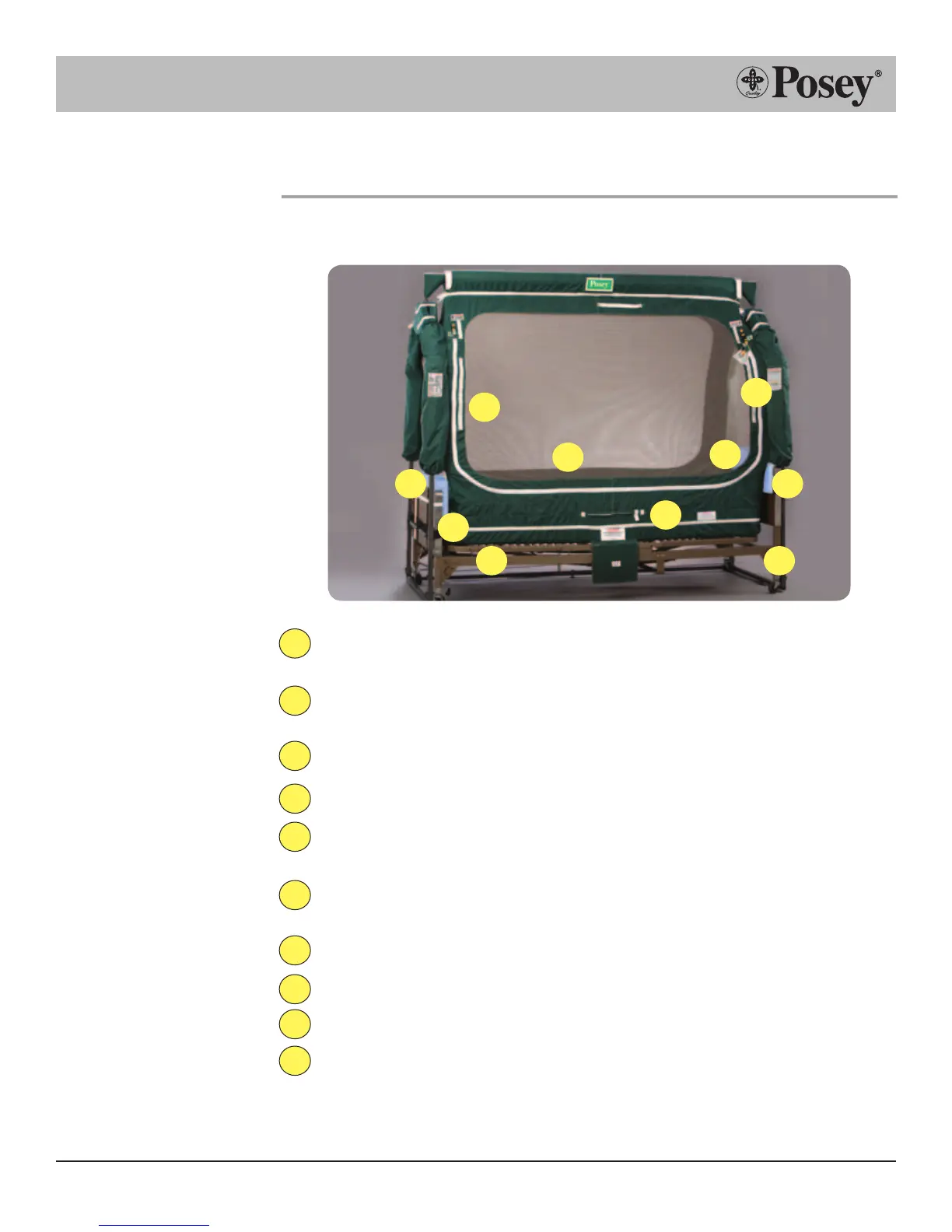
“Quick-Check 10”
Before leaving a patient alone, WALK AROUND THE BED
to be sure that each condition is met.
Exterior: Area around the bed is clear of any tripping hazards.
Interior: Clean and free of clutter and hazards.
Mattress (At-risk patients not able to reposition themselves): To avoid entrapment, keep
the head of the bed flat and use a cushion to elevate the torso if necessary. If the head of
the bed is raised, use gap filler cushions.
Compartments: Zipped completely closed with no gaps or kinks in the entire length of the
zipper. Test by applying pressure along the entire length of the zipper.
Zippers and quick-release buckles: Securely closed.
Drainage/tube port: if tubing and tube port is in use, all fluids are flowing freely; if tubing
is not in use, port is zipped closed.
Frame Condition: Canopy, panel, and netting have no tears, holes or abrasions. Frame is
firmly attached to the bed platform, undamaged, and fully padded. Top rail is in the highest
position.
Bed height: Bed platform should not be raised above 25” (64 cm) or lowered below 16”
(41 cm). Lower bed to 16” (41 cm) when patient is alone.
Side rails: ALWAYS ensure all side rails (if available) are in the fully down position.
Casters: all hospital bed casters (if available) are locked.
A. Nurse Call Button: If the patient’s care plan allows it, the nurse call button is placed
within reach of the patient.
B. Monitoring (Home Use): Caregiver should sleep in the same room or use a device, such
as a child monitoring system for constant montoring.
(See Reverse for Warnings.)
3
4
5
6
9
10
8
7
1
1
2
3
4
5
6
7
8
9
2
10


 To Next Page