
 Need help?
Do you have a question about the Poulan Pro PB175A42LT and is the answer not in the manual?
Identifies the specific model and type of the lawn tractor.
General guidelines for operating the tractor safely.
Specific safety instructions for operating the tractor on slopes.
Safety precautions related to children and the tractor.
Guidelines for towing attachments with the tractor.
Precautions for handling gasoline safely to prevent injury or damage.
General safety practices to follow during tractor service.
Outlines the owner's duties for maintaining the tractor.
Lists and illustrates parts for the steering wheel assembly.
Lists and illustrates parts for the tractor seat assembly.
Lists and illustrates other components like keys, battery, and oil drain extension.
Lists the tools needed for assembling the tractor.
Instructions for safely removing the tractor from its shipping carton.
Steps to take before removing the tractor from the shipping skid.
Step-by-step guide for installing the steering wheel assembly.
Instructions for correctly mounting the tractor seat.
How to adjust the tractor seat for operator comfort.
Procedure for checking the tractor's battery status.
Steps to safely move the tractor off its shipping skid.
Importance and procedure for checking tire pressure.
How to ensure the mower deck is properly leveled.
Verifying that all drive belts are correctly positioned.
Procedures for confirming the tractor's brake system is functional.
A final checklist to ensure all assembly steps are completed correctly.
Explains the meaning of various symbols used on the tractor and in the manual.
Identifies hazard symbols and defines associated risks for safety.
Familiarizes the user with the location and function of tractor controls via diagram and labels.
Step-by-step guide on how to set the tractor's parking brake.
Instructions on how to stop the mower blades, ground drive, and engine.
Guidance on using the throttle control for optimal engine performance.
How to control the tractor's direction and speed using the motion control lever.
Steps to set the desired cutting height for the mower deck.
How to properly adjust mower deck gauge wheels for terrain.
Instructions for engaging and operating the mower blades.
Procedure to disengage and stop the mower blades.
Explanation and usage of the Reverse Operation System.
Safety guidelines and techniques for operating on slopes.
Procedures for safely transporting the tractor via towing or on a trailer.
Recommendations for towing carts and other equipment.
Pre-start checks including engine oil level and fuel tank status.
Guidelines for safely filling the tractor's fuel tank with gasoline.
Procedures for starting the engine in warm and cold weather.
How to warm up the transmission in cold weather.
Advice for optimal mowing performance and grass cutting.
A table outlining recommended maintenance tasks and intervals.
Overall advice for keeping the tractor in good working order.
Diagram and guide for lubricating tractor components.
How to check if the tractor's brakes are functioning correctly.
Care instructions and checks for the tractor tires.
Verifying functionality of safety systems like Operator Presence and Reverse Operation System (ROS).
Tips for maintaining sharp blades and procedures for their safe removal and installation.
Instructions for battery care, charging, and terminal cleaning.
Guidelines for checking V-belts for wear and damage.
Information on transaxle fluid and servicing requirements, noting limited need.
Proper oil selection and levels for engine lubrication.
How to clean the engine's air screen to prevent overheating.
Recommendations for servicing the engine's air filter.
When and how to replace spark plugs for optimal engine performance.
How to clean the engine cooling system to prevent overheating.
Instructions for cleaning the tractor's exterior components.
Procedure for replacing the in-line fuel filter.
Step-by-step instructions for detaching the mower deck from the tractor.
Step-by-step instructions for attaching the mower deck to the tractor.
How to connect the mower's side suspension arms to the tractor chassis.
Procedure for connecting the rear lift links of the mower to the tractor.
How to connect the mower's front link to the tractor's suspension bracket.
Guides for adjusting the mower deck for optimal cutting performance.
A visual method to adjust the mower deck for even cutting.
A precise method to adjust the mower deck for even cutting.
How to adjust the mower deck for proper front-to-back blade pitch.
Instructions for replacing the belt that drives the mower blades.
Instructions for replacing the belt that drives the tractor's motion.
Procedure to test and verify the tractor's brake system functionality.
Adjusting the neutral position of the transaxle motion control lever.
Steps for safely removing wheels from the tractor.
Procedure for jump-starting the tractor with a weak battery.
Correct method for connecting jumper cables for emergency starting.
Step-by-step guide for safely replacing the tractor battery.
Instructions for replacing a burnt-out headlight bulb.
How to replace a blown fuse in the tractor's electrical system.
Procedures for detaching the tractor's hood and grill assembly.
Adjusting the throttle control cable for optimal engine speed response.
Adjusting the choke control for proper engine starting conditions.
Information on carburetor adjustment or when to seek professional service.
Steps to prepare the tractor for long-term storage.
Proper procedures for storing the tractor battery to prevent damage.
How to prepare the fuel system for storage to prevent gum deposits.
Procedures for changing engine oil before storage.
Steps to protect the engine cylinders during storage.
General advice for storing the tractor and related items.
Common causes and solutions for an engine that fails to start.
Causes and corrections for difficulty in starting the engine.
Troubleshooting issues when the engine fails to crank.
Diagnosing why the engine makes clicking sounds but won't start.
Identifying and resolving issues causing reduced engine power.
Causes and remedies for excessive vibration during operation.
Troubleshooting the operator presence control system.
Causes and solutions for an uneven cut quality from the mower.
Diagnosing why the mower blades are not spinning.
Addressing issues related to grass clippings discharge.
Troubleshooting problems with the tractor's headlights.
Diagnosing why the tractor's battery is not charging.
Troubleshooting issues related to the tractor's drive system.
Identifying causes for the engine backfiring when turned off.
Troubleshooting engine shutdown when shifting into reverse.
Details the terms, limitations, and exclusions of the product's limited warranty.
Step-by-step instructions on how to use the guide to measure hill slopes safely.
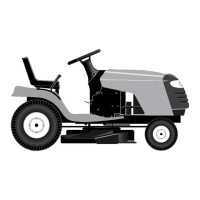
This document is an operator's manual for a Poulan PRO PB175A42LT Lawn Tractor, providing essential information for safe operation, assembly, maintenance, and troubleshooting.
The Poulan PRO PB175A42LT Lawn Tractor is a ride-on mowing machine designed for cutting grass in residential settings. Its primary function is to provide efficient and effective lawn maintenance. The tractor is equipped with an internal combustion engine and a cutting deck that houses rotating blades. It is designed for single-operator use and features various controls to manage engine speed, motion, and attachment operation.
The tractor's operation involves several key controls and safety considerations. To start, the operator must read and understand all instructions and safety rules in the manual. The tractor is equipped with an operator presence sensing switch, which means the engine will shut off if the operator attempts to leave the seat without first setting the parking brake.
Before starting, the operator must ensure the freewheel control is in the "TRANSMISSION ENGAGED" position, sit on the seat, depress the clutch/brake pedal, set the parking brake, place the motion control lever in neutral, and move the attachment clutch to "DISENGAGED." The throttle control is used to manage engine speed, with full speed (fast) recommended for optimal mowing performance. The ignition switch is used to start and stop the engine, and the key should always be removed when leaving the tractor unattended to prevent unauthorized use.
The tractor's motion is controlled by a motion control lever, which allows for forward and reverse movement. Operators are advised to move this lever slowly and gradually. For safety, the manual strongly discourages mowing in reverse unless absolutely necessary, and if done, the ignition key must be placed in the "ROS ON" position, and the operator must look down and behind before and while backing.
The attachment lift lever is used to raise and lower the mower deck, allowing for adjustment of cutting height. Gauge wheels on the mower deck should be adjusted so they are slightly off the ground when the deck is at the desired cutting height, which helps prevent scalping on uneven terrain. The mower blades are engaged using the attachment clutch control. For safety, the mower should not be operated without the grass catcher or deflector chute in place.
Slope operation requires extra caution. The manual advises mowing up and down slopes, not across them, and avoiding slopes greater than 15 degrees. Operators should choose a low ground speed, avoid stopping or turning on slopes, and keep the machine in gear when going down slopes. If traction is lost, the blades should be disengaged, and the tractor should proceed slowly straight down the slope.
When towing attachments, only recommended equipment should be used, and common sense should be exercised, especially on slopes, where heavy loads can cause loss of traction and control.
Regular maintenance is crucial for the tractor's safe and proper operation and to ensure its longevity. The manual provides a detailed maintenance schedule, outlining tasks to be performed before each use, every 8, 25, 50, and 100 hours, every season, and before storage.
Key maintenance tasks include:
For storage, the tractor should be prepared by removing the mower, thoroughly cleaning the entire unit, inspecting and replacing worn parts, lubricating, and touching up paint. The fuel system should be emptied by running the engine until the fuel lines and carburetor are dry, or a fuel stabilizer should be used. The engine oil should be drained and replaced with clean oil, and spark plugs should be removed to add a small amount of oil to the cylinder(s) before reinstallation. The battery should be fully charged, cleaned, and disconnected. The tractor should be stored indoors, covered with a breathable protective cover.
The manual also includes a troubleshooting guide to help operators diagnose and resolve common issues such as the tractor not starting, hard starting, engine not turning over, loss of power, excessive vibration, poor cut, mower blades not rotating, and engine problems. For complex repairs or adjustments, contacting an authorized service center is recommended.
 General
| Engine | Briggs & Stratton |
|---|---|
| Engine Displacement | 500cc |
| Transmission | Automatic |
| Deck Material | Steel |
| Weight | 415 lb |
| Engine Type | 4-Cycle |








 To Next Page