Page No. 9
Issue Date: Rev 14 28 May 2012
Operating Instructions Form No. 102842
To bleed air from the pump, turn the pressure control knob counterclockwise (CCW) (turn lever
down or clockwise on P460 models) and operate the pump handle up and down approximate-
ly twenty times. Turn the pressure control knob clockwise (CW) to its full stop position (turn
lever up or CCW on P460 models). The pump should now be bled of air and ready to use.
3. Hydraulic Fluid Level
WARNING
Cylinder(s) must be fully retracted before checking the uid level. Release all system pres-
sure before breaking any hydraulic connection in the system.
Check the hydraulic uid level in the reservoir periodically. Use a funnel with a lter to add hydrau-
lic uid if needed. Refer to Table 1 for your reservoir type.
For models with Reservoir Type A: Place the pump in a vertical position with the pump head
facing upward. Unscrew and remove the pump head from the reservoir. The uid level within the
reservoir should come to the uid level mark indicated on the reservoir body decal. Before replac-
ing the pump head, visually inspect the O-ring which seals the pump head/reservoir assembly.
Replace this O-ring if it is worn or damaged. Reinstall pump head to reservoir and tighten secure-
ly. Check for leaks.
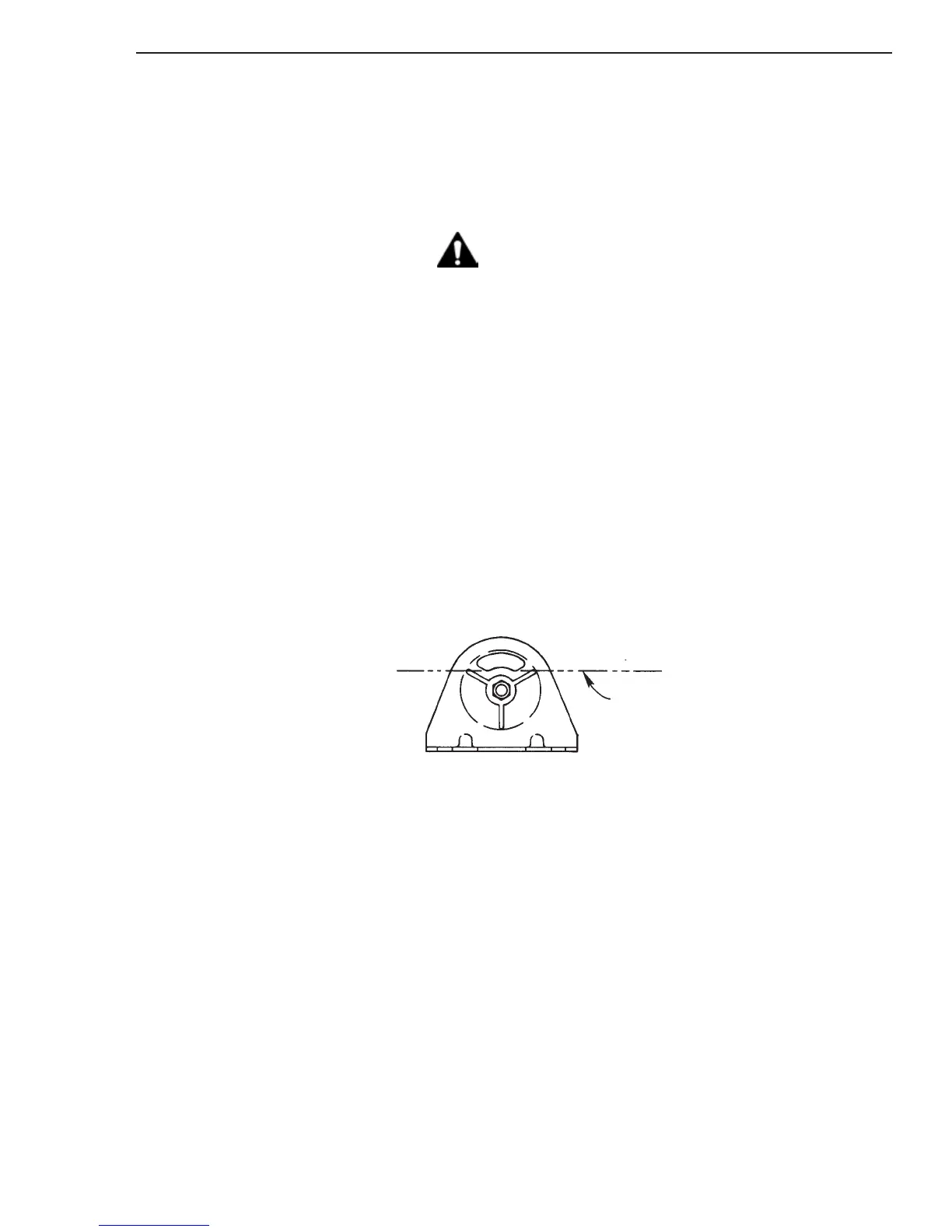
For models with Reservoir Type B: Remove the ller cap. The uid level should come to the
bottom edge of the ller hole when the pump is level and resting horizontally on its base and the
cylinders are retracted (see Figure 2).
END VIEW
OIL
LEVEL
Figure 2
For models with Reservoir Type C: Remove the ller cap. The uid level should be 1/2 inch
(12.7 mm) from the ller hole when the pump is level and resting horizontally on its base and the
cylinders are retracted.
IMPORTANT
The pump sight gauge indicates the presence of hydraulic uid only. It does not determine
correct uid level.
For models with Reservoir Type D: Remove the ller cap. The uid level should be 1/2 inch
(12.7 mm) from the cover plate when the pump is level and resting horizontally on its base and the
cylinders are retracted.
4. Draining And Flushing The Reservoir
Drain, clean and replenish the reservoir with high-grade, approved Power Team hydraulic uid
yearly or more often if necessary. The frequency of uid change will depend upon the general



 To Next Page