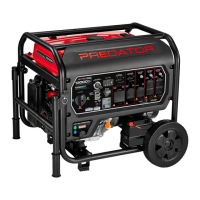
Page 26
For technical questions, please call 1-888-866-5797.
70476
SAFETY OPERATION MAINTENANCESETUP
Connecting Electrical Loads to the Generator
Calculate Power Draw
Power draw can be calculated by multiplying volts and amps. The resulting number is wattage.
• The total combined load through the outlets on the Generator must not exceed the running power of
the unit. Never exceed the running wattage for the Generator or any outlet amperage rating.
• Refer to appliance/tool owner’s manuals to determine the wattage of electrical load devices.
• Long power cords and extension cords draw additional power. Keep cord length at a minimum.
WARNING! Never exceed the rated capacity for this Generator, as serious damage to the Generator and/or
appliances, tools, and equipment could result from an overload. Starting and running wattage requirements should
always be calculated when matching this Generator’s wattage capacity to the appliance, tool, or equipment.
NOTICE: Starting and running wattages vary depending on fuel used to operate Generator. Refer to chart:
Fuel Starting Watts Running Watts
Gasoline 13,000 Maximum 10,000
LPG / Propane 12,000 Maximum 9100
Natural Gas 10,000 Maximum 7800
Wattage Estimates
Refer to your device documentation for start-up and running wattage requirements.
Check nameplate wattages on all loads before connecting to Generator.
Plug the power cord of the 120 / 240 volt appliance/tool into the appropriate Outlet
on the Generator. Plug in appliances from largest to smallest load.
a. Connect the items that require the most wattage first.
b. Connect “inductive” load appliances, tools, and equipment next. Inductive
loads are small hand tools and some small appliances.
c. Connect any lights next.
d. Voltage sensitive appliances, tools, and equipment should be the last to be connected to the Generator.
Plug voltage sensitive items such as TVs, DVD players, microwaves, and cordless telephones into a
UL
®
Listed voltage surge protector (not included). Then, connect the surge protector into the Generator.
IMPORTANT! Failure to connect and operate appliances, tools, and equipment in this sequence can cause
damage to the Generator, appliances, tools, and equipment and will void the Warranty of this Generator.
Note: Do not allow the Generator to completely run out of fuel with devices attached.
A Generator’s output may sharply spike as it runs out of fuel, causing damage to attached devices.
Low Oil Indicator
1. If the Engine oil level is too low, the LOW OIL ALARM light turns on and the Engine will automatically shut off.
2. The Engine cannot be restarted until the proper amount of oil has been added. Add the appropriate
type of oil until the oil level is at the proper level. SAE 10W-30 oil is recommended for general use.
NOTICE: Do not run the engine with too little oil. Engine will shut off if engine oil level is too low.
Automatic Idle Down Switch
1. Turn the Automatic Idle Switch ON to limit noise and fuel consumption for lighter
generator loads. Engine speed (and frequency) are reduced when no load is detected.
Engine runs at full speed (and frequency) when load above 75 W is applied.
Note: Turn Automatic Idle Switch OFF when connected load is less than 300 W.
2. Turn the Automatic Idle Switch OFF to operate Engine at full speed:
a. when starting b. when a heavy load is applied
Evenly distributed
over outlets:
IF ANY CIRCUIT BREAKERS TRIP CHECK THE FOLLOWING:
3. Make sure that ALL circuit breakers are reset
before starting the Generator again.
4. Adjust the plugs so the loads are
shared across outlet circuits.
To achieve rated output from the Generator,
distribute loads over outlets.
Plug Load In


 To Next Page
 Loading...