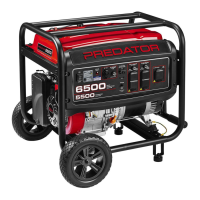
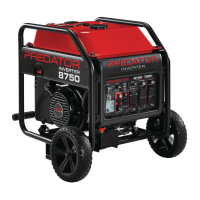
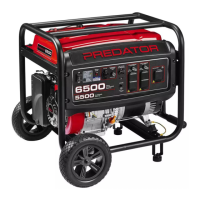
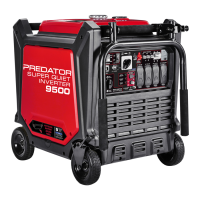
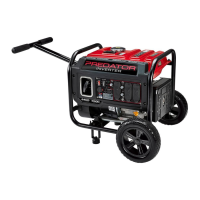
Need help?
Do you have a question about the Predator 59303 and is the answer not in the manual?
Instructions on keeping the manual for safety and reference.
Emphasizes the extreme danger of carbon monoxide from generator exhaust.
Details on output, dimensions, engine, fuel, oil, and performance metrics.
Defines danger, warning, caution symbols and explains safety alert meanings.
Emphasizes reading all instructions to prevent serious injury and death.
Covers fuel handling, fire prevention, ventilation, and electrical connections.
Details CO risks, indoor use prohibition, and the auto-shutoff feature.
Prohibits indoor use, stresses ventilation, and outlines health risks from CO.
Covers electrical safety, preventing overloading, and handling moving parts.
Includes transport, noise, pacemaker, general common sense, and fire prevention.
Guidance on fuel spills, moving parts, and selecting correct extension cords.
Precautions for connecting multiple generators using a parallel kit.
Safety steps before servicing, guard maintenance, and qualified technician use.
Instructions for refueling safely to prevent fire and explosion.
Emphasizes spark arrestor use and fire prevention during setup.
Details generator grounding requirements for electrical safety.
Procedure to install an altitude kit for operation above 3000 feet.
Identifies and explains the various controls and indicators on the control panel.
Locates and names key components visible on the generator's front.
Ensures the generator and engine are in good condition before starting.
Step-by-step guide to checking and adding engine oil.
Instructions for safely checking and filling the fuel tank.
Steps before starting: switch position, fuel valve, choke, and engine switch.
Detailed steps for starting the engine manually, including recoil operation.
Common reasons the engine may not start and solutions.
Explains the CO sensor, alarm lights, and malfunction indicators.
Guidance on the initial 30-hour break-in and subsequent oil change.
How to calculate power draw and connect appliances to the generator.
Explains the overload indicator, its meaning, and troubleshooting.
Describes the low oil indicator and its function to protect the engine.
Procedure for safely stopping the engine and using the Economy switch.
Schedule for brushing, oil checks, and air filter cleaning.
Schedule for oil changes, spark arrestor, spark plug, and valve adjustments.
Safe practices for checking and filling the fuel tank, including ethanol warnings.
Step-by-step instructions for draining and refilling engine oil.
How to clean and maintain both paper and foam air filter elements.
Procedure for cleaning the spark arrestor to prevent fires.
Guide to inspecting, cleaning, gapping, and replacing the spark plug.
Steps for cleaning, fuel treatment, and draining the carburetor for storage.
Guidance on storing the generator and preparing it after storage.
Covers fuel, ignition, compression, oil, and spark arrestor related start failures.
Addresses engine misfires, sudden stops, and issues under heavy load.
Solutions for engine backfiring and problems with connected devices.
This document serves as an owner's manual and safety instructions for a portable inverter generator. It provides comprehensive guidance on the device's function, usage, and maintenance, ensuring safe and efficient operation.
The portable inverter generator is designed to provide electrical power for various applications. It operates by converting mechanical energy from an internal combustion engine into electrical energy, which is then regulated by inverter technology to produce clean, stable power suitable for sensitive electronics. The generator features multiple outlets, including standard 120VAC receptacles, a 120VAC 30A receptacle, and USB-A ports, allowing it to power a wide range of devices. It is equipped with a carbon monoxide sensor, an essential safety feature that monitors CO levels and automatically shuts off the generator if dangerous concentrations are detected, preventing serious injury or death from carbon monoxide inhalation. The generator also includes an economy (ESC) switch to optimize fuel consumption and reduce noise during lighter loads, and an overload indicator to alert users when the generator's capacity is being exceeded.
Operating this generator requires adherence to specific procedures to ensure safety and optimal performance. Before starting, users must perform pre-start checks, including inspecting for damaged or missing parts, and ensuring the engine's crankcase is properly filled with the recommended SAE 10W-30 oil. The generator is shipped without engine oil, and filling it before first use is critical to avoid voiding the warranty. Fueling the generator involves adding 87+ octane or higher unleaded gasoline treated with a fuel stabilizer additive to the fuel tank, making sure not to overfill and leaving room for expansion. It is crucial to use fresh, clean gasoline and avoid gasoline containing more than 10% ethanol (E10) to prevent carburetor damage.
Starting the engine involves a manual pull-start process. The economy (ESC) switch should be in the OFF position, the fuel valve opened, and the choke pulled out to the START position. After turning the engine switch on, the starter handle is pulled gently until resistance is felt, then quickly to start the engine. If the engine does not start, troubleshooting steps include checking the oil level, spark arrestor cleanliness, and choke position. Once started, the OUTPUT light illuminates, indicating power generation. The engine should be allowed to run for several seconds before slowly pushing the choke in. A five-minute no-load run time is recommended for engine stabilization after each start-up.
Connecting electrical loads to the generator involves calculating the power draw of devices to ensure they do not exceed the generator's running wattage or any outlet's amperage rating. Devices should be plugged in from largest to smallest load. It is important to avoid running the generator completely out of fuel with devices attached, as this can cause power spikes and damage connected electronics. The economy (ESC) switch can be turned ON to limit noise and fuel consumption for lighter loads, or OFF for full-speed operation when starting or applying heavy loads.
The carbon monoxide shutoff feature is a critical safety mechanism. A flashing red light indicates dangerous CO levels, prompting an automatic shutdown. In such cases, the generator must be moved to a well-ventilated area immediately. A flashing yellow light signals a CO sensor malfunction, requiring service before further use. The CO sensor should only be serviced by a qualified technician and must not be modified or tampered with.
The generator also has a break-in period of approximately 30 hours, during which the running wattage should not exceed 75% of the generator's capacity. Engine oil should be changed after this period.
Regular maintenance is essential for the generator's longevity and safe operation. Before any service, maintenance, or cleaning, the generator must be unplugged from all devices, the switch turned OFF, the fuel valve closed, the engine allowed to cool, and the spark plug cap removed. All safety guards must remain in place and in proper working order. Electrical equipment must be kept clean and dry, with any damaged wiring or corroded terminals replaced. Any sealed parts of the generator or engine should not be altered or adjusted by unauthorized personnel.
The maintenance schedule includes routine checks and procedures. The outside of the engine should be brushed off regularly. Engine oil level must be checked before every use, and the oil changed periodically (every 3 months or 50 hours of use, or yearly/every 300 hours). The air filter elements need to be cleaned or replaced, with specific instructions for "paper" and "foam" filter types. The spark arrestor requires cleaning with a wire brush and replacement if damaged, to prevent brush fires. Spark plug maintenance involves disconnecting the cap, cleaning debris, inspecting the plug for oil or deposits, and replacing it if cracked or chipped. The spark plug gap must be adjusted according to specifications, and anti-seize material applied to the threads during installation.
For storage, especially if the generator will be idle for more than 20 days, specific steps are necessary. The engine should be cleaned with a dry cloth after cooling, avoiding water. The fuel tank should be filled with fresh, stabilizer-treated gasoline, or any untreated gasoline should be safely drained. The carburetor must also be drained by removing the drain bolt from the carburetor bowl after closing the fuel valve. Lubrication involves changing the engine oil, cleaning the area around the spark plug, pouring a tablespoon of engine oil into the cylinder, and pulling the starter handle to distribute the oil. The generator should be stored in a dry, level, well-ventilated area, away from ignition sources and direct exposure to rain or sunlight. During extended storage, the engine should be started every 3 months and run for 15-20 minutes to prevent the warranty from being voided. After storage, untreated gasoline should be drained and replaced with fresh fuel if it has been sitting for a month, or if the engine does not start.
 General
| AC Voltage | 120 / 240 V |
|---|---|
| Engine Displacement | 420 cc |
| Engine Type | 4-Stroke OHV |
| Starting Method | Electric Start |
| Outlet Types | 2x 5-20R, 1x L14-30R |

 To Next Page