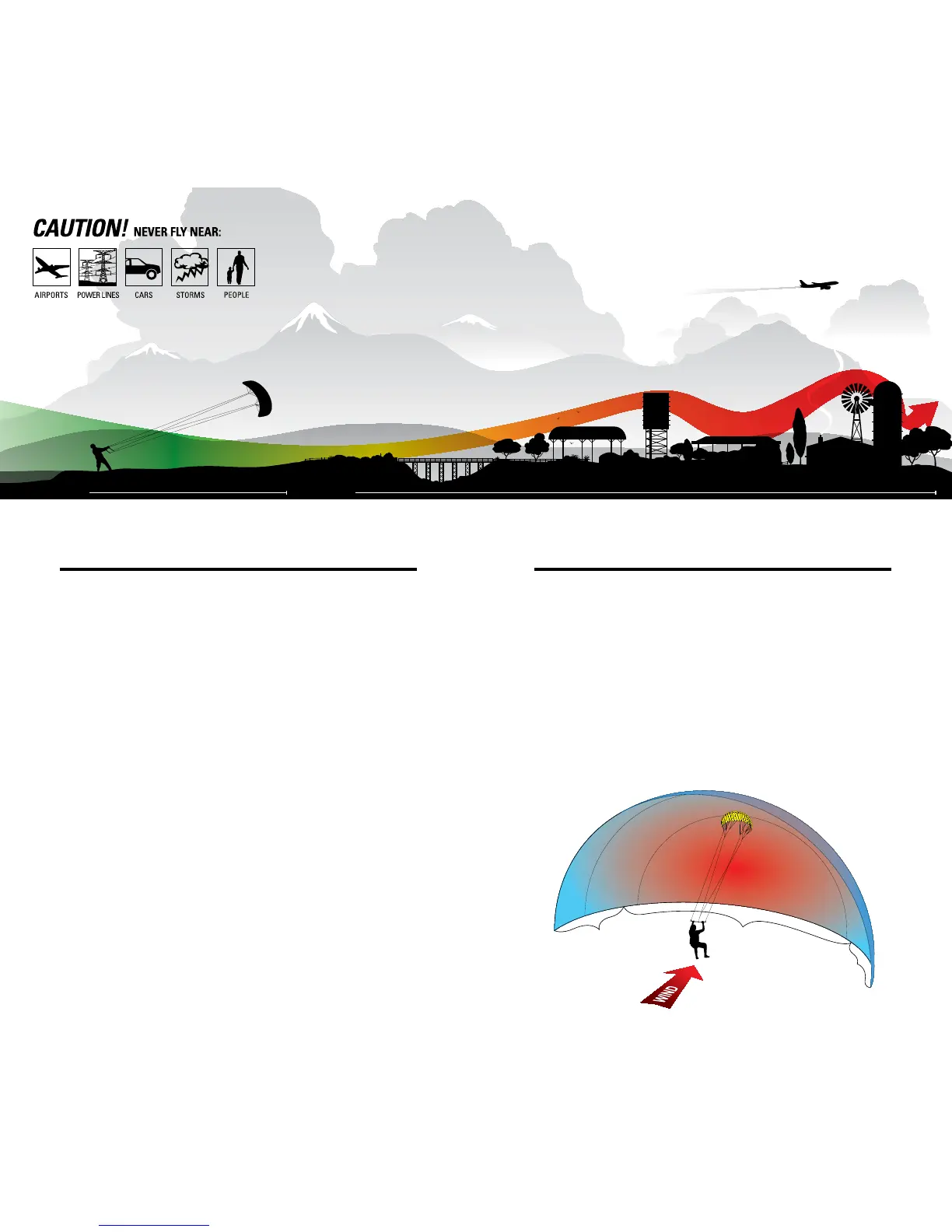
safe/ideal for flight not safe for flight
Where to Fly
Your choice of flying field is the single most important ingredient for success
with your kite, and most troubles come from picking a spot where the wind is
turbulent and gusty from obstacles in its path. Like whitewater in a river, wind
that flows past trees, buildings and hills becomes gusty and choppy and can
make controlling your kite difficult or dangerous.
The best possible place to fly is a beach or field with wind blowing from off the
water
(see Fig. 4.a). If you have such a place available, it’s worth the extra travel
time to get there because you’ll learn to fly in literally a fraction of the time. If
you have to fly inland, look for wide open fields with no trees, buildings, or hills
for at least a half mile upwind.
Remember, flying safely is YOUR responsibility. Never fly your kite in extreme
conditions or winds that are stronger than its rated range. Never fly your kite
near power lines, storms, roads, railways, people or animals. If you have ANY
doubts about the safety of your flying situation, don’t risk it! One slip, or a broken
line, and you or a bystander could be seriously hurt.
The Wind Window
The flight area of the kite is called the Wind Window. The wind window extends
in a semi-circle from the left to the right side of the pilot. In the middle of the
wind window, known as the Power Zone, the kite will fly fastest and generate
the most pull.
As it reaches the edge of the window it will pull less and come to a stop. The
zenith, directly above the pilot at the top of the wind window, is the best place to
“park” the kite when you want to rest your arms and minimize the pull
(see Fig. 4.b).
In a normal launch, the kite is flown from the ground through the middle of the
wind window up to the zenith. This will result in near maximum pull. For this
reason, it is very important prior to launch to check that the lines are attached
correctly, safety systems are in place, and that the appropriate kite is being
flown given the strength of the wind. Make your first flights in very light winds
(less than 10 mph/16kph) until you are familiar with the power and handling of
the kite.
Fig. 4.b: Wind Window
landing area
landing area
power zone
zenith
Fig. 4.a: Where to Fly
FIRST FlIGHT
For questions, replacement parts or repairs:
WWW.PRISMKITES.COM
For questions, replacement parts or repairs:
WWW.PRISMKITES.COM
For questions, replacement parts or repairs:
WWW.PRISMKITES.COM
For questions, replacement parts or repairs:
WWW.PRISMKITES.COM
For questions, replacement parts or repairs:
WWW.PRISMKITES.COM



 To Next Page