9
4.8 Frequency measurement
Pass V position:
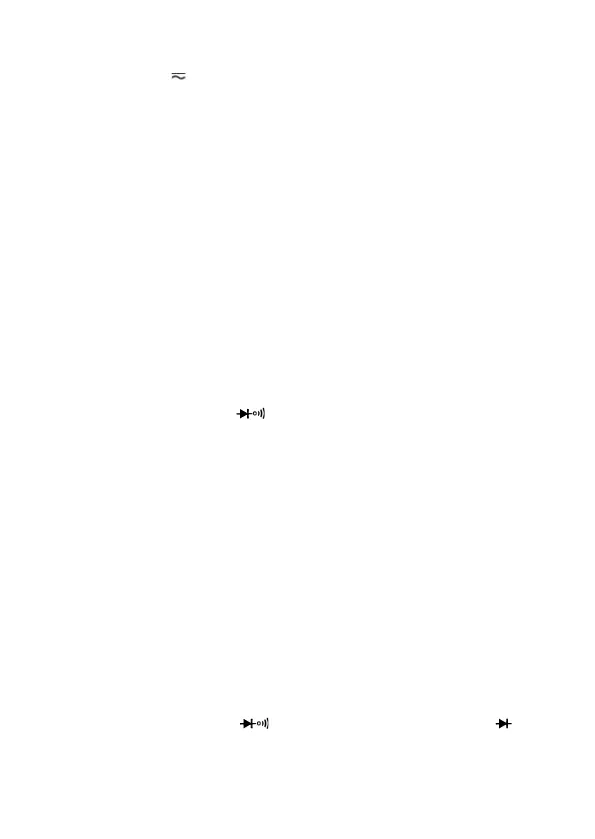
1)Turn the switch to “ V” and press “FUNC” to choose ACV; then press “Hz” to choose
Hz.
2)Connect the black test lead to the COM jack and the red lead to the V/Ω jack.
3)Measure the frequency value of the circuit under test with the other two ends of the test
leads and “Hz” the measured value on LCD screen.
Pass AC A position(The signal current must be ≥4A):
1)Turn the rotary switch to the appropriate position 4/40A or 400A/600A; then press the “Hz”
key to choose Hz .
2)Hold the trigger, open the clamp head and clamp one cable of the measured circuit.
3)When measured signal ≥ 4A AC current, the LCD of the meter displays the measured Hz
value.
4.9 Resistance Measurement
Ohm is the unit of electric resistance (Ω).
The measuring ranges of electric resistance of this meter are 400Ω, 4kΩ, 40kΩ, 400kΩ,
4MΩand 40MΩ,
Measurement of electric resistance
1)Turn the rotary switch to the Ω
position, press “FUNC” to choose Ω.
2)Connect the test lead in black and test lead in red to COM input socket and V/Ω input
socket respectively.
3)Use another two ends of the test lead to measure the electric resistance of the circuit to
be measured.
4)Read the measured electric resistance value on LCD screen.
Note:
The measured value of the electric resistance of the circuit differs a bit from the rated
value of the electric resistance.
To ensure measurement accuracy, in attempting a low resistance measurement, first
put two lead-shaped meters in short circuit and capture the resistance reading of these
short circuits. Then subtract the aforesaid reading from the measured resistance.
When the meter is in open circuit, the display unit will show “OL” that indicates the
measured value is over the measuring range.
4.10 Diode test
1) Turn the rotary switch to the Ω position and press “FUNC” to choose .
2) Connect the test leads in black and in red to COM input socket and V/Ω input socket
respectively.
3) Connect the test leads in black and in red to the positive and negative poles of the diode


 To Next Page