15
j. Using your throttle
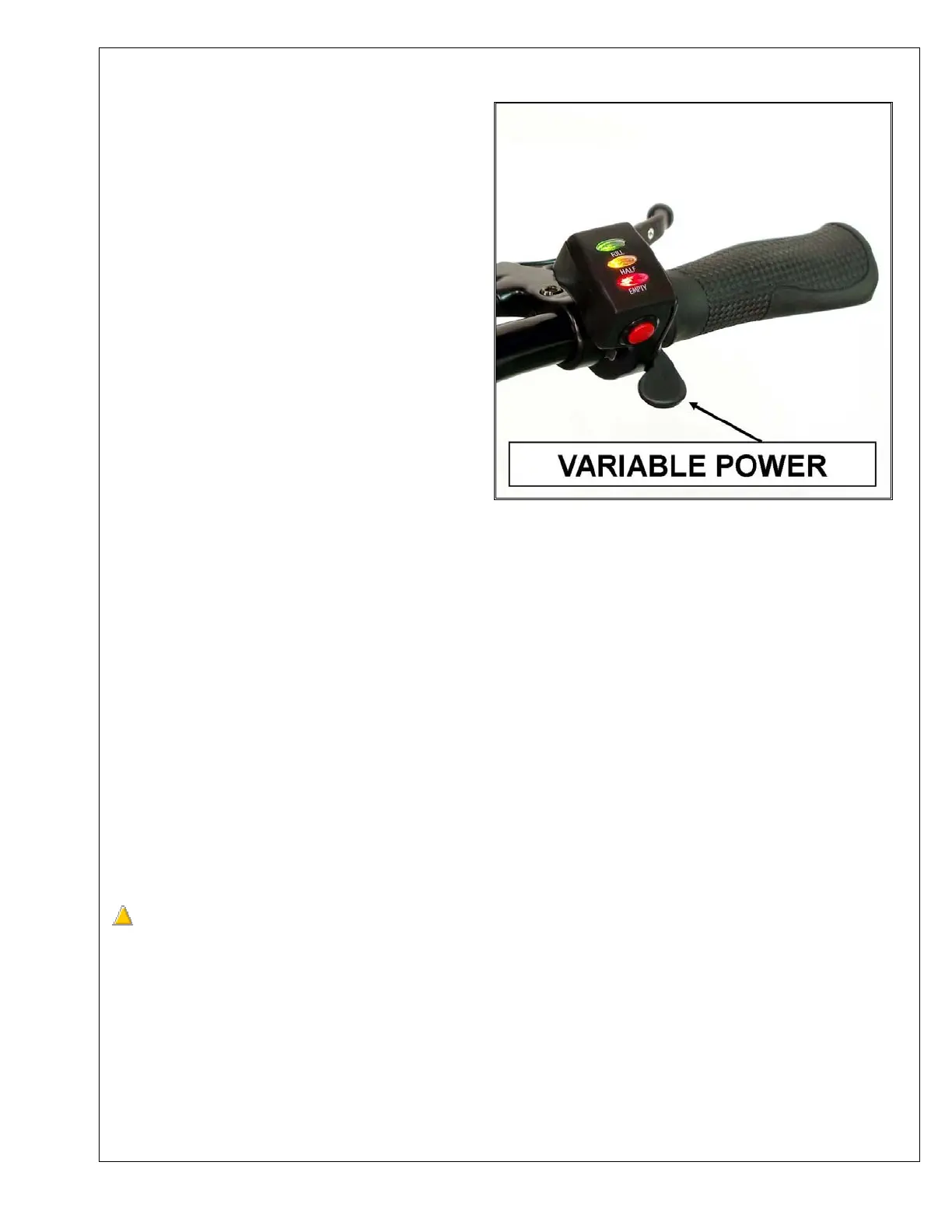
The variable throttle included with your G Plus
Stride R was designed to allow you the ability to
choose the speed to ride at and determine the
amount of torque off the line. Similar to an
automobile; the pressing of the throttle mimics the
depressing of the accelerator. The higher the
speed, the less distance per charge (less distance
per gas tank), the faster you accelerate off the line,
the less distance per charge. If there are multiple
stop and go’s this also affects the range of distance
per charge. It is recommended you become
accustomed to your style of riding and adjust the
style depending on distance needed per charge.
For example: if you are planning a short local trip,
full throttle at takeoff and top speed will not be an
issue due to your ability to be able to recharge the
battery prior to the next trip. If you are planning a
longer trip, 10-15 miles or more, it is suggested you
add pedaling, hold throttle back 10% and whenever
possible allow the bicycle to coast under no power.
Coasting under no power is similar to riding a
traditional pedal powered bicycle. When riding, a
rider will pedal for a few seconds and then stop
pedaling, allowing the bike to coast with no power
being used. This will greatly enhance your distance
between charging.
k. Using your brakes
Your G Plus Stride R includes a high performance “Tool Free” adjusting Promax Disc Brake system. The DSK-715
front and rear disc brakes allow your new G Plus Stride R to stop quickly and accurately. Oversized 203mm
stainless steel disc rotors were utilized for the front axle for increased heat dissipation. When properly adjusted, the
G Plus Stride R’ high performance disc brake system offers tremendous stopping power but they must be properly
adjusted. Prior to leaving the factory, the G Plus Stride R brakes were adjusted tight and properly tested. Due to
cable stretching from new, your brakes may need to be readjusted within a few weeks of riding. Please refer to
Chapter 7 “Maintenance and Replacement”, section c “Brake adjustments” to adjust your brakes for optimum
performance.
When braking, both brake levers should be applied simultaneously. Your left brake lever manages your front brake
and your right brake lever manages your rear brake. You should first become accustomed with the stopping power
of each brake (front & rear). Test each brake separately in a controlled environment for their ability to stop the
bicycle. Front brakes when locked can cause the rear wheel to come off the ground and the rider can be thrown off
the. In emergency situations, apply pressure to each brake lever, shift your weight to the back of the bicycle and
only attempt to use full force on the front brakes when the bicycle is not stopping quickly enough. You should
always keep a safe distance according to speed between vehicles, pedestrians and other bicycle riders from
yourself.
WARNING: Locking the front wheel during braking can cause the rear wheel to lift off the ground
and throw the rider off the bicycle. Both brake levers should be applied simultaneously. In an emergency
situation shift your weight to the back of the bicycle. Locking the front wheel can cause the rider to lose
control, be thrown and cause serious injury or death.
l. Pedaling
Pedaling your G Plus Stride R is the same as pedaling a traditional bicycle. It is recommended you add pedaling to
the power of the bicycle to enhance the distance per charge. The G Plus Stride R is a 7 speed bicycle and has the
ratio of a 44T front chain ring (sprocket) against a 13-28T rear freewheel which is designed to offer an easy
pedaling pace at any speed from 1 MPH to 16 MPH. It is recommended on steep inclines; the rider utilizes the
throttle to assist in powering the bicycle up the incline but simultaneously drops the bicycle to a lower gear. If a
rider’s style of riding is throttle only with no pedaling, distance per charge will be decreased and upon a steep
incline, the rider is required to assist the motor by pedaling to power up the incline.


 To Next Page