During the first few weeks of your exercise program, you should keep your heart rate near the low end
of your Training Zone. Over the course of a few months, gradually increase your heart rate until it
reaches the high end of your Training Zone. As your condition improves, a greater workload will be
required in order to raise your heart rate to your Training Zone.
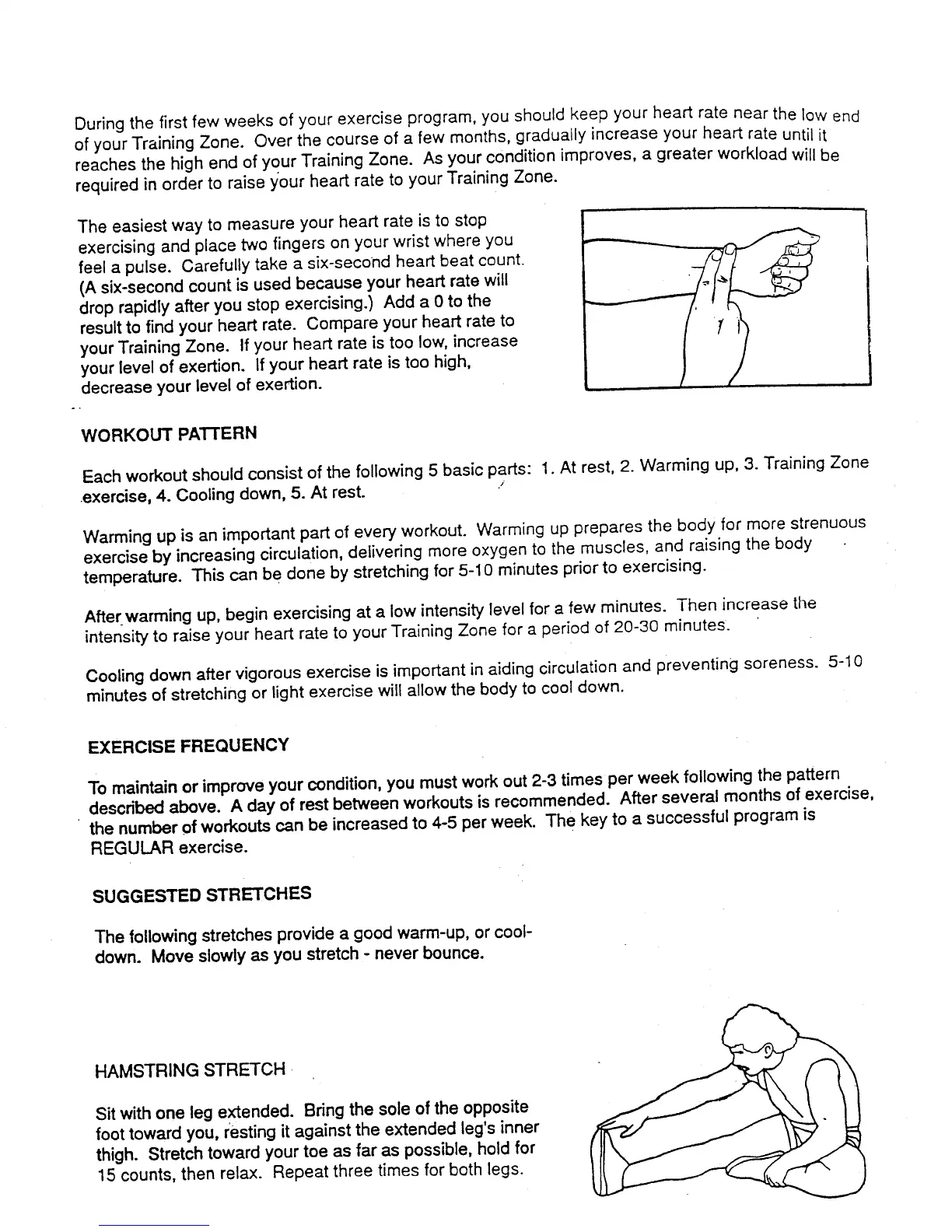
The easiest way to measure your heart rate is to stop
exercising and place two fingers on your wrist where you
feel a pulse. Carefully take a six-second heart beat count.
(A six-second count is used because your heart rate will
drop rapidly aRer you stop exercising.) Add a 0 to the
result to find your heart rate. Compare your heart rate to
your Training Zone. If your heart rate is too low, increase
your level of exertion. If your heart rate is too high,
decrease your level of exertion.
.,
WORKOUT PATTERN
Each workout should consist of the following 5 basic parts: 1. At rest, 2. Warming up, 3. Training Zone
exercise, 4. Cooling down, 5. At rest. '
Warming up is an important part of every workout. Warming up prepares the body for more strenuous
exercise by increasing circulation, delivering more oxygen to the muscles, and raising the body
temperature. This can be done by stretching for 5-10 minutes prior to exercising.
After_warming up, begin exercising at a low intensity level for a few minutes. Then increase the
intensity to raise your heart rate to your Training Zone for a period of 20-30 minutes.
Cooling down after vigorous exercise is important in aiding circulation and preventing soreness. 5-10
minutes of stretching or light exercise will allow the body to cool down.
EXERCISE FREQUENCY
To maintain or improve your condition, you must work out 2-3 times per week following the pattern
described above. A day of rest between workouts is recommended. After several months of exercise,
the number of workouts can be increased to 4-5 per week. The key to a successful program is
REGULAR exercise.
SUGGESTED STRETCHES
The following stretches provide a good warm-up, or cool-
down. Move slowly as you stretch - never bounce.
HAMSTRING STRETCH
Sit with one leg extended. Bring the sole of the opposite
foot toward you, resting it against the extended leg's inner
thigh. Stretch toward your toe as far as possible, hold for
15 counts, then relax. Repeat three times for both legs.



 To Next Page