3
• MULTI-CHEMISTRY CHARGING
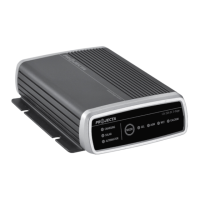
• The IDCX charger supports a variety of battery types, including standard automotive
batteries and newer lithium-based batteries. For automotive batteries, it offers
tailored charging profiles for AGM, GEL, WET, Calcium, and LiFePO4 chemistries.
Users should ensure compatibility with non-automotive lithium batteries by checking
the battery’s datasheet to confirm that the IDCX’s charging profile is suitable before
connecting.
• ADAPTIVE CHARGING
This feature helps protect your starter battery by automatically adjusting the
charging current when your car’s engine stops, ensuring the battery is not
overstressed during idle periods
• PARALLEL CHARGING
IDCX can be wired in parallel to provide more charging current for larger systems.
This flexibility gives users the option to add another IDCX into their system should
power requirements change. For example, two IDC25X would provide a total
charging current of 50A.
• FUTURE PROOF
IDCX was designed to stand the test of time. When IDCX is paired with an Intelli-IQ,
the firmware can be updated via Bluetooth ensuring IDCX software is always up to
date with the latest features.
• SOLAR MPPT
The IDCX utilises sophisticated MPPT (Maximum Power Point Tracking) solar regular
technology. MPPT maximises the power generated from the solar panels to the
auxiliary battery.
• CHARGING VOLTAGE LOSS COMPENSATION
to compensate the voltage drop on the wire leading to the Auxiliary battery, the
IDCX may increase its output voltage while charging. This ensures the charging
voltage is at its optimum level.
• PROTECTIVE FEATURES
The unit has a output capacitor inside, when a battery is connected to the AUX
output, there will always be a small spark.
• REVERSE CONNECTION PROTECTION
Reverse connection on input and output posts does not damage IDCX internal
circuit. The IDCX detects reverse connection condition and indicates whether input
or output connection is reversed.
• OVER AND UNDER VOLTAGE PROTECTION
The charger will automatically shut down if there is an over voltage or under
voltage problem.
• OVER TEMPERATURE PROTECTION
The charger will lower its output current if the temperature of the unit begins to
overheat.



 To Next Page