6
Rev. D / January 2015
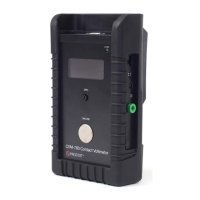
CVM-780 Contact Voltmeter
H. A small p replacement tool is supplied to prevent probe and
p damage when exchanging ps. The p should never be over
ghtened
I. An outer removable rubber boot reduces mechanical shock
during portable operaons and provides an easel stand during
use.
J. few alcohol prep wipes are included to periodically clean the
black insulator mounted at the front of the probe assembly. The wipe may be used to clean the
probe and instrument cases. the alcohol wipes on the display LED.
III.
The CVM-780 operaon is quite unique.
A. As the probe p of the CVM-780 approaches a charged conductor it senses the conductor’s
charge. The p is driven by the probe to match the conductor’s polarity and increases p voltage
as its distance to the conductor decreases.
B. While p voltage connues to increase as it approaches the charged conductor, the CVM-780
probe p does not reach the conductor’s full voltage unl it physically contacts the charged con-
ductor.
C. At the moment of contact a small transfer of electrons occurs from the conductor to the CVM-780
p that completes the measurement. The probe p voltage will be well within
1. 5% of the conductor’s original voltage, ±2 counts from ±25 to ±525 volts, and
2. Within 10% ±2 counts at <±25 volt measurements.
Therefore the change in conductor voltage at moment of p contact is very small.
D. Though very small electron transfer occurs at moment of contact, there is no measureable “ESD”
event when employing ceramic ps. The small amount of electron transfer is controlled by both p
and probe design. Also, there is no signicant RF generated because the electron transfer is small
and “relavely slow” to avoid a discharge event.
E. The resulng measurement accuracy depends on the actual voltage of the conductor, the length
and types of probe ps, and the inuences in the measurement environment. Environmental
inuences include presence and movement of objects and bodies, ambient condions, and size of
objects and their distance to ground (Capacitance).
IV.
The CVM-780 is a precision instrument designed to measure electrostac DC voltage.


 To Next Page