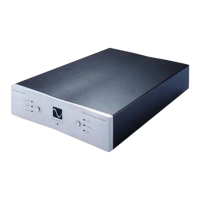
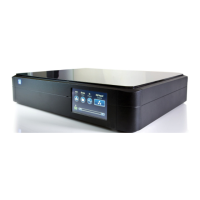
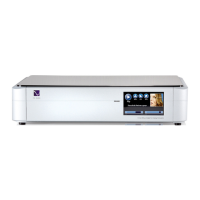
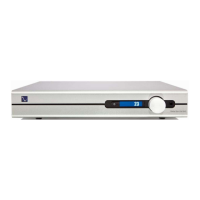
Owner’s Reference DirectStream Junior
4826 Sterling Drive, Boulder, CO 80301
PH: 720.406.8946 service@psaudio.com www.psaudio.com
©2016 PS Audio Inc. All rights reserved.
Introduction
®
Most output schemes for DSD modulators are active low pass lters, covering the required
120dB S/N ratio from 10Hz to 220MHz and have a number of design challenges and
problems associated with even the best designs.
If the analog processing isn’t linear and doesn’t have a very wide bandwidth it will modulate the
high frequency noise that’s inherent in DSD back into the audio band. That modulation will not
result in just low level noise. In practice it will be aliased back into the audible band with serious
sonic consequences. To maintain low noise and linearity, the design incorporates both high speed
symmetrical video amps and a passive output lter.
The rst challenge in such a design is the output switch that generates the nal 1’s and 0’s of the
modulator. A very clean switch that hooks up the positive rail with a 1 and the negative rail with
a 0 is essential. If it has too much resistance, if the resistance is dierent at the positive end than
the negative end, if the resistance changes from time to time, … the result will not be as clean as
it needs to be. For 120dB S/N the switch resistance has to be quite consistent.
Another design requirement is consistent and fast switching time. If the switch is too slow it won’t
keep up with the 5.6MHz signal used in this instrument. If the switch doesn’t react in consistent
times it will introduce jitter. Use of traditional CMOS gates adds a lot of jitter as do cross-coupled
totem-poled bipolar transistors. Instead, DirectStream Junior relies on high speed dierential
video amps, which are essentially class A switches, have their outputs either near the top rail or
near the bottom power supply rail (without ever saturating) and provide a very clean DSD switch.
For the all important low pass ltering requirements an active lter adds self noise even if it is
eectively lowering incoming noise. A unique and eective solution to this problem is a passive
lter.
The theory of operation, the rmware and the complex algorithms needed to execute a design of
this magnitude are daunting in their scale and scope. The actual hardware to run the instrument is,
perhaps, easier to grasp although no less critical to the perfected performance.
Listed in this section are the highlights of the hardware, system’s overview and design choices
made to create an instrument of this caliber.
1. DirectStream Junior runs from one master clock designed to subtend all possible combinations
of sub-clocks, from 44.1, 88.2, 48, 96, etc in order to eliminate the need for multiple clocks that
cause errors and problems associated when noise from the unused clock propagates to the
desired clock.
2. All sample rates supported are synchronously upsampled to 10x the standard DSD sample
rate and then back down to double rate DSD (2 * 64 * 44.1kHz). There’s no need for other clocks
to interpret the inputs, no matter what their sample rate, because of the instrument’s single clock
architecture.
No active ltering
Design
challenges
Hardware
Highlights


 To Next Page