This document is an owner's manual for PUR Under Sink Quick-Connect Reverse Osmosis Filtration Systems, covering models PQC3RO, PQC4RO, and PQC5RO. It provides comprehensive information on installation, operation, maintenance, troubleshooting, performance data, and replacement parts.
Function Description:
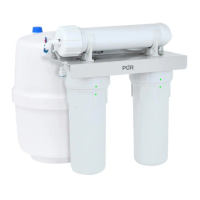
The PUR Under Sink Quick-Connect Reverse Osmosis Filtration Systems are designed to provide filtered drinking water by reducing various contaminants from the supply water. These systems utilize a multi-stage filtration process, including sediment, carbon block, and reverse osmosis (RO) membranes, to purify water for household use. The quick-connect design simplifies filter installation and replacement. The systems are intended for cold water use only and are equipped with an automatic shut-off control. An optional refrigerator hook-up is also described, allowing filtered water to be supplied to an ice maker or water dispenser.
Important Technical Specifications:
The systems operate within specific supply water parameters:
- Supply Water Pressure Limits: 40 - 100 psi (276-689 kPa)
- Supply Water Temperature Limits: 40 - 113°F (4.4 - 45°C)
- Maximum Water pH Limits: 4-10
- Maximum Total Dissolved Solids (TDS): 2,000 ppm
- Maximum Water Hardness at 6.9 pH: 10 gpg
- Maximum Iron / Manganese / Hydrogen Sulfide: 0.2/0/0 mg/L
- Maximum Chlorine in Supply Water: 2.0 ppm
- Automatic Shut-off Control: Yes
The performance data indicates significant reduction of various contaminants:
- Chlorine (NSF Standard 42): ≥ 50% reduction (tested at 91.8% for PQC3RO & PQC4RO post filter only)
- Particulate Class III (NSF Standard 42): ≥ 85% reduction (tested at 99.9% for PQC3RO & PQC4RO post filter only)
- Arsenic (Pentavalent) (NSF Standard 58): 0.30 mg/L influent, 0.010 mg/L max allowed, 99.2% reduction (tested at 0.007 mg/L)
- Barium (NSF Standard 58): 10.0 mg/L influent, 2.0 mg/L max allowed, 97.6% reduction (tested at 0.43 mg/L)
- Cadmium (NSF Standard 58): 0.03 mg/L influent, 0.005 mg/L max allowed, 98.1% reduction (tested at 0.0014 mg/L)
- Chromium (Hexavalent) (NSF Standard 58): 0.30 mg/L influent, 0.10 mg/L max allowed, 98.5% reduction (tested at 0.009 mg/L)
- Chromium (Trivalent) (NSF Standard 58): 0.30 mg/L influent, 0.10 mg/L max allowed, 96.7% reduction (tested at 0.010 mg/L)
- Copper (NSF Standard 58): 3.0 mg/L influent, 1.3 mg/L max allowed, 98.7% reduction (tested at 0.1 mg/L)
- Fluoride (NSF Standard 58): 8.0 mg/L influent, 1.5 mg/L max allowed, 95.7% reduction (tested at 0.4 mg/L)
- Lead (NSF Standard 58): 0.15 mg/L influent, 0.010 mg/L max allowed, 96.6% reduction (tested at 0.005 mg/L)
- Radium 226/228 (NSF Standard 58): 25 pCi/L influent, 5 pCi/L max allowed, 80% reduction (tested at 5 pCi/L)
- Selenium (NSF Standard 58): 0.10 mg/L influent, 0.05 mg/L max allowed, 97.9% reduction (tested at 0.002 mg/L)
- TDS (NSF Standard 58): 750 ± 40 mg/L influent, 187 mg/L max allowed, 96.7% reduction (tested at 25 mg/L)
- Cyst (NSF Standard 58): ≥ 50,000 /mL influent, 99.95% reduction (tested at 99.99%)
- Turbidity (NSF Standard 58): 11 ± 1 NTU influent, 0.5 NTU max allowed, > 99.1% reduction (tested at < 0.1 NTU)
- Daily Production Rate: 20.3 gpd
- Efficiency: 14.97%
- Recovery: 27.81%
Usage Features:
The manual emphasizes several key usage features:
- Quick-Connect Filters: The system uses quick-connect filters, making installation and replacement straightforward. Filters are unlocked by sliding a tab, lifted, turned 1/4 turn, and then locked back into position.
- Color-Coded Tubing: All tubing is color-coded (black, red, yellow, blue, 3/8" black) to simplify connections during installation, corresponding to specific functions (waste water, cold water inlet, RO membrane to storage tank, system outlet to faucet, faucet to drain clamp).
- Air Gap Faucet: The system includes an air gap faucet, which is generally required by plumbing codes in the US and Canada, to prevent waste water contamination of the RO filters in case of a drain line blockage.
- Storage Tank: A storage tank is included to ensure a liberal flow of filtered water from the faucet, as the RO process is slow. It takes approximately 2 hours to completely fill the storage tank.
- Start-up Procedure: A specific start-up procedure is outlined, including turning on valves, ensuring the RO faucet is closed, slowly opening the cold water supply, checking for leaks, and purging at least two tanks of RO water before consumption.
- Refrigerator Hook-up (Optional): Instructions are provided for connecting the RO system to a refrigerator's ice maker or water dispenser, recommending specific tubing types and the installation of an inline ball valve for maintenance.
Maintenance Features:
Regular maintenance is crucial for the system's performance and longevity:
- Filter Replacement Schedule: Filters must be replaced periodically to protect the RO membrane from chlorine and prevent clogging.
- PQC3RO: Carbon Block Filters (PQCCRB) for 1st and 3rd stages every 6 months. RO Membrane (PQCROM) for 2nd stage every 24 months.
- PQC4RO: Sediment Filter (PQCSED) for 1st stage and Carbon Block Filters (PQCCRB) for 2nd and 4th stages every 6 months. RO Membrane (PQCROM) for 3rd stage every 24 months.
- PQC5RO: Sediment Filter (PQCSED) for 1st stage and Carbon Block Filters (PQCCRB) for 2nd and 3rd stages every 6 months. RO Membrane (PQCROM) for 4th stage every 24 months. Granular Activated Carbon (GAC) Polishing Filter (PROPF) for 5th stage every 6 months.
- Filter Replacement Procedure: Detailed steps are provided for un-installing and installing quick-connect filters, including unlocking tabs, turning filters, and sliding tabs to lock.
- RO Membrane Replacement: The RO membrane is critical for contaminant reduction and should be replaced every 24 months. The manual outlines how to remove and install the membrane housing.
- GAC Polishing Filter Replacement (PQC5RO only): Specific instructions are given for removing and installing the GAC polishing filter, including disconnecting and reconnecting tubing with horseshoe clips.
- Troubleshooting Guide: A comprehensive troubleshooting guide helps users diagnose and resolve common issues such as milky colored water, noise from the faucet, slow water production, offensive water taste/smell, no drain water, and water leaks. Solutions range from checking tubing and air pressure to replacing filters and membranes.
- Warranty: A limited warranty of one year from the date of retail sale covers defects in material and workmanship. It specifies conditions for coverage, what is not covered (e.g., misuse, lack of maintenance, non-OEM parts), and the claims handling process.

 Need help?
 General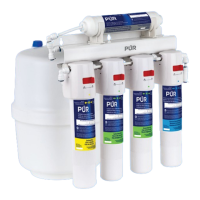

 To Next Page