The Quantek Model ZR1000 is a portable, battery or AC-operated oxygen analyzer designed for measuring O2 in inert gases such as nitrogen, argon, and helium. It operates within a range of 0 to 1000 ppm oxygen, with a resolution of 1 ppm. The device is powered by a universal adapter (100 to 240 Vac) or an optional internal gel battery, providing approximately 8 hours of operation before recharging is needed.
Function Description:
The ZR1000 utilizes a heated miniature zirconia oxygen sensor, which is unaffected by inert gases like nitrogen or carbon dioxide. However, exposure to hydrocarbon gases, CO, or other oxidizable gases can poison the sensor. The sensor has a typical lifetime of 5 years and is totally sealed, operating at an elevated temperature. The device provides a real-time readout of O2 concentration on an LCD display. Sample gas flows through an inlet fitting and tubing to the sensor, then out to a vent.
Important Technical Specifications:
- Range: 0 to 1000 ppm Oxygen
- Resolution: 1 ppm Oxygen
- Accuracy: ± 5 ppm above 500 ppm; ± 2 ppm between 100 and 500 ppm; ± 1 ppm between 0 and 100 ppm
- Drift: Less than 1 ppm per six months
- Sensor Type: Proprietary zirconia cell, expected lifetime 4-5 years
- Warmup Time: 5 minutes
- Power Supply: 100-240VAC to 12 Vdc adapter (internationally compatible power supply/charger)
- Backup Power: (Optional) internal 12V NiMH battery pack
- Input Voltage: 100-240V, 50-60Hz
- Battery Life: 8-10 hours before recharging
- Size: 9.8in x 4in x 10in. (249 x 102 x 254 mm)
- Weight: 8 lb. (3.6 Kg)
- Standards: CE, RoHS compliant
- Analog Output (Optional): Typically 0-3Vdc or 4-20mA, linear to concentration.
Usage Features:
The ZR1000 includes operating controls and adjustments such as a power switch, pump switch (for optional internal pump), span, zero, and pump time adjustments. For AC-only units, the LOW BATT LED is not present. Units without an internal pump do not have the PUMP switch and SAMPLE LED.
Flow Rate Control:
Controlling the flow rate is critical for accurate readings.
- Without Internal Pump: A flow rate of 800 – 1000 cc/min is recommended. Lower flow rates produce higher readings, and higher flow rates produce lower readings. The ideal flow rate entering the analyzer is 1 L/min. If injecting gas, a flow meter at the inlet is recommended. Operating at flow rates other than 1 L/min requires recalibration of the O2 span and zero.
- With Optional Internal Pump: The internal sampling pump draws about 5 cc/second (~300 cc/min). The instrument is calibrated for best accuracy using the pump. The pump time can be adjusted between 2 and 12 seconds via a potentiometer. For accurate readings, the pump should operate for at least two minutes, requiring about 1 L of sample. The pump can be operated continuously by "clicking" the pump button into place, provided the analyzer is not drawing on a vacuum or significantly less than 1.0 atm.
- Important Note for Pumped Units: Do not flow 1 L/min through an analyzer equipped with a pump without recalibrating. Do not press the pump button and flow gas directly into the instrument simultaneously, as this can damage the pump if the injected flow rate exceeds 1 L/min. If using a pumped unit, either use it with the pump running as calibrated, inject gas at 300 cc/min (to avoid recalibration), or inject at 1 L/min and recalibrate.
Response Time:
- At recommended flow rate (1 L/min):
- 7 seconds from 1000 to 100 ppm
- 15 seconds from 100 to 10 ppm
- Up to 3 minutes for 10 ppm to 0 ppm
- Using the internal pump:
- 10 seconds from 1000 to 100 ppm
- 20 seconds from 100 to 10 ppm
- Up to 5 minutes for 10 ppm to 0 ppm
Environmental Conditions:
The analyzer should operate above freezing and below 50°C (30°F and 50°C). Gas flow should be conditioned to <50°C, <95% RH (non-condensing), and free of hydrocarbon, volatile, corrosive compounds, and particulate matter. Do not pressurize the sensor beyond 20 psig to avoid damage and erroneous readings.
Calibration:
Calibration is performed using standard gas and adjusters on the back of the analyzer. It is recommended once per year.
- O2 Span Setting: Checked by sampling a calibration standard (100-1000 ppm). Adjusted with the O2 SPAN potentiometer. The instrument is factory-calibrated for best accuracy across the range but can be calibrated to any specific point to maximize accuracy in a particular section of the range (e.g., 50 ppm for 0-100 ppm accuracy).
- O2 Zero Setting: Checked by sampling N2. The zero should read 0 ppm (± 2 ppm O2). Adjusted with the O2 ZERO potentiometer using N2 or another inert gas (helium, argon). This adjustment affects all readings and must be done carefully.
- Analog Output Calibration: Calibration of the analyzer affects both the LCD and the analog output.
Maintenance Features:
- Sensor Preservation: Check valves on the sensor exit limit exposure to ambient air (20.9% O2). Long-term exposure to ambient air shortens sensor life by about 3 months. It is best practice to limit oxygen exposure to the sensor if possible.
- Storage: If possible, flush the instrument with pure nitrogen and clamp the inlet before storage to extend sensor life and facilitate flushing upon startup.
- Power Management: Turn the unit off when not in use. Reduction in sensor life is more affected by the amount of time the instrument is on. If stored off for 2 years, the sensor can last a total of 7 years from the date of shipment.
- Battery Maintenance (for battery-operated units): Remove the fuse if stored for more than 2 weeks to prevent battery discharge.
- Cleaning: Avoid getting liquids into the unit through the sample port. Do not immerse in water or spray water on the unit.
- Sample Integrity: Do not test moist samples, as moisture will damage the sensor.
- Power Supply: Use only the supplied 12V, center-positive, 2.1mm, >1A power supply.
Included Items:
- Adjustment screwdriver
- Owners manual (includes detailed calibration instructions, calibration certificate, precautions)
- NIST calibration certificate
Interfering Gases:
- May interfere with readings: NO2 (nitrogen dioxide), NOx (nitrogen oxides), NH3 (ammonia).
- May negatively impact sensor life: Halogens, F2, Chlorine, HCL, HF, SO2, H2S, Freons, CFCs; SiO2, Si, Platinum, Zn, Cd, Pb, Bi.

 Need help?
 General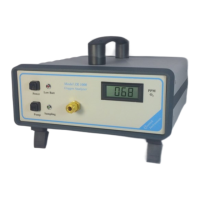

 To Next Page