www.qutools.com quED Manual 25
Measurement of correlation curves
The simplest test to verify entanglement of photon pairs generated in the quED involves a
measurement of correlation curves in two non-orthogonal complementary bases. This is
accomplished by fixing the orientation of one polarizing filter and continuously changing the
orientation of the other. The two settings and are usually chosen for
convenience, corresponding to the measurement in horizontal/vertical polarization basis and
the diagonal basis, respectively; (zero angle corresponds to horizontal polarization). The
recorded coincidence count rates for the two settings show the
dependencies in
analogy to the Malus’ law. This observation demonstrates the impossibility of finding a
measurement basis, in which the polarization state of the photon pairs is separable - the two-
photon state is entangled. On the other hand, the single count rates show no dependence on
the orientation whatsoever. Thus, the outcome of a state-measurement on one of the two
photons is completely random.
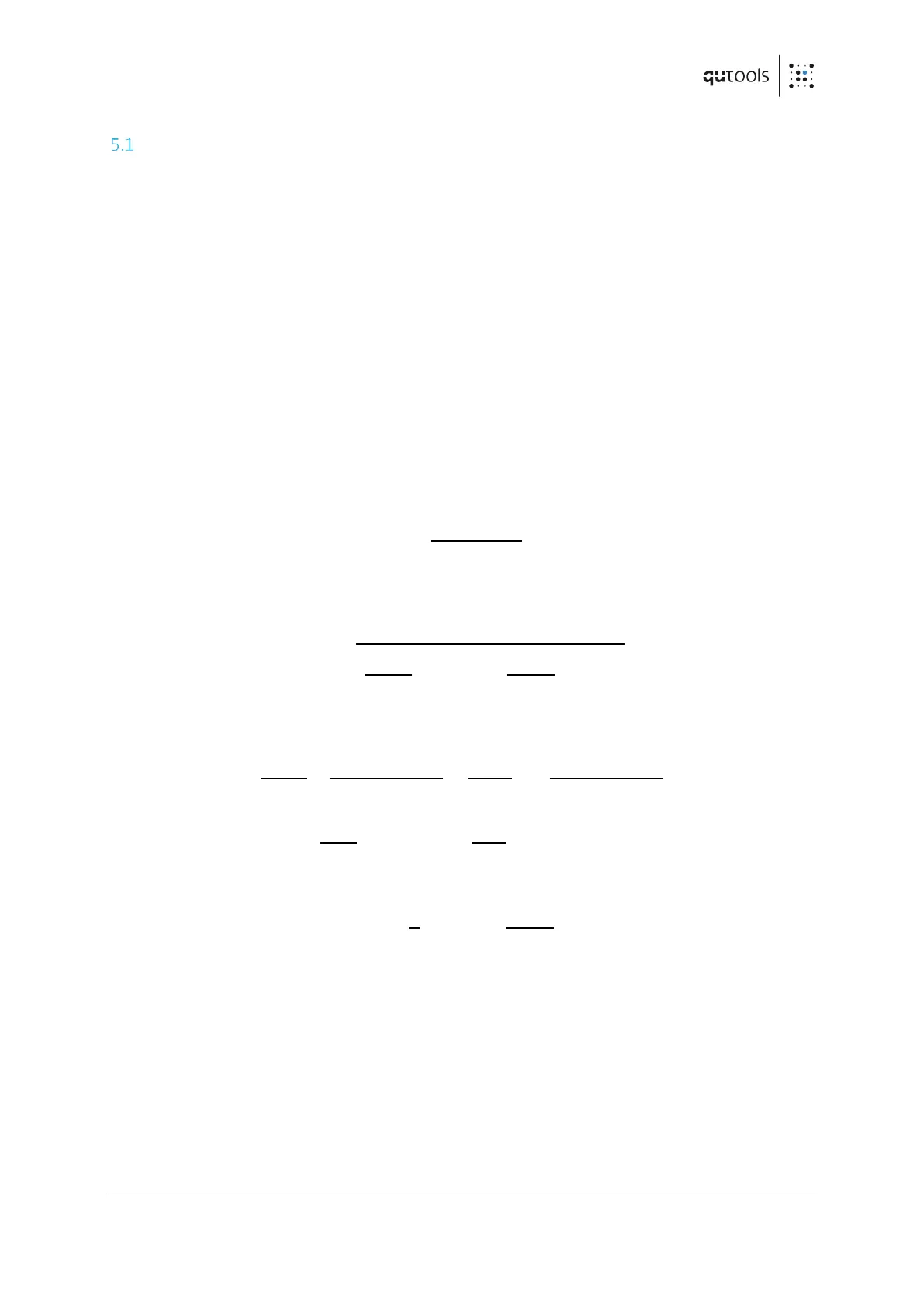
To quantify the quality of the polarization correlations, the visibility of measured curves can
be directly estimated from the formula:
where
is the /minimum coincidence count rate. The error on the visibility is
determined by applying the Gaussian error propagation rule:
where
and the acquired coincidence rates are assumed to be statistically independent Poisson random
variables, so that
and
. A more precise determination of the
visibility follows from the best fit to the measured data using the function:
where ,
, V, are the fitting parameters determining the curve amplitude, center, visibility
and periodicity, respectively.



 To Next Page