4 quED Manual www.qutools.com
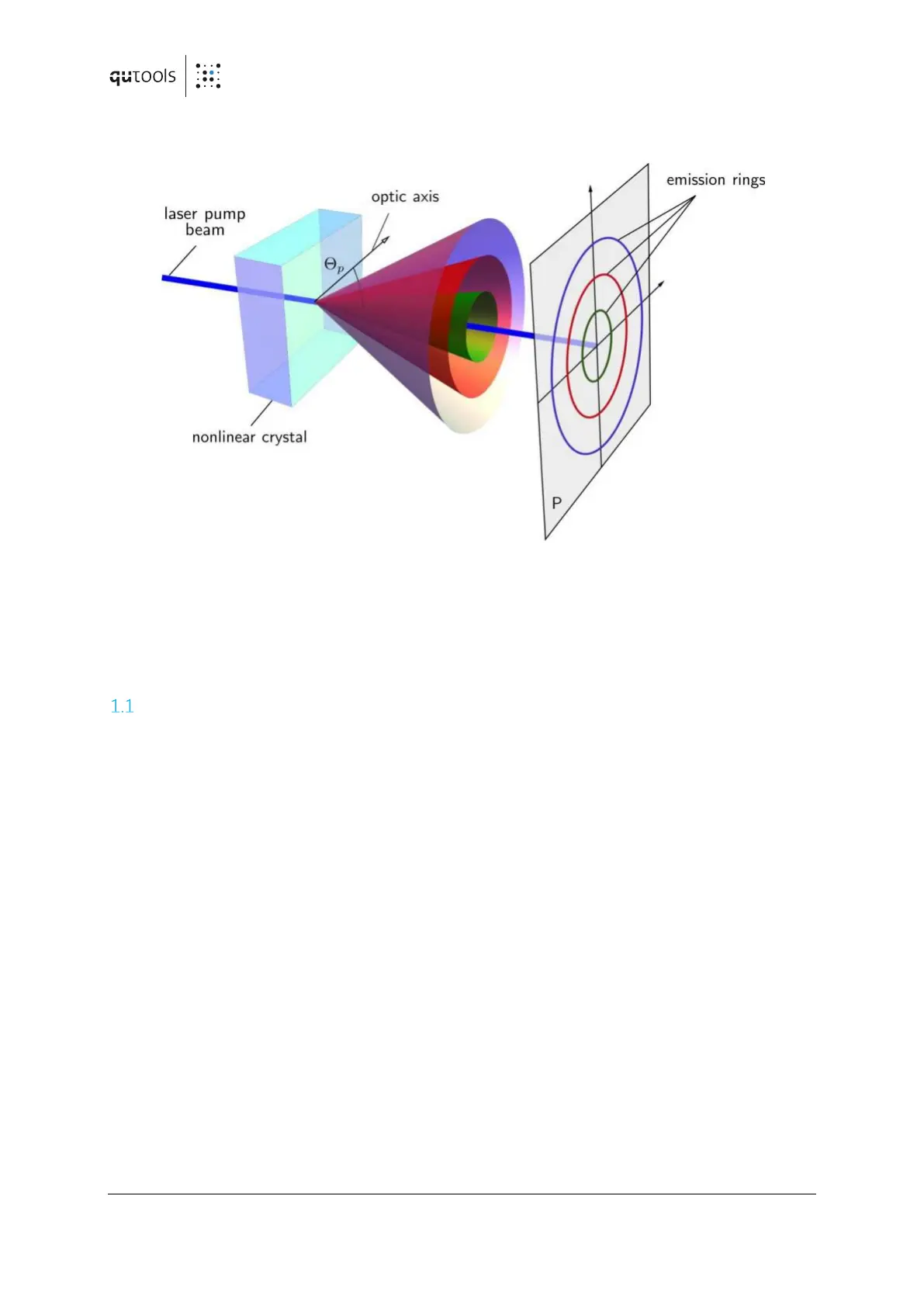
Figure 1: Spatial distribution of the down-conversion emission for type I phase matching. The
transverse momentum conservation requires that down-conversion photons have to emerge
from the crystal along the directions lying always on exactly opposite sides of the cone.
Basic Principles of Operation
To generate entangled photon pairs, a second-order nonlinear process, usually referred to as
spontaneous parametric down-conversion (SPDC), is used in the quED. In the SPDC process
photons of an intense laser pump beam spontaneously convert in a nonlinear crystal with a
very low probability (≈
for standard materials) into pairs of lower-frequency photons. Due
to energy and momentum conservation in the nonlinear interaction the possible wavelengths
and emission directions of the generated photons are severely constrained. Consequently, the
emission pattern is formed by cones, which imprint the characteristic rings in the plane (P)
perpendicular to the pump-beam direction. In type I phase matching the cones are concentric
around the pump direction, as illustrated in Figure 1. Every cone corresponds to a distinct
emitted wavelength. The opening angles of the emission cones thus depend on the
wavelengths of the emitted photons, but also on the angle
between the pump direction and
the optical axis; (the smaller the angle
, the smaller the opening of the cone with a given
wavelength). This allows to angle tune the spatial emission of down-conversion photons as
required.



 To Next Page