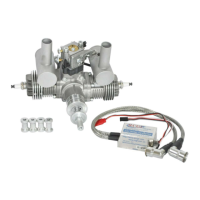
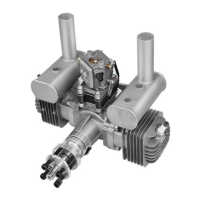
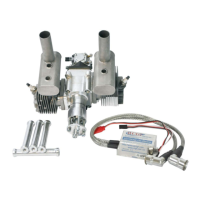
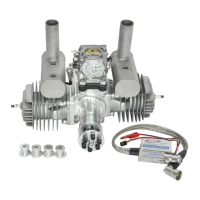
Need help?
Do you have a question about the RCGF 40CC-Twin and is the answer not in the manual?
Type, displacement, bore x stroke, carburetor, ignition system, power supply, and required items for the RCGF 40cc twin engine.
Engine maximum output, speed range, recommended fuel mix, lubrication oil, and propeller suggestions.
Information on engine weight components, technical data like fuel mix ratios, and static thrust.
A list of included spare parts for the RCGF 40cc twin engine.
Crucial safety advice for operating the engine, emphasizing safe practices and potential hazards.
Warnings related to propeller use, fuel lines, handling hot engines, and transporting the model.
Initial checks and preparations before mounting the engine, ensuring all parts are secure and functional.
Step-by-step guide for drilling propeller holes and securely mounting the propeller to the engine.
Detailed procedures for adjusting idle speed, low-speed, and high-speed needles for optimal performance.
Recommended method for starting the engine manually, with safety notes and steps.
Recommended method for starting the engine using an electric starter, with steps.
Common engine issues, their diagnosis, and fixes for starting and running problems.
Instructions for connecting and using an optional digital tachometer to monitor engine RPM.
Details on the engine's warranty period, service terms, and contact information for support.
Visual breakdown and list of spare engine parts with corresponding accessory numbers.
This document outlines the operation, installation, and maintenance procedures for the RCGF 40CC-Twin engine, a gasoline-powered, two-cycle piston valve engine designed for model aircraft. The manual emphasizes safety, proper setup, and troubleshooting to ensure optimal performance and longevity of the engine.
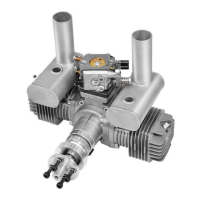
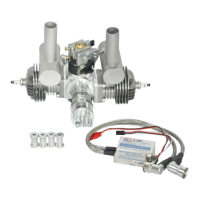
The RCGF 40CC-Twin is a high-performance gasoline engine specifically engineered for model airplanes. It operates on a two-cycle principle, utilizing a piston valve type mechanism. The engine is equipped with a DC-CDI (Computer Controlled auto advance, electronic ignition system) for precise ignition timing, contributing to its efficiency and power output. It requires a specific fuel mixture of gasoline and two-cycle engine oil, with a recommended ratio of 30:1 for optimal performance and engine life. The engine is designed to run within a speed range of 1500-8500 rpm, offering a balance of idle stability and high-speed power. It is air-cooled, simplifying its design and reducing weight. The engine package includes essential components such as the electronic CDI ignition module, mufflers, spark plugs, gaskets, bolts, a throttle arm extension, and the operator's manual, providing a comprehensive solution for model aircraft enthusiasts.
The RCGF 40CC-Twin engine is designed for straightforward installation and operation, though it requires careful attention to detail. Before installation, all screws and bolts must be checked for tightness, and any damaged or missing parts should be replaced. The engine should be mounted securely to a firewall of at least 9.5mm [3/8"] thick, preferably made of 5-ply plywood, reinforced with triangle stock and hardwood dowels to withstand the engine's power. Threadlocking compound is recommended for all mounting screws.
Fuel system setup is critical, requiring gasoline-approved fuel tanks, lines, and stoppers. A 2-line or 3-line system can be used for fueling, with the carburetor line serving as a fill line or a dedicated third line for cleaner fueling. It is crucial to use gasoline-approved vinyl or neoprene rubber fuel lines, as silicone lines will be dissolved by gasoline. Fuel should always be filtered before entering the tank to prevent carburetor clogging.
The ignition system involves connecting the pick-up lead from the engine to the electronic ignition module, securing connections with a three-pin connector clip. The kill switch lead connects to the red connector on the ignition module, and the ignition module battery (4.8-8.4V, 1000mAh or above) connects to the kill switch. The ignition module should be securely installed in the aircraft's forward area, preferably with foam rubber cushioning and Velcro to absorb vibrations.
Propeller installation is a key step, requiring precise drilling to fit the hub. Most propellers come with a pre-drilled 10mm center hole. For drilling the outer holes, the engine should be set at the top of the compression stroke, and the propeller placed at the one o'clock position to mark the hole locations accurately. A drill press with a 2.81mm pilot bit and a 5mm finishing bit is recommended for clean holes. Threadlocker should be used when mounting the propeller to the engine.
Starting the engine can be done manually or with an electric starter. For manual starting, a thick glove or starter stick is essential for safety. The propeller should be positioned at the one o'clock position at the beginning of the compression stroke. With the ignition ON, choke closed, and throttle slightly open, the propeller is flipped briskly until a popping sound indicates firing. The choke is then moved to the OPEN position, and the propeller is flipped again to start the engine. For electric starting, a 12-24V electric starter is recommended, following a similar sequence of choke, throttle, and ignition settings. After starting, the engine should idle for 30-45 seconds, and the throttle should be slowly opened and closed to ensure smooth operation and acceleration.
Regular maintenance is crucial for the RCGF 40CC-Twin engine's performance and longevity. The manual highlights several key maintenance aspects:
 General
| Displacement | 40cc |
|---|---|
| Carburetor | Walbro |
| Fuel Type | Gasoline |
| Engine Type | Gasoline engine |
| Ignition System | Electronic ignition |
| Recommended Fuel | 91 Octane Gasoline + 2 cycle oil (25:1) |
| Propeller | 18x8 |
| Power Supply | 4.8V-8.4V (4-7 NiMH/NiCd, 2S LiPo/LiFe) |

 To Next Page