Need help?
Do you have a question about the Redarc BCDC Series and is the answer not in the manual?
Highlights danger of explosive gases from lead-acid batteries during operation.
Explains signal words (Warning, Caution, Notice) and their hazard levels.
Overview of the 7 LEDs on the unit for status indication.
Explains the 4 charging profiles and LED status.
Details Solar, Vehicle, and Stage LED functions.
Describes Boost, Absorption, and Float stages of the charging cycle.
Details the initial current ramp-up for the BCDC1250D model.
Lists voltage thresholds for charger activation and deactivation.
Explains LED flashing sequences indicating fault types.
Describes the periodic test mode for input conditions and battery presence.
Guidance on mounting the unit considering heat and airflow for optimal performance.
How to select charge profiles for different battery types using the orange wire.
Configuration of the blue wire for standard or low voltage trigger modes.
Details required cable thickness and length for various connections.
Advises on creating secure, low-resistance electrical connections.
Recommends MIDI fuses and explains why they are preferred over blade fuses.
Illustrates typical wiring for lead-acid and LiFePO4 battery setups.
Instructions for connecting multiple solar panels and avoiding regulated types.
Steps to diagnose when no LEDs are lit on the unit.
Explains causes and checks for a flashing charge profile LED.
Steps to diagnose why the Solar LED is off when solar is connected.
Steps to diagnose why the Vehicle LED is off when vehicle power is connected.
Provides information on checking full warranty terms and conditions via the website.
Instructs users on where to find the product serial number for identification.
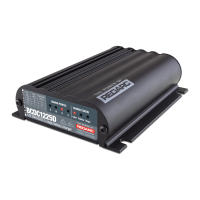
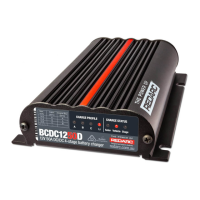
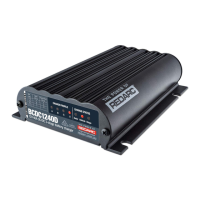
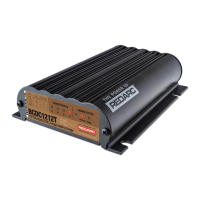
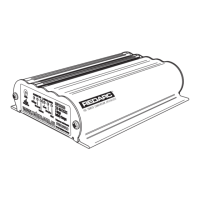
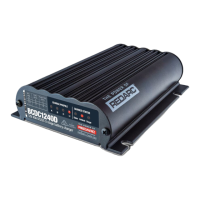
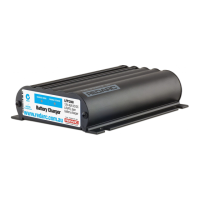
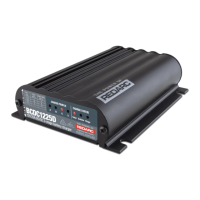
The REDARC BCDC Dual Input Multi-Stage In-Vehicle Battery Charger is a sophisticated device designed to efficiently charge auxiliary batteries in vehicles. It comes in three models: BCDC1225D (25 A), BCDC1240D (40 A), and BCDC1250D (50 A), offering varying current outputs to suit different battery sizes and charging needs. This charger is engineered to ensure auxiliary batteries reach a full 100% charge, regardless of their type or size, making it a versatile solution for various automotive setups.
At its core, the BCDC Dual Input charger operates as a DC-DC battery charger, meaning it can take an input voltage and convert it to a different output voltage, either boosting or reducing it as required. This capability is crucial for maintaining optimal charging conditions for an auxiliary battery, especially when there's a significant voltage drop due to the distance from the main battery. The BCDC1225D and BCDC1240D models feature a three-stage charging profile (Boost, Absorption, and Float), while the BCDC1250D offers a four-stage profile, adding a Soft-Start stage for enhanced battery care.
A key feature of these chargers is their dual input capability, allowing them to draw power from both the vehicle's alternator (12 V or 24 V) and an unregulated 12 V nominal solar panel input. This intelligent design incorporates Maximum Power Point Tracking (MPPT) solar regulation, ensuring that the unit always extracts the maximum possible power from the solar input first. If the solar input alone cannot meet the charging demands, the charger will supplement the power from the vehicle input, up to its maximum rated output. This "Green Power Priority" technology optimizes energy usage and reduces reliance on the vehicle's alternator when solar power is abundant.
The BCDC Dual Input also functions as a battery isolator, automatically turning on and initiating charging when it detects that the vehicle has started, and similarly turning off when the vehicle is turned off. This prevents the auxiliary battery from over-discharging the main start battery, safeguarding the vehicle's primary power source. The charger is compatible with a wide range of 12 V automotive lead-acid batteries, including Standard Lead Acid, Calcium Content, Gel, AGM, SLI, and Deep Cycle types, as well as LiFePO4 lithium batteries. For LiFePO4 batteries, it's essential that they feature an inbuilt battery management system with under and over voltage protection and cell balancing.
The BCDC Dual Input charger is designed for user-friendly operation with a clear display panel featuring seven LEDs. These LEDs provide visual feedback on the selected charge profile and the current charge status. There are four distinct charging profiles (A, B, C, and Li) that can be selected by connecting the ORANGE wire in different configurations (disconnected, to ground, to the RED wire, or to the GREEN wire). This allows users to tailor the charging voltage to the specific requirements of their auxiliary battery, ensuring optimal charging and longevity. It's crucial to consult the battery manufacturer's specifications and the provided temperature chart when selecting a profile.
The "Charge Status" LEDs indicate which input sources (Solar and/or Vehicle) are active and the current stage of the charging process (Boost, Absorption, Float, and Soft-Start for the BCDC1250D). A solid profile LED signifies that the unit is ON and charging, while a flashing LED indicates standby mode. The Solar and Vehicle LEDs illuminate when their respective inputs are available and in use, and turn off when not. If both are on, both sources are contributing to the charge.
An optional external 12 V LED can be wired to provide remote charge status and error feedback, illuminating when charging, off when not charging, and flashing to indicate an error. The unit also features a battery test mode that runs every 100 seconds. This mode verifies input conditions and checks for the presence of a battery on the output, protecting the vehicle battery from over-discharge and the wiring from damage.
The charger incorporates various turn-on/off thresholds and safety shutdowns to protect both the unit and the connected batteries. These include input open circuit low voltage conditions, input loaded low voltage conditions, input overvoltage shutdown, and output undervoltage shutdown. The BLUE wire allows for selection between "Standard Trigger" (for fixed voltage or temperature compensating alternators) and "Low Voltage Trigger" (for variable voltage alternators), further enhancing its adaptability to different vehicle systems.
While the BCDC Dual Input charger is a robust device, proper installation and adherence to safety guidelines are crucial for its longevity and performance. The manual emphasizes the importance of correct cable sizing and fusing, recommending MIDI style bolt-down fuses (REDARC FK40 and FK60 kits) for their low resistance connection, and advising against blade type fuses or self-resetting circuit breakers.
The unit is designed to operate optimally below 55°C (130°F) with good airflow. If the ambient temperature rises above this, the unit will gradually de-rate its output current to protect itself and the battery, eventually turning off at 80°C (175°F). This thermal management system is an inherent maintenance feature, preventing damage from overheating.
In the event of a fault, the unit's LEDs will flash in specific sequences to indicate the type of fault, such as internal hardware fault, unit under/over temperature, output battery fault (volts too high), input under voltage, or input over voltage. These error codes provide valuable diagnostic information, simplifying troubleshooting. For instance, if the input from the vehicle or solar panel is undervoltage, the corresponding source LED will flash five times.
The charger's robust construction and intelligent design minimize the need for active user maintenance beyond ensuring proper installation and addressing any error codes that may arise. REDARC recommends using soldered butt splice crimp connections with heatshrink for heavy gauge wires to ensure a low resistance and long-lasting electrical connection, preventing issues like wire insulation breakdown, short circuits, or fire. The unit is not designed for user alteration or disassembly; any faulty units must be returned to REDARC for repair to maintain warranty validity and ensure safe operation.
 General
| Input Voltage Range | 9 - 32VDC |
|---|---|
| Battery Chemistry Compatibility | AGM, Gel, Lithium (LiFePO4) |
| Solar Input | Yes |
| Charging Stages | Bulk, Absorption, Float |
| Protection Features | Over-voltage, over-temperature, reverse polarity |
| Efficiency | 96% |
| Output Voltage | 12VDC |

 To Next Page