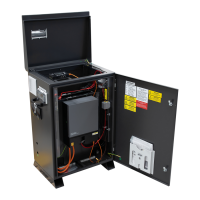
BushChook – Installation and Operation Manual
Page 7 of 48
Issue date: 19/12/2023. Version 1.1
Overview of the installation tasks
A typical complete installation of the BushChook home battery will require the electrical
connection of the following items. If the home is only off-grid then there is no need to connect
the grid or the feed-in meter/CT, but a backup generator will very likely be required.
Note: Differences between 1-phase and 3-phase systems are highlighted where necessary.
1.
Grid:
AC cables run from the MSB (Main switchboard) directly to the grid terminals
inside the BushChook system. In 3-phase system observe the correct phase
rotation.
2.
Feed-in Meter/CT
(supplied) Required for on-grid systems that are not installed as
whole home backup. It is installed in the MSB and connected to the BushChook
system via a Cat5/6 cable or similar (not supplied).
The information from this meter
affects the operation of the BushChook system, make sure both the wires and CT
are connected the right way around.
o In addition to the Feed-in meter the MSB will also require a MCB to be installed
to allow the BushChook system to be isolated, for example to work on the MSB.
3.
Load:
AC cables from the MSB directly to the Load terminals inside the BushChook
system.
o
Note:
The BushChook system is designed as a whole home backup system,
however if the loads in a particular house are greater than the capacity of the
BushChook system then the loads inside the MSB will need to be split to ensure
that the backed-up circuits do not overload the BushChook system.
o The BushChook 3-ph is rated at 12kW and the 1-phase at either 8kW or 5kW,
depending on which system was ordered. Loads such as pool pumps and under
floor heating should probably not be backed up.
o Putting too many loads on the backed-up circuit can also empty the battery
quickly during an outage. In this case additional battery capacity may be
required. Note that the BushChook has a multi-purpose SMART Port that can act
as a Smart load which can be programmed to turn off at a pre-determined
battery state-of-charge (SOC) leaving the remainder of the battery capacity for
more critical loads. see details below under
Optional - SMART Port connection.
4.
Solar:
The BushChook has 2 MPPTs. The 5KW 1-phase BushChook accepts up to 2
arrays of PV solar panels, the 8KW 1-phase BushChook accepts up to 4 arrays,
where each tracker accepts two strings in parallel. The maximum string voltage on
the 1-phase systems is 500Vdc. The 3-phase BushChook accepts up to 3 arrays,
where two of these are paralleled into one of the MPPTs. The maximum string
voltage on the 3-phase systems is 800Vdc, although 600Vdc may be the maximum
voltage allowed on a residential installation.
5.
Batteries:
The BushChook is pre-wired for up to eight Troppo batteries. Each Troppo
battery has a nominal capacity of 4.1kWh. The batteries need to be installed and
plugged in.
6.
Remote monitoring:
The BushChook system needs to be connected to the internet
to provide its full capabilities. Note this applies to both on-grid and off-grid
Installations. If no Internet connection is available, then no remote monitoring is
available for the BushChook system. RedEarth provides 4G internet during the first
3-month trial of any BushChook installation. After the 3-month trial the customer can
choose to join RedEarth's Optimum Customer Support program, and the 4G internet
option will continue, otherwise the customer can provide their own internet if they
want remote monitoring.



 To Next Page