© 2006 GE ECM by Regal-Beloit
- 44 -
Indoor Blower Motors
v0.2
Severe airflow restrictions may cause the motor to oscillate, sometimes called
huffing or hunting. This is when the motor appears to be speeding up and slowing
down over and over. This is due to the motor program hitting the speed limit and
backing off the motor torque, and then ramping back up again in an attempt to
maintain airflow.
Some manufacturers also have fault codes that indicate when the motor is at the
speed limit. The system may still be operating with this fault code or may be shut
down depending on how the fault code is applied. This is also typically an indication
of an airflow restriction, since we know that the wheel speed increases when
pressure increases.
Checking the External Static Pressure (ESP) of the system should be done at the
time of installation and is also a valuable troubleshooting tool. If all of the above
airside components are clean and there is still a restriction problem external static
pressure can help isolate where that problem is.
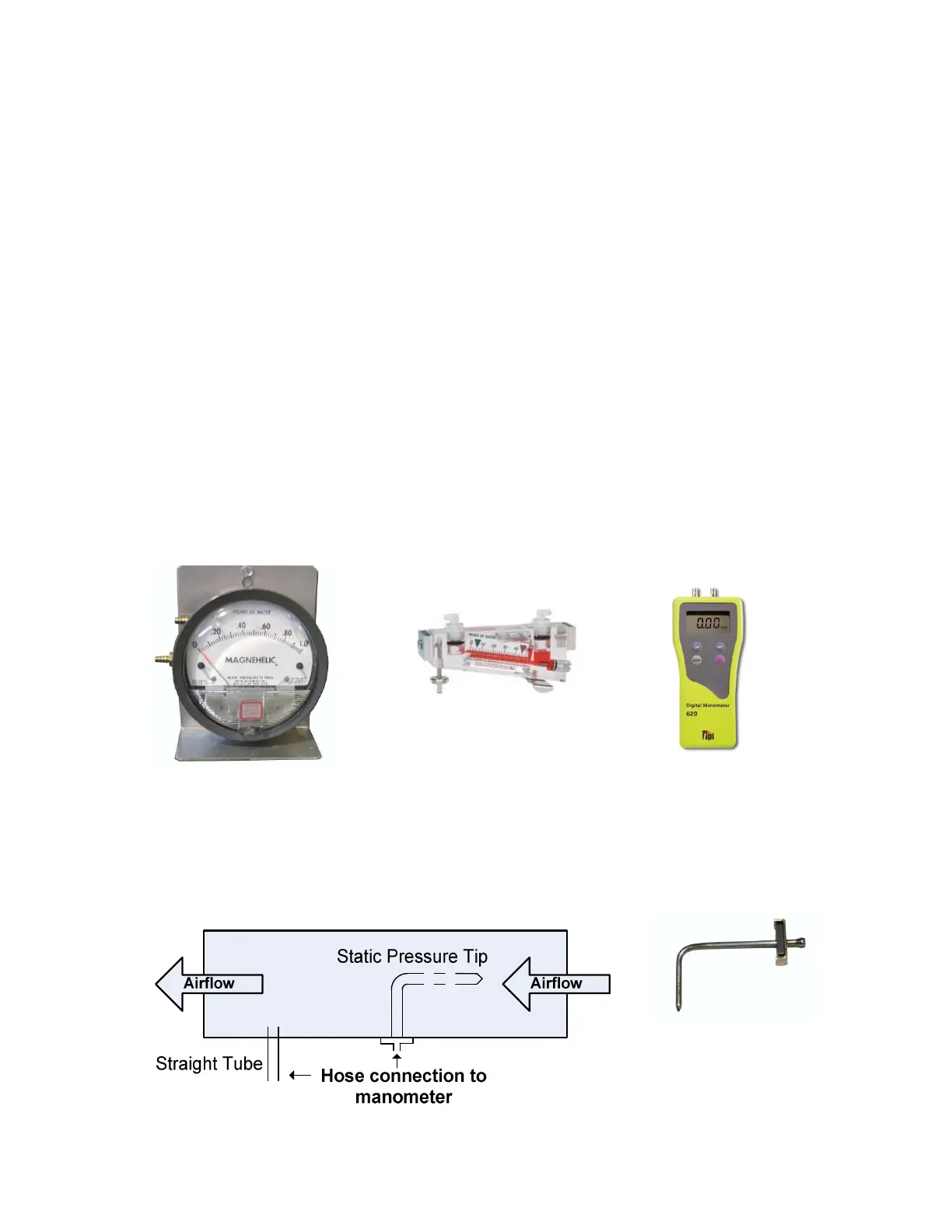
ESP (often simply called pressure) can be checked with most any analog or digital
manometer that can read down to 0.01 inches water column (in. wc.). However a
differential gauge is the most effective since it takes both readings at the same time.
Courtesy Dwyer Instruments and Test Products International (TPI)
A static pressure tip can also make the readings more accurate. However since
static pressure exerts force in all directions a straight tube can also be used.
Ductwork Static Pressure Tip
Incline Manometer



 To Next Page