EasyManua.ls Logo

Regency ULTIMATE U41FS-NG - Draft Hood; Venting

Regency ULTIMATE U41FS-NG
18 pages
Print Icon
To Next Page IconTo Next Page
To Previous Page IconTo Previous Page
Loading...
INSTALLATION
DRAFT
HOOD
The
heater
has
a
draft
hood
built
into
its
back.
It
must
not
be
altered,
obstructed,
or
blocked
in
any
way,
and
the
unit
must
be
installed
so
that
the
draft
hood
is
in
the
same
atmospheric
pressure
zone
as
the
combus¬
tion
air
inlet
to
the
burner.
VENTING
This
heater
is
a
vented
appliance
and
must
be
con¬
nected
to
a
chimney/flue
in
accordance
with
the
installation
codes.
Note:
The
rear
cover
plate
is
only
attached
when
outside
air
is
being
used.
If
using
room
air
for
combustion,
remove
the
cover
plate
from
the
back
of
the
pedestal.
For
your
safety
this
heater
is
equipped
with
a
vent
safety
switch
designed
to
sense
incorrect
venting
and
react
by
shutting
down
the
gas
supply.
This
thermally
actuated
switch
is
located
within
the
draft
hood
and
will
detect
either
a
blocked
chimney
or
backdraft
condition
where
the
chimney
flow
has
reversed.
If
this
switch
is
closing
the
unit
down,
it
indicates
a
drafting
problem
-
the
thermally
actuated
switch
must
never
be
by-passed
or
disconnected
as
a
hazardous
or
deadly
condition
can
result.
Venting
Requirements
A
minimum
four
inch
diameter
vent
is
required.
13-
Vent,
Class
A
or
Masonry
with
an
approved
liner
are
all
acceptable.
For
cosmetic
or
aesthetic
purposes
5"
or
6"
outer
vent
can
be
used
as
long
as
an
approved
inner
vent
is
installed.
Fasten
the
B-Vent
to
the
bracket
on
the
top
of
the
stove
with
one
sheet
metal
screw
but
do
not
penetrate
the
inner
sleeve
of
the
B-
Vent
when
tightening
the
screw.
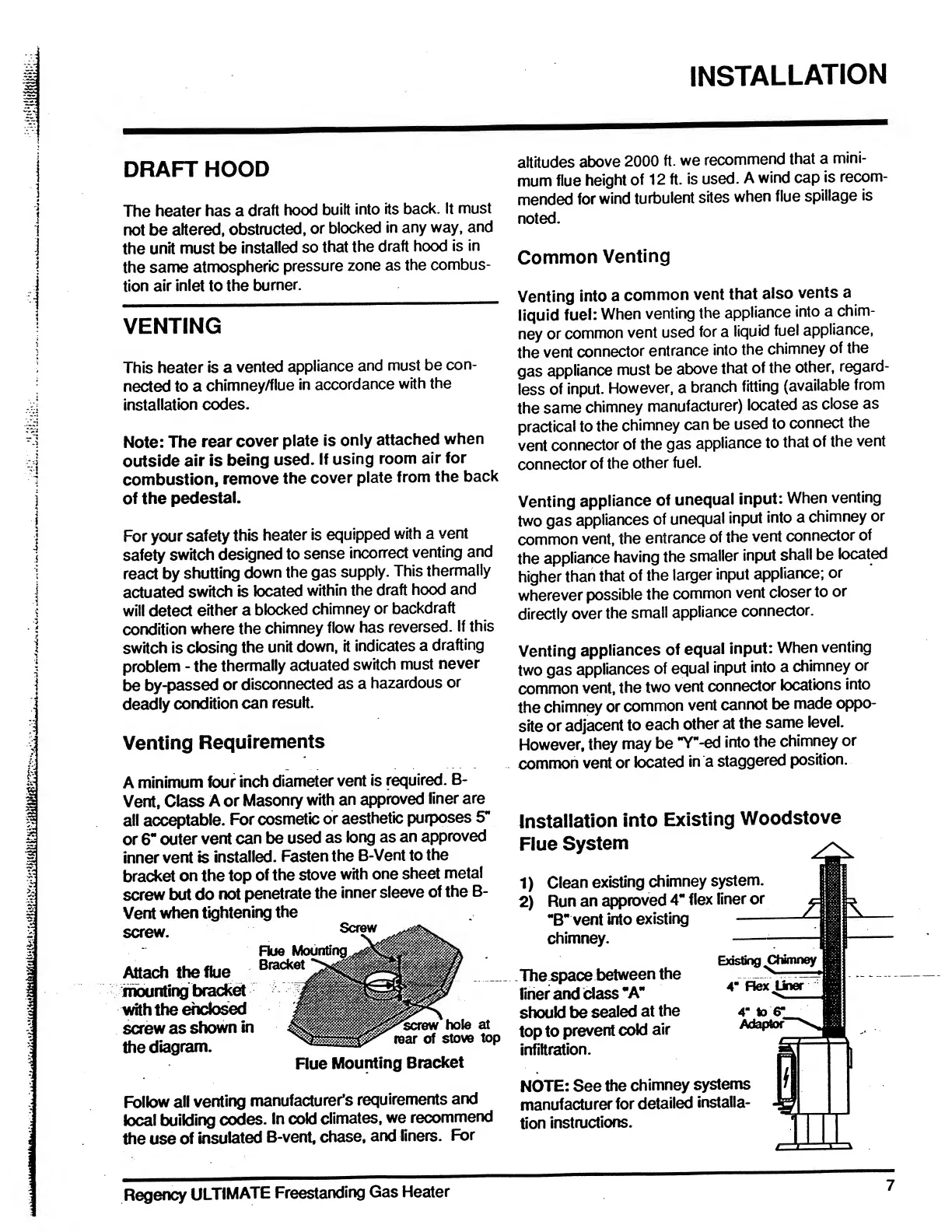
Attach
the
flue
mounting
bracket
with
the
enclosed
screw
as
shown
in
hole
at
the
diagram.
rear
of
stoVB
top
Flue
Mounting
Bracket
Screw
Flue
Mounting
Bracket
Follow
all
venting
manufacturer’s
requirements
and
local
building
codes.
In
cold
climates,
we
recommend
the
use
of
insulated
B-vent,
chase,
and
liners.
For
altitudes
above
2000
ft.
we
recommend
that
a
mini¬
mum
flue
height
of
12
ft.
is
used.
A
wind
cap
is
recom¬
mended
for
wind
turbulent
sites
when
flue
spillage
is
noted.
Common
Venting
Venting
into
a
common
vent
that
also
vents
a
liquid
fuel:
When
venting
the
appliance
into
a
chim¬
ney
or
common
vent
used
for
a
liquid
fuel
appliance,
the
vent
connector
entrance
into
the
chimney
of
the
gas
appliance
must
be
above
that
of
the
other,
regard¬
less
of
input.
However,
a
branch
fitting
(available
from
the
same
chimney
manufacturer)
located
as
close
as
practical
to
the
chimney
can
be
used
to
connect
the
vent
connector
of
the
gas
appliance
to
that
of
the
vent
connector
of
the
other
fuel.
Venting
appliance
of
unequal
input:
When
venting
two
gas
appliances
of
unequal
input
into
a
chimney
or
common
vent,
the
entrance
of
the
vent
connector
of
the
appliance
having
the
smaller
input
shall
be
located
higher
than
that
of
the
larger
input
appliance;
or
wherever
possible
the
common
vent
closer
to
or
directly
over
the
small
appliance
connector.
Venting
appliances
of
equal
input:
When
venting
two
gas
appliances
of
equal
input
into
a
chimney
or
common
vent,
the
two
vent
connector
locations
into
the
chimney
or
common
vent
cannot
be
made
oppo¬
site
or
adjacent
to
each
other
at
the
same
level.
However,
they
may
be
"Y"-ed
into
the
chimney
or
common
vent
or
located
in
a
staggered
position.
Installation
into
Existing
Woodstove
Flue
System
1)
Clean
existing
chimney
system.
2)
Run
an
approved
4”
flex
liner
or
“B"
vent
into
existing
chimney.
The
space
between
the
finer
and
class
"A"
should
be
sealed
at
the
top
to
prevent
cold
air
infiltration.
NOTE:
See
the
chimney
systems
manufacturer
for
detailed
installa¬
tion
instructions.
Regency
ULTIMATE
Freestanding
Gas
Heater
7

Related product manuals