Coil
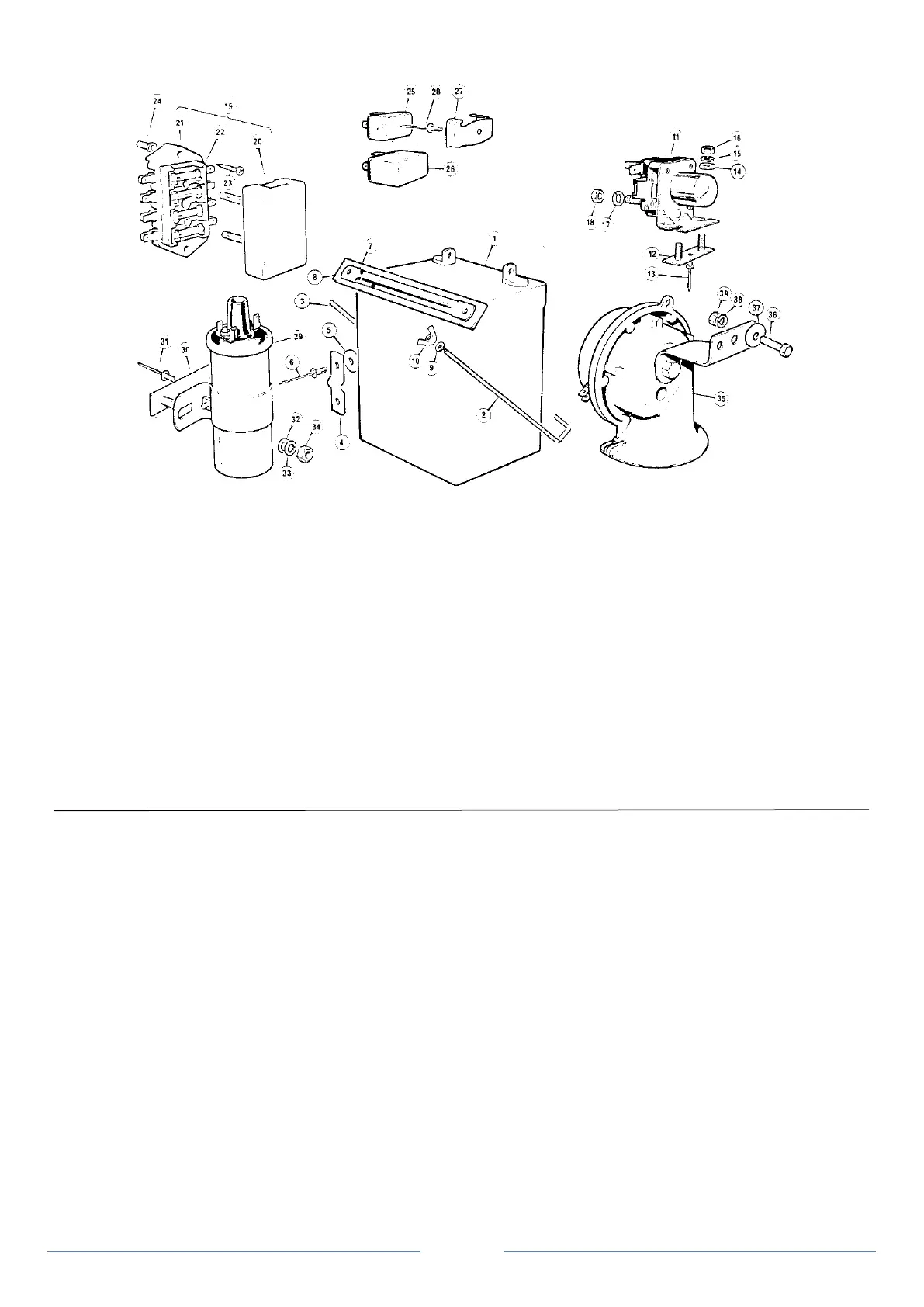
The coil is secured to its mounting plate on the front right-hand side
of the engine bay by two nuts, washers and lock washers. (Figure 19)
Very little attention to the coil is necessary aside from keeping the
terminals tight and the insulation clean.
The efficiency of the coil can be tested as follows:
1. Remove the distributor cap and turn the engine until the
points are closed.
2. Unplug the "king" lead (coil to distributor cap) from the
distributor cap and, whilst holding the cable approximately 6.0 mm
(0.25 in) from a good ground, open and close the points with a
screwdriver (ignition switched on). A strong blue spark should jump
from the end of the "king" lead to ground as the points are opened. If
the spark is pink, or weak then there is a problem which requires
further investigation. If there is no spark this might indicate a
defective coil. This can only be proved by substitution.
Note: The voltage generated in this test is very high. To avoid the
chance of an electric shock it is recommended that rubber gloves be
worn for this exercise.
Starter solenoid
The starter solenoid is secured to a mounting plate on the right-hand
side of the engine bay, by two nuts, washers and lock washers.
If difficulty is encountered when trying to start the engine a faulty
solenoid could be the cause but before replacing the unit, check all
connections and earths for cleanliness and security. (Figure 19)
Sparking plugs
Motocraft AGR 32 plugs are fitted as standard to all Kittens. The gap
should be maintained at 0.64 mm (0.025 in). as long as the
carburation and timing are correct a set of plugs should last for at
least 6,000 miles (10,000 km) without attention. When attention is
necessary the plugs should be cleaned on a specialised sand blasting
machine. If the plugs are worn or the electrodes badly eroded they
must be renewed to maintain acceptable engine performance. The
centre electrode of a plug in good condition should be square and flat
without signs of wear.
When setting the plug gap, only the side electrode should be adjusted,
being gently levered to obtain the required gap. On replacement
ensure that the plugs are screwed firmly home.
Plugs should be replaced every 12,000 miles (20,000 km).
Figure 19 General electrics - components
1. Battery 14 Washer 27. Clip
2. Front securing hook 15. Lock washer 28. Rivet
3. Rear securing hook 16. Nut 29. Ignition coil
4. Saddle plate 17. Lock washer 30. Coil bracket
5. Washer 18. Nut 31. Rivet
6. Rivet 19. Fuse box assembly 32. Washer
7. Clamping strap 20. Fuse box cover 33. Lock washer
8. Insulator 21. Fuse box body 34. Nut
9. Washer 22. Fuse 35. Horn
10. Wing nut 23. Screw 36. Screw
11. Starter solenoid 24. Insert 37. Coach washer
12. Solenoid mounting plate 25. Flasher unit 38. lock washer
13. Rivet 26. Hazard flasher relay 39. Nut



 To Next Page