Need help?
Do you have a question about the Retevis RB18 and is the answer not in the manual?
Lists the items included in the package for verification.
Instructions for charging and handling the Li-Ion battery pack.
Steps for installing the belt clip and optional audio accessories.
How to adjust volume and select radio channels for communication.
Using scan to find active channels and monitor to listen for signals.
How to lock the keypad and operate the built-in flashlight.
Accessing weather forecasts and managing voice prompt languages.
Detailed technical specifications of the radio device.
Solutions for common radio operational problems and issues.
Essential safety instructions for RF energy exposure and product usage.
FCC, CE, and IC compliance information and usage restrictions.
Warnings about choking hazards, hearing protection, and safe operation practices.
Precautions against burns and guidelines for approved accessories.
This document serves as a comprehensive user manual for the Retevis RB18 Two Way Radio, providing essential information for its operation, maintenance, and safety. The RB18 is designed for dependable and cost-effective communications, incorporating advanced technology and craftsmanship to ensure quality and a rich feature set.
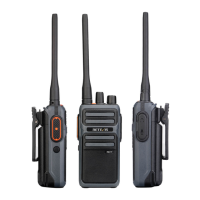
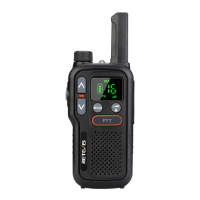
The Retevis RB18 is a professional two-way radio designed for reliable communication. Its core function involves transmitting and receiving radio frequency (RF) signals to facilitate communication between two or more users over a distance. The radio features a channel switch for selecting communication channels, a PTT (Push-to-Talk) button for initiating transmissions, and a power switch/volume control for managing the device and audio output. An LED indicator provides visual feedback on the radio's status, showing red during transmission and green during reception. The device also includes a screen area to display operational information, such as the current channel number, battery level, and various function indicators like CTCSS, DCS, VOX, and key lock status.
Beyond basic communication, the RB18 offers several advanced functions to enhance usability and security. It supports scanning, allowing the radio to quickly cycle through added channels and stop when a valid voice signal is detected. A monitor function enables users to open the monitor to listen to weaker signals. For convenience, the radio includes a keyboard lock feature to prevent accidental changes to settings, except for the monitor and PTT keys. A flashlight function is integrated for illumination, and a NOAA weather forecast feature provides access to weather channels. The radio also supports Chinese/English voice prompts, which can be changed via a PTT+DOWN key combination. For repeater systems, the PTT+UP key can activate repeater audio with selectable DTMF tones (1750HZ, 1450HZ, 2100HZ).
The RB18 can be customized and managed through a Computer Programming Software (CPS). This software allows users to read and write radio frequencies, set function parameters, and configure various advanced features. This includes setting CTCSS/CDCSS codes for each channel to prevent interference from unrelated calls, enabling or disabling VOX (Voice Operated eXchange) with adjustable sensitivity levels, and activating Busy Channel Lockout (BCL) to prevent transmission on an occupied channel. A Time Out Timer (TOT) is also available to prevent any single caller from monopolizing a channel for too long. The squelch level can be adjusted to filter out weak background noise. An automatic power saving mode helps conserve battery life when no signal is received or no operation occurs for a set period. The radio also features a low power alarm to alert users when the battery voltage is low and prohibits transmission when the voltage drops further. For enhanced privacy, a frequency-hopping encryption function can be enabled via the PC software.
The RB18 is designed for ease of use, with straightforward controls and clear indicators. To switch the radio on or off, simply turn the power switch/volume control clockwise. A beep and speech prompt will confirm the action. Volume adjustment is achieved by rotating the same control while holding down the monitor button to listen to the audio level. Channel selection is done by pressing the UP/DOWN keys in standby mode, with long-press functionality for quick switching. Voice prompts will announce the selected channel if enabled.
For transmitting, users should hold the microphone 2.5cm to 5cm from their mouth and press the PTT key. The red indicator light and TX icon will confirm transmission. Releasing the PTT key returns the radio to receive mode, indicated by a green light and RX icon. The keyboard lock feature, activated by long-pressing the LAMP/LOCK button, prevents accidental channel changes. The NOAA weather forecast can be accessed by a short press of the MONI/NOAA key, allowing users to select weather channels. The flashlight is activated by a short press of the LAMP key.
When using the radio, it's crucial to maintain proper distance from the antenna for optimal RF exposure. In hand-held mode, the radio should be held vertically with the microphone at least 2.5 cm (one inch) away from the nose or lips, keeping the antenna away from the eyes. For body-worn use, the radio should be placed in a Retevis-approved clip, holder, holster, case, or body harness to ensure compliance with RF exposure guidelines.
Proper maintenance is key to ensuring the longevity and optimal performance of the Retevis RB18. The battery pack, a JL-11 Li-Ion Battery Pack, provides approximately 8 hours of usage based on a standard duty cycle. New or stored batteries should be charged for 2-3 cycles to reach full capacity. Charging is indicated by a red light, which turns green upon full charge (approximately 3 hours). It is important not to recharge an already full battery, as this can shorten its life. The battery pack should not be short-circuited or thrown into fire, and users should not attempt to disassemble it.
The belt clip is installed by aligning it with the slots on the back of the battery pack and securing it with screws. Optional speaker/microphones are connected by inserting their plugs into the transceiver's jack. However, it's noted that the transceiver is not fully water resistant when using these accessories.
For troubleshooting, the manual provides solutions for common issues such as weak or intermittent voice, inability to communicate with other group members, unknown voices or noise, and excessive noise during reception. These solutions often involve checking battery voltage, volume, antenna connection, frequency and signaling type consistency, and proximity to other users or sources of interference. If the radio keeps transmitting, users should check if VOX is on or if the headset is properly installed. If keys are unresponsive, restarting the radio is recommended.
The manual also emphasizes safety precautions, including referring service to qualified technicians, not disassembling or modifying the transceiver, avoiding direct sunlight or extreme heat, placing the radio on a stable surface, and keeping it away from dust, moisture, and water. Importantly, the radio should not be operated or charged in explosive conditions.
The Retevis RB18 is designed to comply with RF exposure guidelines. Users are advised to transmit for no more than 75% of the time to meet compliance requirements. It is also recommended to turn off the radio in facilities where posted notices instruct to do so, such as hospitals or aircraft, to avoid electromagnetic interference. Protecting hearing is also highlighted, with advice to use the lowest necessary volume, turn down the volume before adding headsets, and limit high-volume usage. Small parts pose a choking hazard for children under 3 years. The radio should be turned off before removing/installing batteries or accessories, and in potentially hazardous environments like near electrical blasting caps or flammable materials. Chargers should only be used indoors in dry conditions and should not be disassembled or operated if damaged. The radio should not be placed in areas where airbags deploy in a vehicle. Only Retevis-approved accessories should be used to ensure compliance with RF exposure guidelines.
 General
| Channel Capacity | 16 |
|---|---|
| Antenna Impedance | 50Ω |
| Frequency Range | 400-470MHz |
| Modulation Mode | FM(F3E) |
| Maximum Deviation | ±5kHz |

 To Next Page